Federalist No. 8 was written by Alexander Hamilton under the name Publius and published in the New York Packet on November 20, 1787. In this essay, Hamilton continues arguing that disunion would lead to conflict among the states, but he adds a darker consequence: constant danger and war would gradually destroy liberty itself.
This is one of the stronger warning essays in the early Federalist run. Hamilton’s point is not just that disunion would be messy. It is that repeated conflict would push the states toward standing armies, stronger executives, militarized politics, and eventually forms of government far less free than Americans imagined themselves defending.
1. The consequences of disunion would be severe
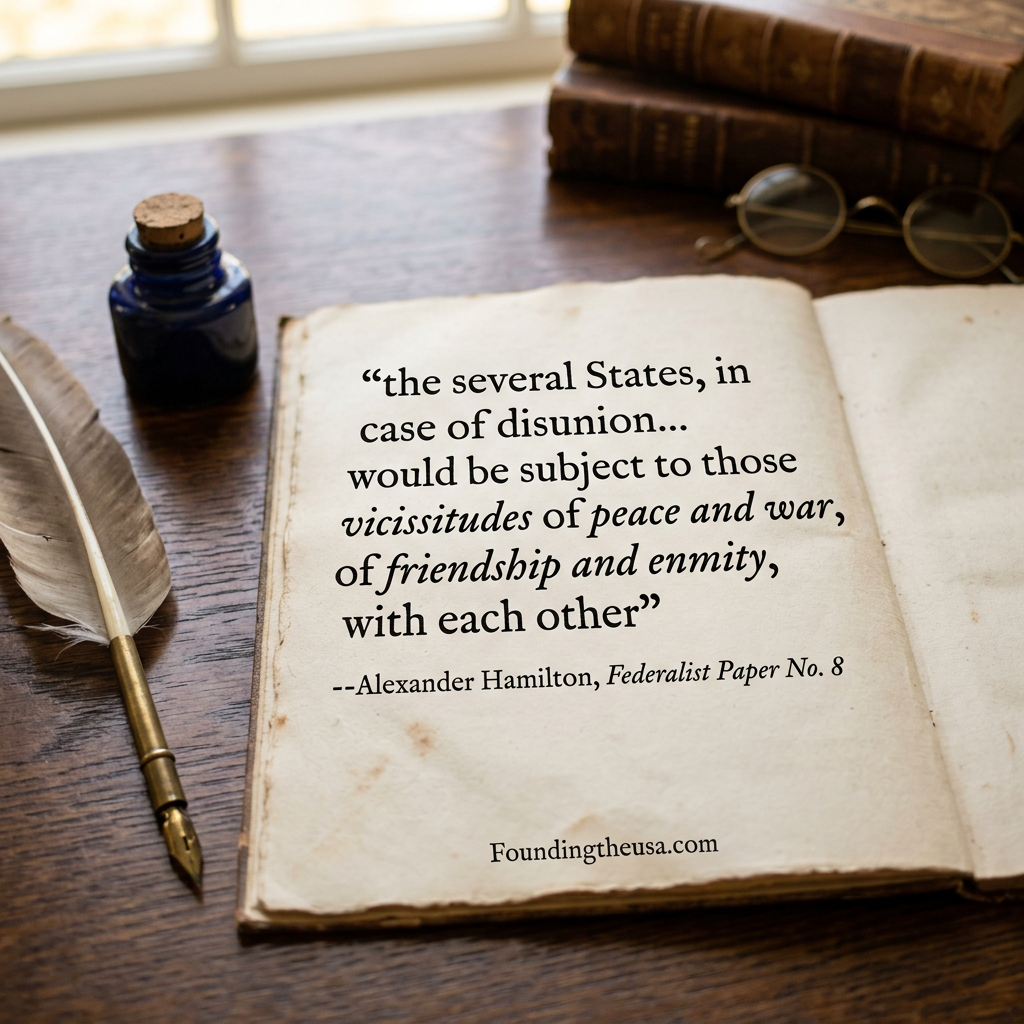
“the several States, in case of disunion… would be subject to those vicissitudes of peace and war, of friendship and enmity, with each other”
Hamilton begins by treating interstate conflict as basically inevitable if the Union falls apart. Peace, then hostility, then temporary friendship, then war again — he sees that cycle as the normal fate of neighboring powers not joined under one government.
2. War would be harsher here than in Europe
“War between the States… would be accompanied with much greater distresses than it commonly is in those countries where regular military establishments have long obtained.”
Hamilton argues that American wars between states would be especially brutal in the beginning. The country lacked the fortifications and regular military structures that sometimes slowed destruction in Europe. That means invasion, plunder, and devastation would come faster and hit civilians harder.
3. Easy conquest, hard peace
“Conquests would be as easy to be made as difficult to be retained.”
That is a strong, compact line. Hamilton is saying that in a disunited America, states might overrun each other quickly, but holding territory and stabilizing control would be another matter. So war would not just be destructive. It would also be chaotic and unstable.
4. Plunder and devastation follow irregular war
“PLUNDER and devastation ever march in the train of irregulars.”
This is one of the most vivid lines in the paper. Hamilton is painting a picture of warfare without strong national order: raids, destruction, looting, and suffering falling heavily on ordinary people. Very meme-capable, and very grim.
5. Safety can make people surrender liberty
“Even the ardent love of liberty will, after a time, give way to its dictates.”
Here “its” refers to the demands of safety. This is one of the most important warnings in the essay. Hamilton argues that when people live under constant danger, their devotion to freedom starts bending under the pressure of fear and exhaustion.
6. The famous warning
“To be more safe, they at length become willing to run the risk of being less free.”
This is the headline quote from Federalist No. 8. It is one of the most memorable lines in the entire early Federalist sequence. Hamilton is warning that persistent insecurity drives people to accept stronger, harsher institutions that may protect them physically while undermining their liberty politically.
7. Standing armies would follow
“Standing armies… must inevitably result from a dissolution of the Confederacy.”
Hamilton’s logic is straightforward: if states fear each other, they arm against each other. And once they do that, military establishments become permanent, not temporary. This is one of his clearest links between disunion and militarization.
8. Constant fear creates constant preparation
“Frequent war and constant apprehension, which require a state of as constant preparation, will infallibly produce them.”
That line expands the standing-army argument. Hamilton is saying you do not even need constant war. Constant apprehension is enough. The fear of war is often enough to build the machinery that narrows liberty.
9. War strengthens the executive
“They would, at the same time, be necessitated to strengthen the executive arm of government”
This is one of Hamilton’s major constitutional warnings. States under military pressure would not just arm. They would also strengthen executive power in order to act faster and more forcefully. That is part of how republics slide toward more concentrated authority.
10. The classic Hamilton line
“It is of the nature of war to increase the executive at the expense of the legislative authority.”
This is one of the strongest and most enduring lines in the Federalist Papers. It goes far beyond the specific ratification debate and speaks to a recurring political pattern: war tends to centralize power, especially in the executive branch.
11. Engines of despotism
“the same engines of despotism which have been the scourge of the Old World.”
Hamilton is saying that if America breaks apart, it will not remain some innocent republican paradise. It will end up copying the very political machinery of militarized Europe that Americans claim to distrust. Strong line, strong image, very usable.
12. The military state rises above the civil
“The military state becomes elevated above the civil.”
That is one of the coldest warnings in the paper. Hamilton is describing what happens when armed institutions, constant alarm, and executive force become normal. Civil government gets pushed downward, and military priorities begin to dominate public life.
13. Soldiers become superiors
“the people are brought to consider the soldiery not only as their protectors, but as their superiors.”
Another powerful line. Hamilton is describing a psychological and political shift: when danger is constant, people stop treating the military as a temporary necessity and start accepting it as a ruling force.
14. Union preserves a kind of insular advantage
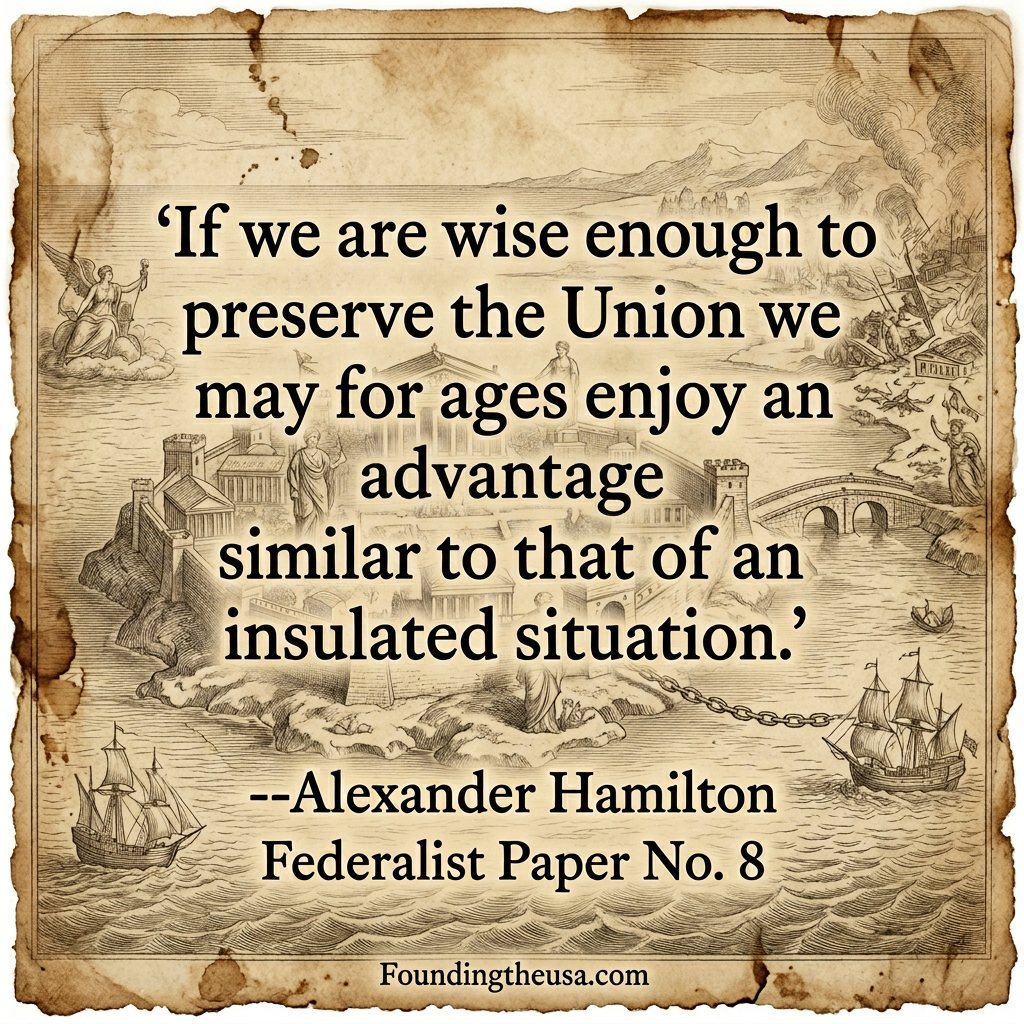
“If we are wise enough to preserve the Union we may for ages enjoy an advantage similar to that of an insulated situation.”
This is Hamilton’s optimistic turn. A preserved union, he argues, would spare America the internal military pressures that plague continental Europe. In that sense, union protects liberty not just politically, but strategically.
15. Disunion makes liberty prey to defense
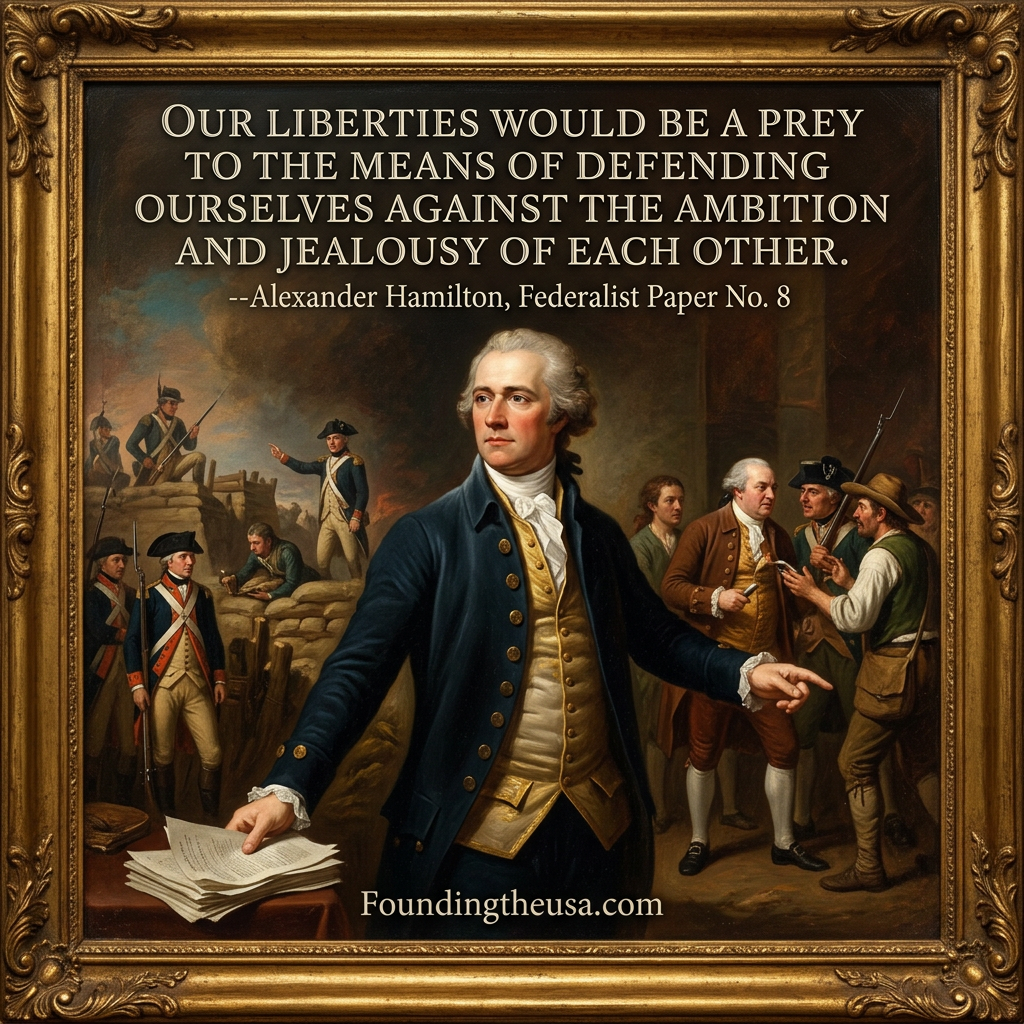
“our liberties would be a prey to the means of defending ourselves against the ambition and jealousy of each other.”
That is one of the best closing lines in the essay. Hamilton is saying the danger would not only come from invasion or conquest. It would come from the very institutions Americans built to protect themselves from one another.
16. Real dangers over airy phantoms
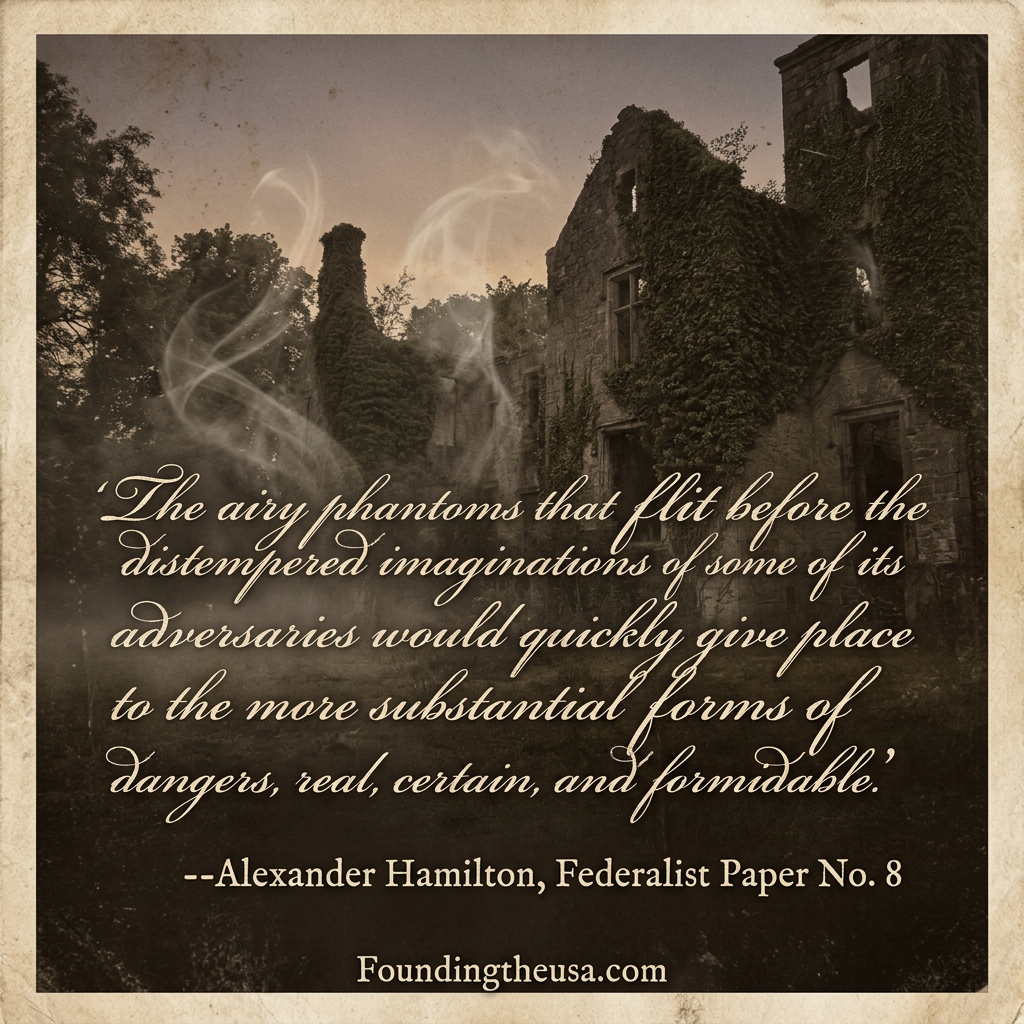
“The airy phantoms that flit before the distempered imaginations of some of its adversaries would quickly give place to the more substantial forms of dangers, real, certain, and formidable.”
Classic Hamilton closing shot. He is mocking exaggerated fears of the Constitution and arguing that rejecting it would expose Americans to dangers that are not imaginary at all, but hard, real, and destructive.
Why Federalist No. 8 Works for Highlights
Federalist No. 8 works extremely well as a highlights page because it is packed with hard, memorable warnings about the relationship between war, fear, executive power, standing armies, and liberty. It feels broader than just an argument about ratification. Hamilton is making a lasting point about political life under conditions of danger.
This is one of the more philosophically and politically durable early Federalist essays. It does not just say disunion would be inconvenient. It says disunion would change the kind of governments Americans live under. That is serious material.
Related Links
- Federalist No. 8 Full Text
- Federalist Papers
- Alexander Hamilton
- Federalist No. 7
- Articles of Confederation
- United States Constitution