




Federalist No. 17 was written by Alexander Hamilton under the name Publius and published on December 4, 1787. In this essay, Hamilton answers a different kind of objection to the proposed Constitution: the fear that a federal government able to legislate directly on individuals would eventually swallow up the states. His reply is blunt — that fear points in the wrong direction. He argues that state governments are naturally stronger in local influence, more closely tied to the people’s daily lives, and therefore more likely to encroach on the Union than the Union is to destroy them.
This paper matters because Hamilton is trying to calm a central Anti-Federalist fear. He says the national government will naturally care most about commerce, finance, negotiation, and war, while the states will continue to dominate the everyday concerns nearest to the people, especially the administration of civil and criminal justice. In other words, the federal government is not likely to absorb the states because the states sit closer to the public heart.
1. The national government will not crave every local power
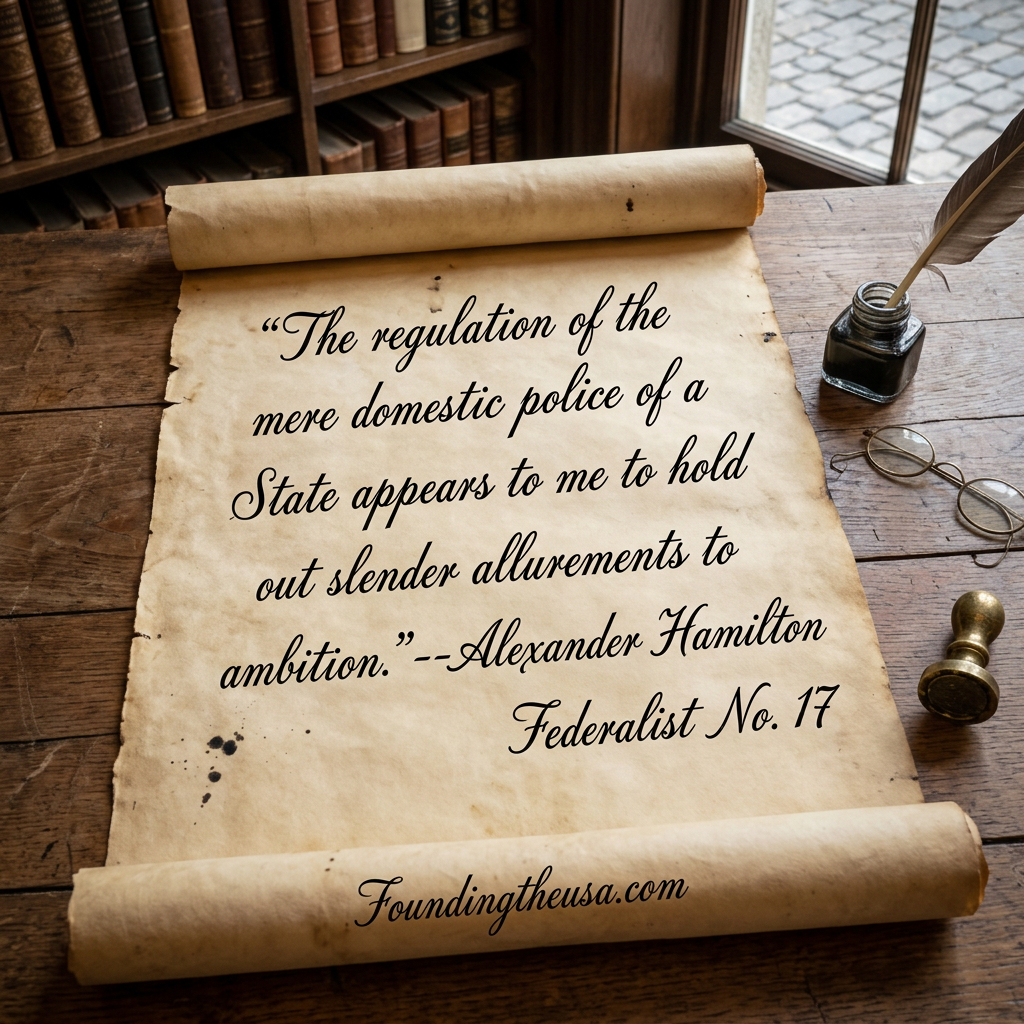
“The regulation of the mere domestic police of a State appears to me to hold out slender allurements to ambition.”
“Commerce, finance, negotiation, and war seem to comprehend all the objects which have charms for minds governed by that passion”
Hamilton’s point is that ambitious national leaders are more likely to care about the big, glittering objects of sovereignty than about micromanaging local matters. That is his first answer to the fear of federal absorption.
2. Local matters belong naturally to local governments
“The administration of private justice between the citizens of the same State… all those things… proper to be provided for by local legislation, can never be desirable cares of a general jurisdiction.”
This is one of the core lines in the paper. Hamilton argues that the ordinary business of local life is naturally better suited to state governments, and the federal government has little reason to want that burden.
3. The states are more likely to encroach than the Union
“It will always be far more easy for the State governments to encroach upon the national authorities than for the national government to encroach upon the State authorities.”
That is probably the headline line from Federalist No. 17. Hamilton is flipping the usual fear on its head. He says jealousy is looking in the wrong direction: the bigger danger is not federal domination, but state resistance and encroachment.
4. Human attachment grows stronger the closer the object is
“its affections are commonly weak in proportion to the distance or diffusiveness of the object.”
“the people of each State would be apt to feel a stronger bias towards their local governments than towards the government of the Union”
Hamilton is leaning on ordinary human psychology here. People care more about what is close, visible, and familiar. That gives state governments a built-in advantage in affection and influence.
5. The ordinary administration of justice is the great source of loyalty
“the ordinary administration of criminal and civil justice”
“the most powerful, most universal, and most attractive source of popular obedience and attachment.”
This is one of the most important passages in the essay. Hamilton says the states possess a huge advantage because courts and everyday law are what people encounter constantly. That makes the states deeply rooted in public habit and loyalty.
6. Justice is the great cement of society
“This great cement of society… would insure them so decided an empire over their respective citizens as to render them at all times a complete counterpoise”
Great line. Hamilton argues that because local justice touches life and property so directly, it binds people to their state governments in a way the federal government will rarely match.
7. The Union’s benefits are less visible to ordinary people
“The operations of the national government… falling less immediately under the observation of the mass of the citizens”
“will be less apt to come home to the feelings of the people”
Hamilton admits that the federal government will often feel more abstract to ordinary citizens. That is precisely why he thinks it is less likely to dominate popular affection than the states are.
8. Feudal history is a warning
“The power of the head of the nation was commonly too weak, either to preserve the public peace, or to protect the people against the oppressions of their immediate lords.”
“the times of feudal anarchy.”
Hamilton uses feudal Europe as a warning. He compares local centers of power to feudal barons and says history shows how often the central authority was the weaker party.
9. Local rulers can become dangerous rivals
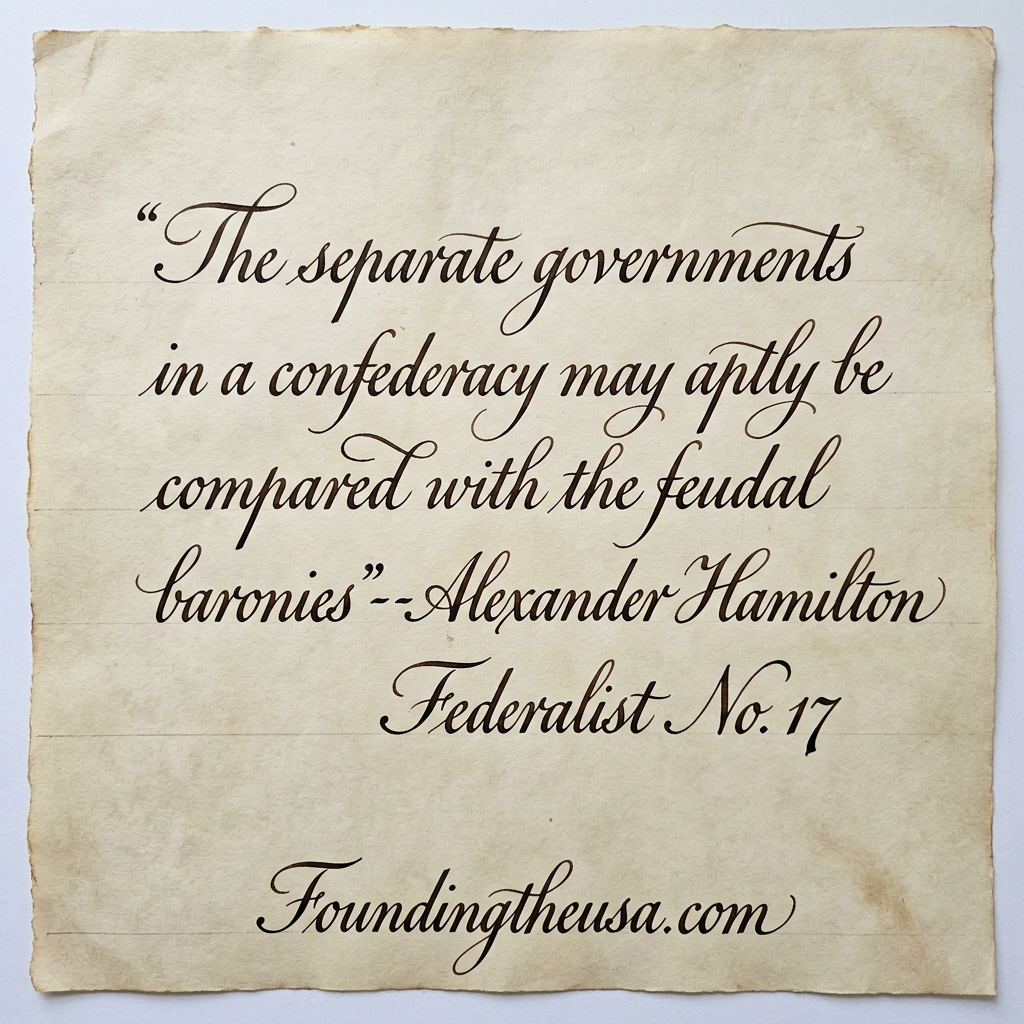
“The separate governments in a confederacy may aptly be compared with the feudal baronies”
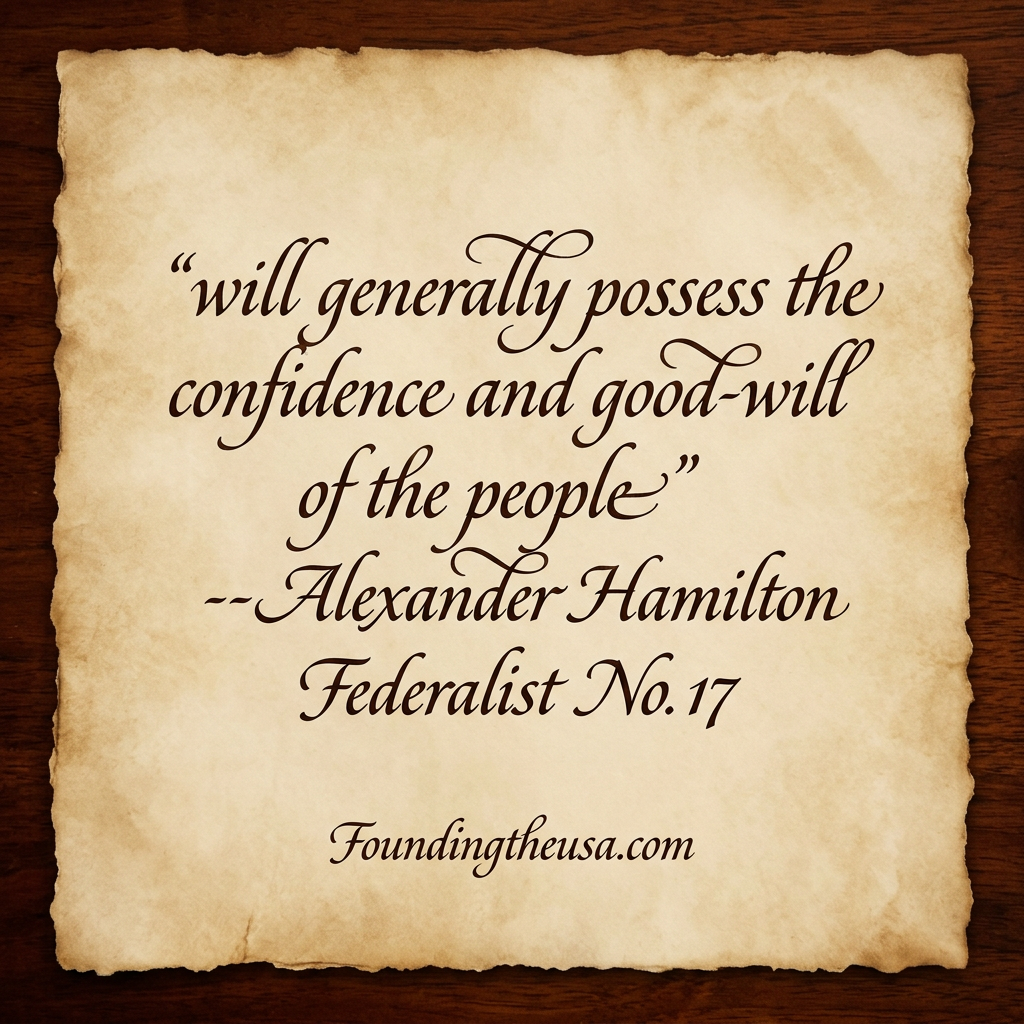
“will generally possess the confidence and good-will of the people”
This is one of Hamilton’s sharpest analogies. He says state governments, like baronies, can become powerful enough through local loyalty to rival or obstruct the general authority.
10. The real danger is not federal usurpation, but state obstruction
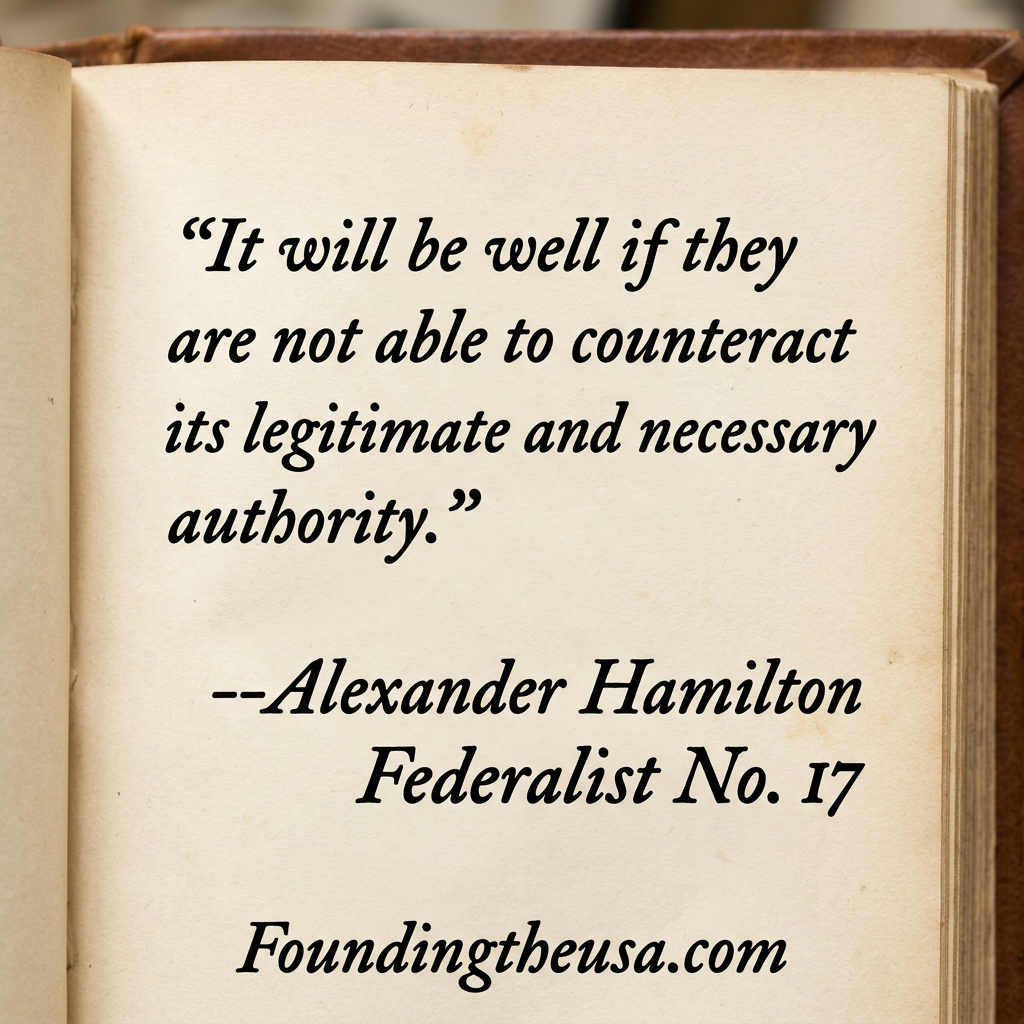
“It will be well if they are not able to counteract its legitimate and necessary authority.”
That line is the sting in the tail. Hamilton’s concern is not that the states will disappear. It is that they may remain strong enough to block the federal government when the federal government is acting properly.
11. Jealousy has been aimed at the wrong target
“our jealousy [has] a direction to the wrong side.”
Excellent closing line. Hamilton is saying that Americans have misread the balance of danger. They fear the Union swallowing the states, when the actual pattern of confederacies shows the local powers are often the stronger danger.
Why Federalist No. 17 Works for Highlights
Federalist No. 17 works very well as a highlights page because it has one tight, unified theme: the states are not fragile victims waiting to be devoured; they are naturally powerful local governments with deep roots in the people’s daily lives. That lets the paper hit hard without sprawling all over the map.
It is also one of the more psychologically perceptive Federalist papers. Hamilton is not just talking about legal structures. He is talking about affection, habit, visibility, and the way people actually attach themselves to governments. That makes the essay more alive than a dry federalism lecture.
Related Links
- Federalist No. 17 Full Text
- Federalist Papers
- Alexander Hamilton
- Federalist No. 16
- Articles of Confederation
- United States Constitution