Federalist No. 2 was written by John Jay under the name Publius and published in the Independent Journal on October 31, 1787. In this essay, Jay argues that the American people are better off as one nation under one federal government than as several smaller confederacies. The big theme of the paper is union: common geography, common history, common interests, and the danger of breaking apart.
This one is not as punchy as Hamilton at his most theatrical, but it has strong lines and a very clear argument. Jay is basically saying: this country already looks like it belongs together, and pretending otherwise is asking for trouble.
1. The basic question
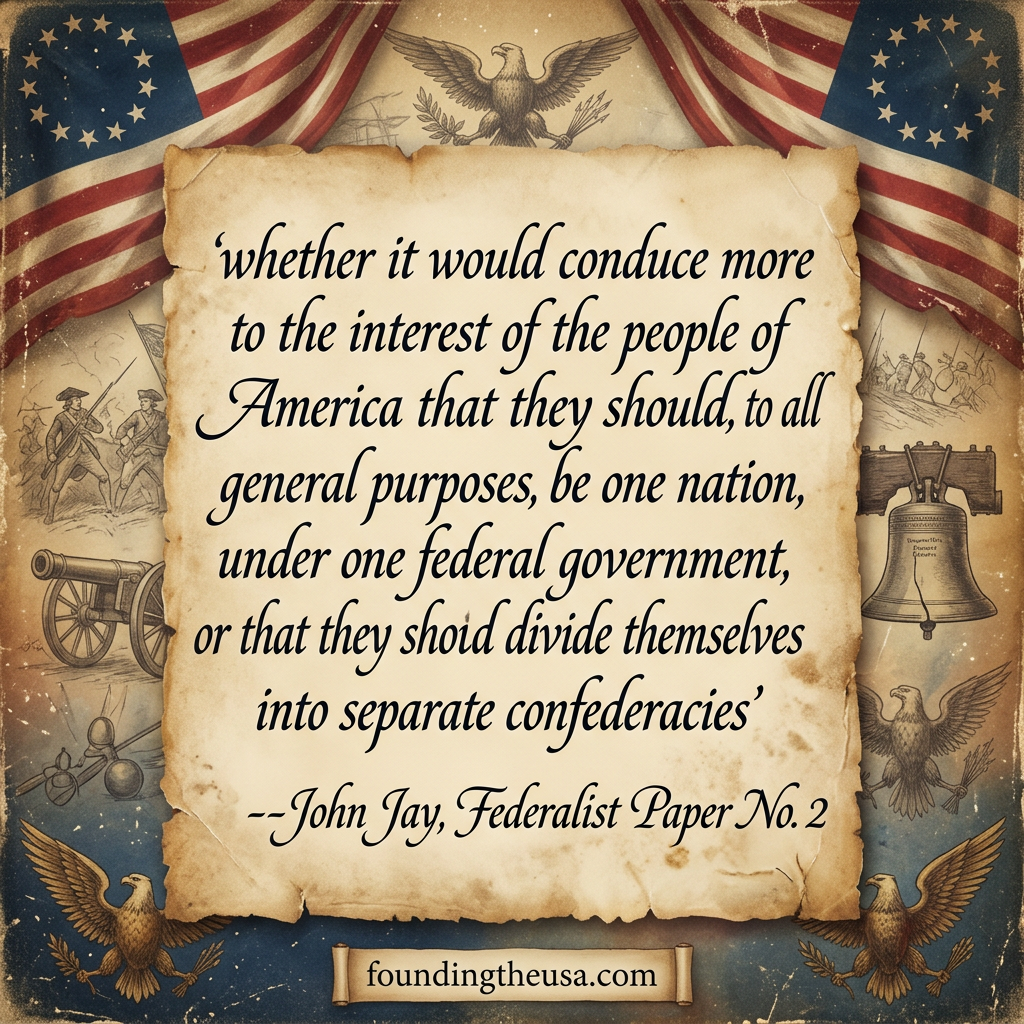
“whether it would conduce more to the interest of the people of America that they should, to all general purposes, be one nation, under one federal government, or that they should divide themselves into separate confederacies”
This is the heart of Federalist No. 2. Jay frames the issue plainly: one union or several smaller political groupings. Before getting into detailed constitutional mechanics, he wants readers to confront the basic fork in the road.
2. One connected country
“one connected, fertile, widespreading country”
Short, vivid, and very useful for a highlights page. Jay is arguing that the country itself makes union sensible. Geography is not just scenery to him. It is part of the political argument.
3. A country bound together
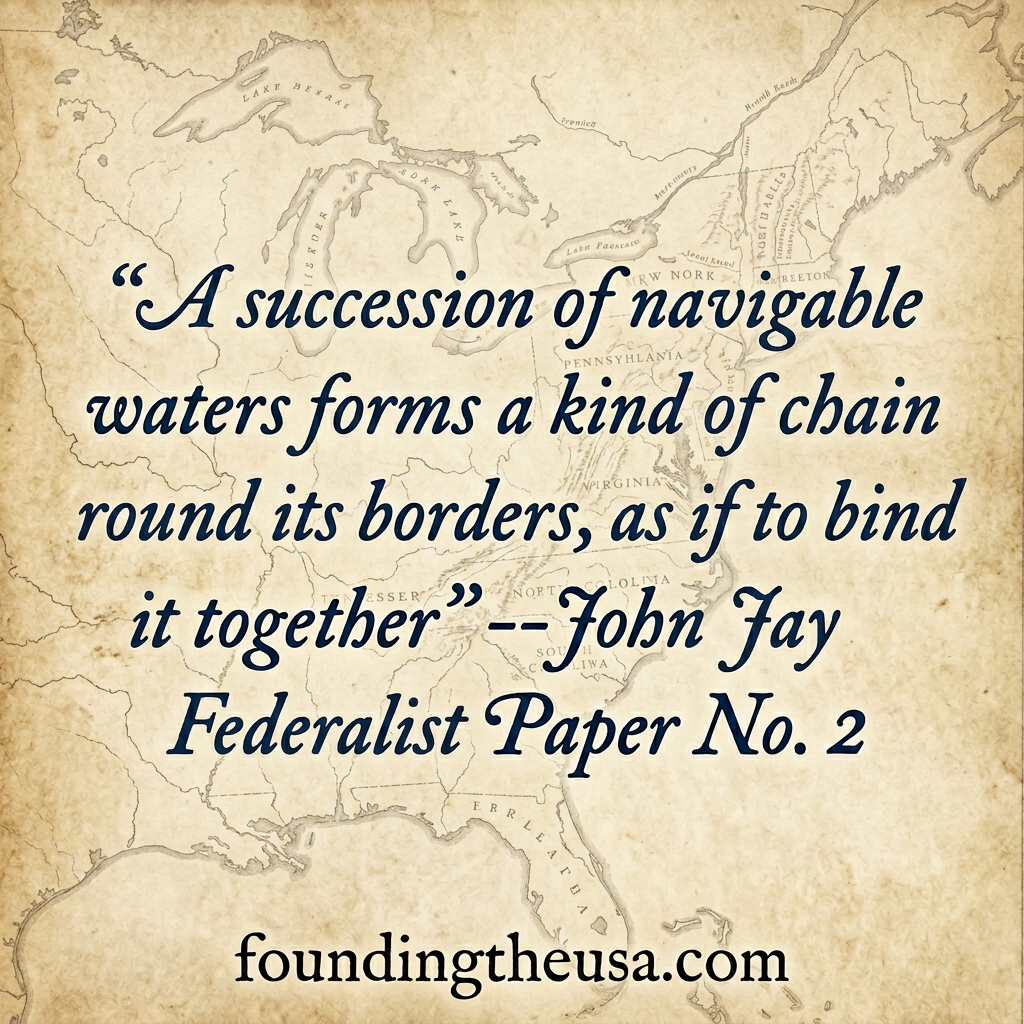
“A succession of navigable waters forms a kind of chain round its borders, as if to bind it together”
That is one of the strongest lines in the essay. Jay is painting America as a place naturally linked by rivers, movement, commerce, and communication. It is a very visual quote and a strong meme candidate.
4. One people
“Providence has been pleased to give this one connected country to one united people”
This is probably the most famous line in Federalist No. 2. It captures Jay’s entire claim in one sentence: one country, one people, one union. It is one of the cleanest quotes in the paper.
5. Shared identity
“a people descended from the same ancestors, speaking the same language, professing the same religion, attached to the same principles of government”
This quote shows how Jay builds the case for union through shared identity. It is very much an eighteenth-century argument, and it tells you what he thinks binds the states together beyond mere convenience.
6. Made for each other
“This country and this people seem to have been made for each other”
Another very strong line. Simple, memorable, and ideal for a quote image. Jay is arguing that separation would be unnatural and self-destructive.
7. The warning against division
“should never be split into a number of unsocial, jealous, and alien sovereignties.”
This is one of the sharper warnings in the essay. Jay is not just praising union; he is attacking the alternative. “Unsocial, jealous, and alien sovereignties” is a great phrase and has real bite.
8. The Articles were formed in crisis
“They formed it almost as soon as they had a political existence; nay, at a time when their habitations were in flames, when many of their citizens were bleeding”
This is an important quote because it explains why the earlier federal framework was weak. Jay is reminding readers that the first union was built during war and emergency, not during calm reflection. That helps set up the case for the Constitution.
9. A wiser national government
“ample security for both could only be found in a national government more wisely framed”
That line bridges the union argument directly into the constitutional argument. Jay is saying the people still love liberty and still love union, and the Constitution is supposed to better secure both.
10. Recommended, not imposed
“this plan is only RECOMMENDED, not imposed”
A very useful line politically. Jay is reassuring readers that the Constitution is being offered for serious consideration, not forced on them by decree. Good quote, especially if you want to emphasize ratification as a deliberate public choice.
11. Blind approval vs. blind rejection
“neither recommended to BLIND approbation, nor to BLIND reprobation”
That line still works beautifully. Jay is calling for sober judgment rather than knee-jerk loyalty or knee-jerk hostility. It is one of the best lines in the paper for modern use.
12. The final warning
“FAREWELL! A LONG FAREWELL TO ALL MY GREATNESS.”
Jay ends with drama here, borrowing from Shakespeare to warn what the dissolution of the Union would mean. It is theatrical, but it lands. He wants readers to feel that disunion would not just be inconvenient. It would be a national ruin.
Related Links
- Federalist No. 2 Full Text
- Federalist Papers
- John Jay
- Alexander Hamilton
- James Madison
- United States Constitution