Federalist No. 14 was written by James Madison under the name Publius and published on November 30, 1787. In this essay, Madison answers one of the major objections to the proposed Constitution: that the United States is too large in territory to be governed as a republic.
His answer is sharp and important. Critics, he says, are confusing a democracy with a republic. A democracy, where the people meet and govern directly, must stay small. A republic, where the people govern through representatives, can extend across a much larger country. That is the heart of the paper.
1. The objection from size
“the great extent of country which the Union embraces.”
This is the central objection Madison is answering. The critics say the country is simply too large for republican government. Madison says that objection sounds serious only because it rests on a mistaken definition.
2. Imaginary difficulties
“to supply, by imaginary difficulties, the want of those solid objections”
That is a nice Madison knife twist. He is saying the opponents of the Constitution are leaning on scare talk about size because they are short on stronger arguments.
3. Republic vs. democracy
“the confounding of a republic with a democracy”
This is one of the most important lines in the paper. Madison says the whole objection comes from mixing up two different forms of government. That confusion, in his view, is the source of the error.
4. The key distinction
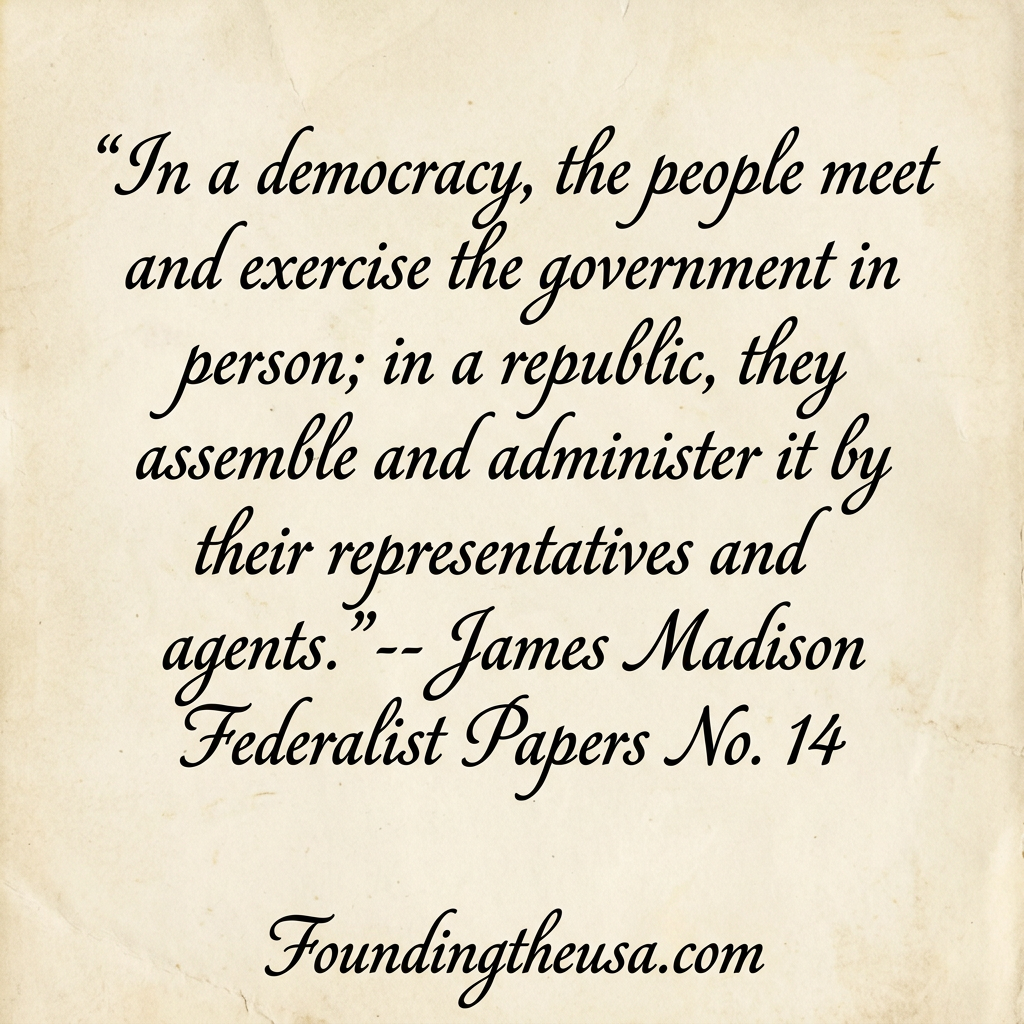
“In a democracy, the people meet and exercise the government in person; in a republic, they assemble and administer it by their representatives and agents.”
This is the defining passage of the essay. Clear, direct, and foundational. It explains exactly why Madison thinks the Anti-Federalist objection misses the mark.
5. Small spot vs. large region
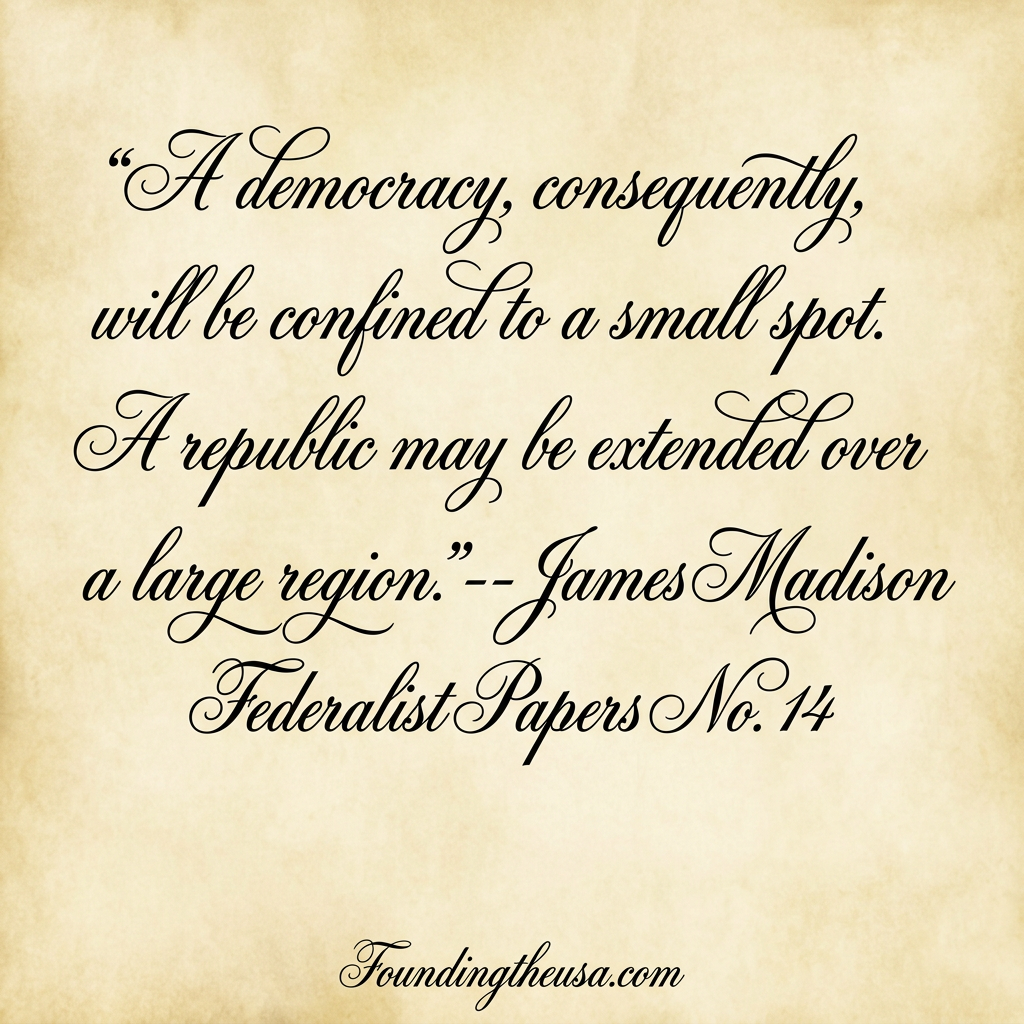
“A democracy, consequently, will be confined to a small spot. A republic may be extended over a large region.”
This is probably the headline quote from Federalist No. 14. It gives the whole argument in two sentences. Excellent quote. Strong meme candidate.
6. Representation as a great mechanical power
“this great mechanical power in government”
That phrase is one of the best in the essay. Madison is talking about representation as a political invention that makes large republican government possible. It is a very smart phrase and a very useful one.
7. America gets credit too
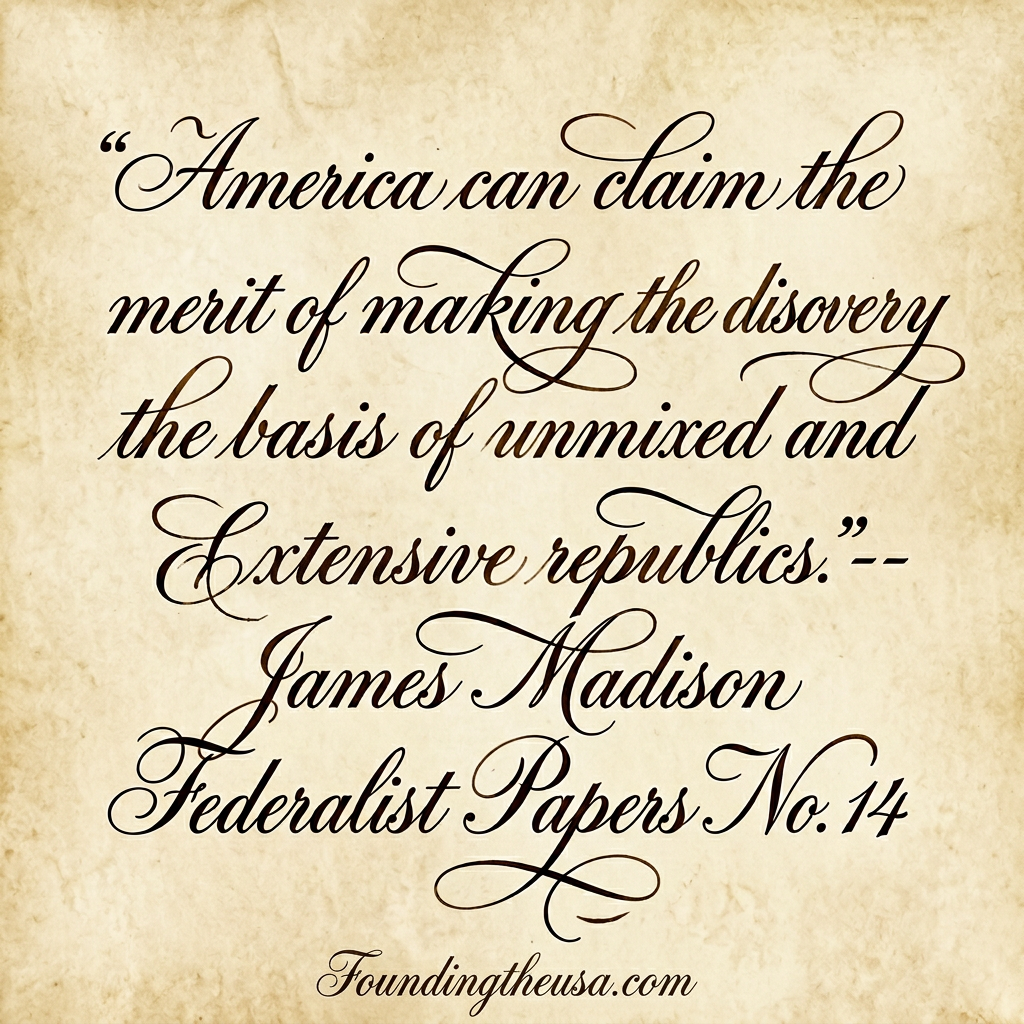
“America can claim the merit of making the discovery the basis of unmixed and extensive republics.”
This is Madison in a more patriotic, ambitious mode. He is arguing that America is not just borrowing political ideas. It is improving them and putting them on a larger scale.
8. The natural limit of a republic
“the natural limit of a republic is that distance from the centre which will barely allow the representatives to meet”
This is a practical line. Madison is saying the real territorial question is not whether every citizen can gather in one place, but whether representatives can travel and meet often enough to do their work.
9. The Union is not too large
“the representatives of the States have been almost continually assembled”
This is Madison using actual experience as evidence. Congress had already been functioning across the states, so the idea that representation over distance is impossible looks weak to him.
10. The powers of the federal government are limited
“Its jurisdiction is limited to certain enumerated objects”
This is a major constitutional point. Madison reminds readers that the federal government is not meant to handle every possible subject. Its power is limited to national concerns, while the states retain the rest.
11. The states remain active
“The subordinate governments… will retain their due authority and activity.”
Another important line. Madison is saying the Constitution does not erase the states. It leaves them with substantial authority over local matters.
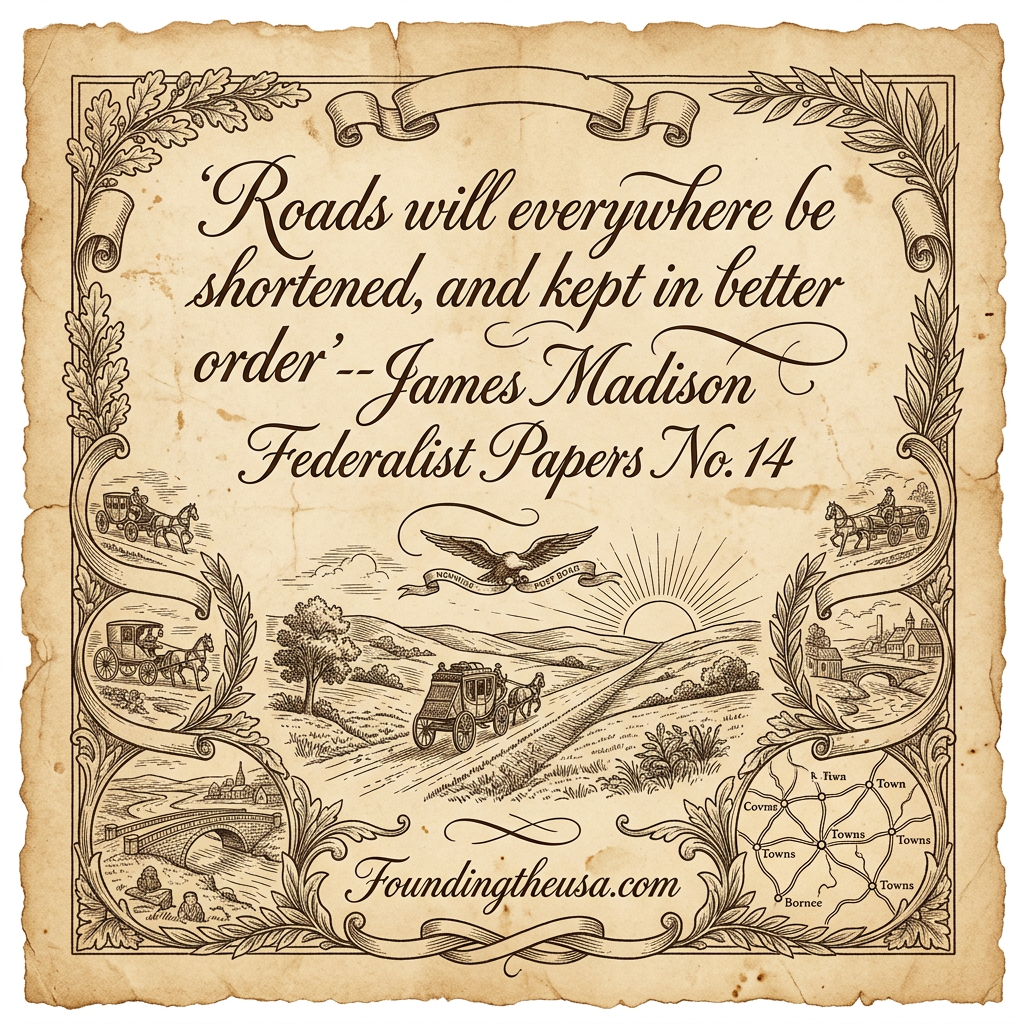
12. New improvements will shrink distance
“Roads will everywhere be shortened, and kept in better order”
This is one of the more forward-looking lines in the paper. Madison is basically saying transportation and internal improvements will make distance less burdensome over time.
13. Interior navigation
“an interior navigation… will be opened throughout, or nearly throughout, the whole extent of the thirteen States.”
Again, Madison is thinking ahead. He is arguing that communication and travel across the Union will improve, making extended republican government even more practical.
14. Frontier states need the Union most
“they would find it more so to struggle alone against an invading enemy”
This is a strong practical point. Madison says the more distant states may have to travel farther, but they also stand in greater need of the Union’s strength and protection.
15. The same family
“the people of America… can no longer live together as members of the same family”
That is one of the strongest emotional lines in the essay. Madison is attacking disunion not only as bad policy, but as a betrayal of the bonds tying Americans together.
16. Shut your ears
“shut your ears against this unhallowed language.”
Very strong phrasing. Madison is not whispering here. He is telling readers to reject the poisonous rhetoric of disunion outright.
17. Kindred blood
“the kindred blood which flows in the veins of American citizens”
This is one of the more powerful lines in the whole paper. Madison appeals to shared sacrifice, shared identity, and the blood already shed together in defense of liberty.
18. The most alarming novelty
“the most alarming of all novelties… is that of rendering us in pieces”
That is a terrific Madison line. Critics attack the Constitution as a dangerous novelty, but Madison turns the accusation around: the truly wild experiment would be breaking the Union apart.
19. Not blind veneration for antiquity
“they have not suffered a blind veneration for antiquity, for custom, or for names”
This is one of the best philosophical lines in the paper. Madison is defending the American willingness to improve on old political forms rather than bowing down to them just because they are old.
20. America chose a new and more noble course
“they pursued a new and more noble course.”
This is one of the most uplifting lines in the essay. Madison is framing the American founding as a bold improvement on inherited politics, not a timid repetition of the past.
21. No parallel in the annals of human society
“They accomplished a revolution which has no parallel in the annals of human society.”
Big line. Big claim. Very memorable. Madison is treating the American experiment as historically extraordinary.
22. Governments with no model
“They reared the fabrics of governments which have no model on the face of the globe.”
Another excellent line. Madison is saying Americans have already built what had not existed before, so they should not panic now at the thought of improving the Union further.
Why Federalist No. 14 Works for Highlights
Federalist No. 14 works extremely well as a highlights page because it combines:
- a major constitutional argument
- a clean distinction between democracy and republic
- a defense of representation
- a strong answer to the territorial objection
- some of Madison’s best patriotic rhetoric
This paper has both theory and fire. Madison is usually measured, but here he also sounds proud, defiant, and forward-looking.
Related Links
- Federalist No. 14 Full Text
- Federalist Papers
- James Madison
- Federalist No. 10
- Articles of Confederation
- United States Constitution