






Federalist No. 10 was written by James Madison under the name Publius and published on November 23, 1787. It is one of the most famous essays in the entire Federalist Papers because it tackles one of the biggest problems in free government: faction. Madison’s basic argument is that faction cannot be eliminated without destroying liberty, so the real task is to control its effects.
This paper matters because Madison is not writing about some tiny technical flaw. He is writing about the permanent danger that groups of citizens, driven by passion or interest, may use political power to injure the rights of others or the long-term good of the community. His solution is one of the central Federalist ideas: a large representative republic is better able than a small democracy to keep faction from becoming tyranny.
1. The violence of faction
“its tendency to break and control the violence of faction.”
That is the opening target of the essay. Madison is saying one of the great promises of a well-constructed Union is that it can weaken the destructive force of faction instead of letting it run wild.
2. Popular governments are vulnerable here
“The friend of popular governments never finds himself so much alarmed… as when he contemplates their propensity to this dangerous vice.”
Madison is not anti-republican. He is a defender of republican government. But he is honest enough to say its danger is real. Faction is not a side issue. It is one of the main ways free governments can decay.
3. The mortal diseases
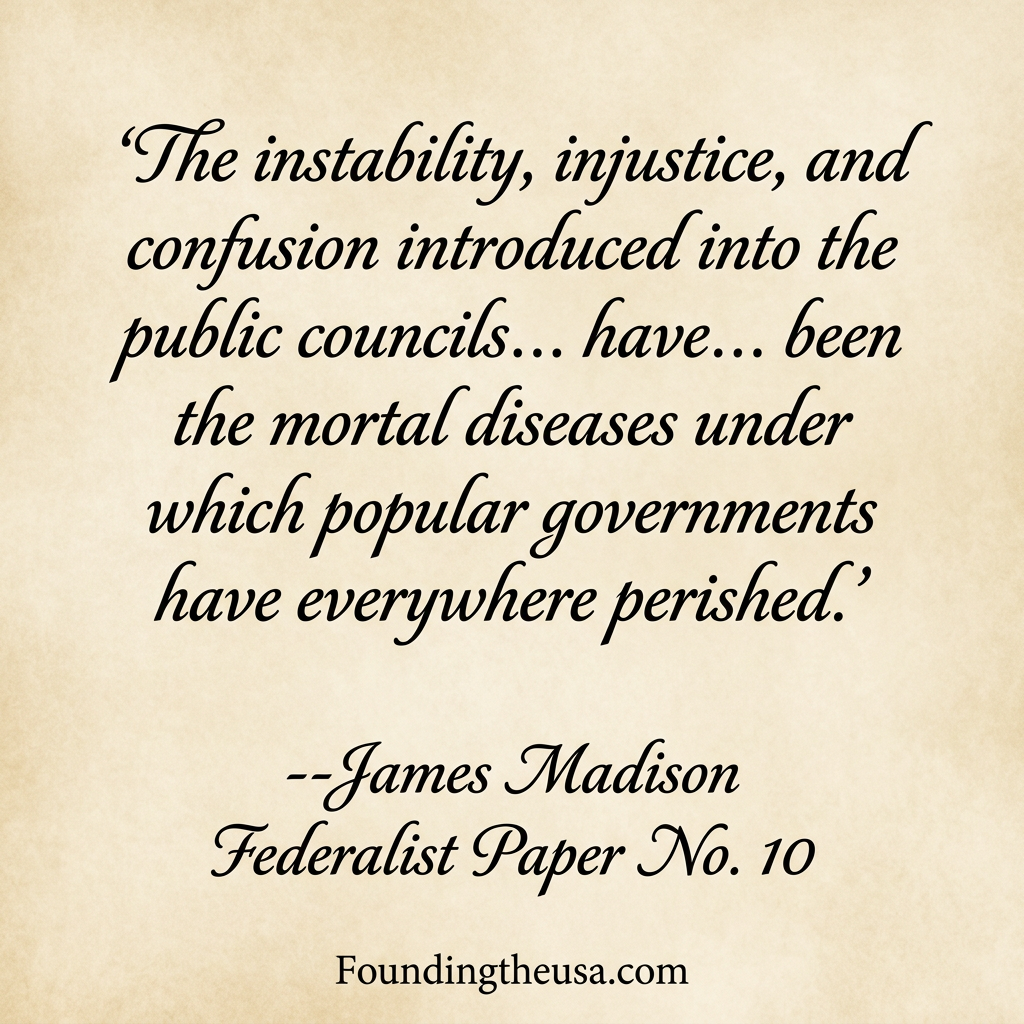
“The instability, injustice, and confusion introduced into the public councils… have… been the mortal diseases under which popular governments have everywhere perished.”
That is one of the strongest lines in the paper. Madison is saying free governments often do not die only from foreign conquest. They also rot from internal instability, injustice, and faction-driven politics.
4. Madison’s definition of faction
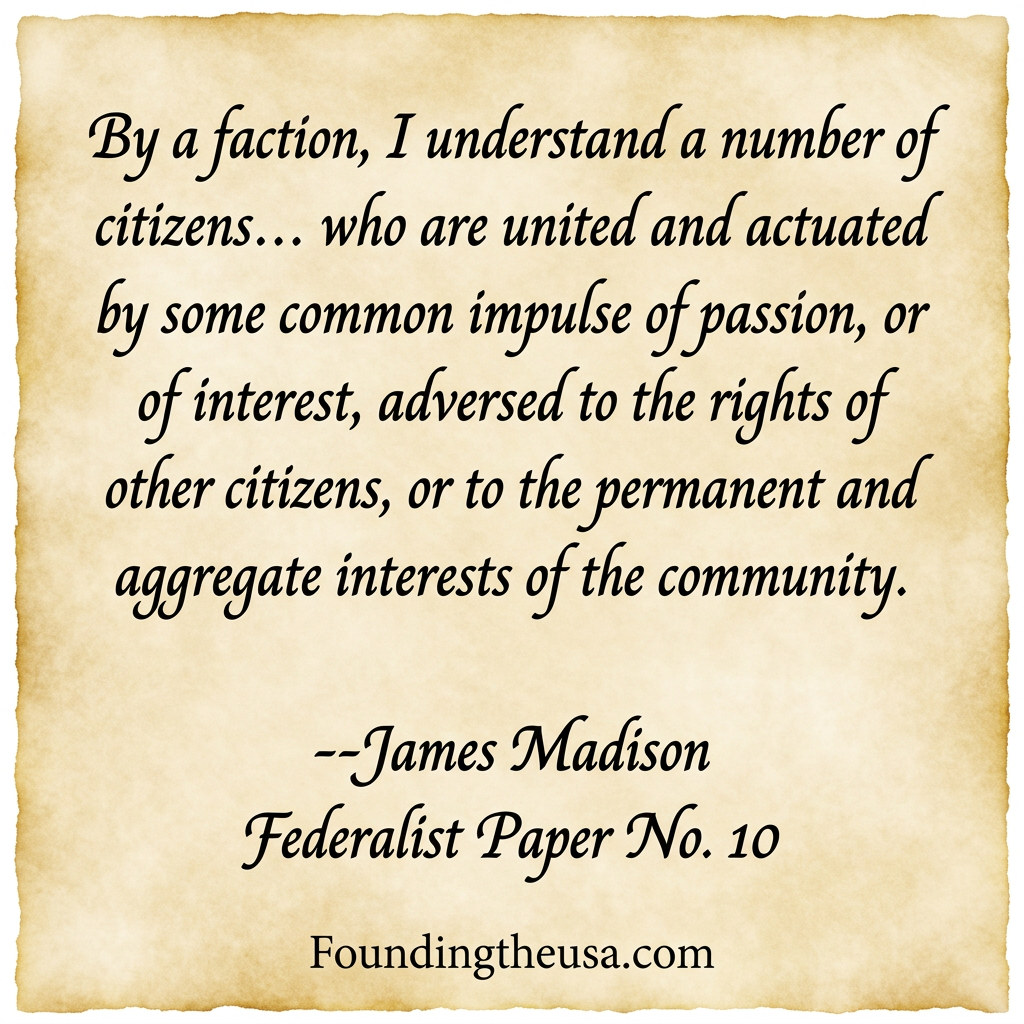
“By a faction, I understand a number of citizens… who are united and actuated by some common impulse of passion, or of interest, adversed to the rights of other citizens, or to the permanent and aggregate interests of the community.”
This is the most famous definitional passage in the essay. It is the sentence you build the whole paper around. Madison is not saying every group is bad. He is saying faction becomes dangerous when passion or interest turns against justice and the common good.
5. Two methods
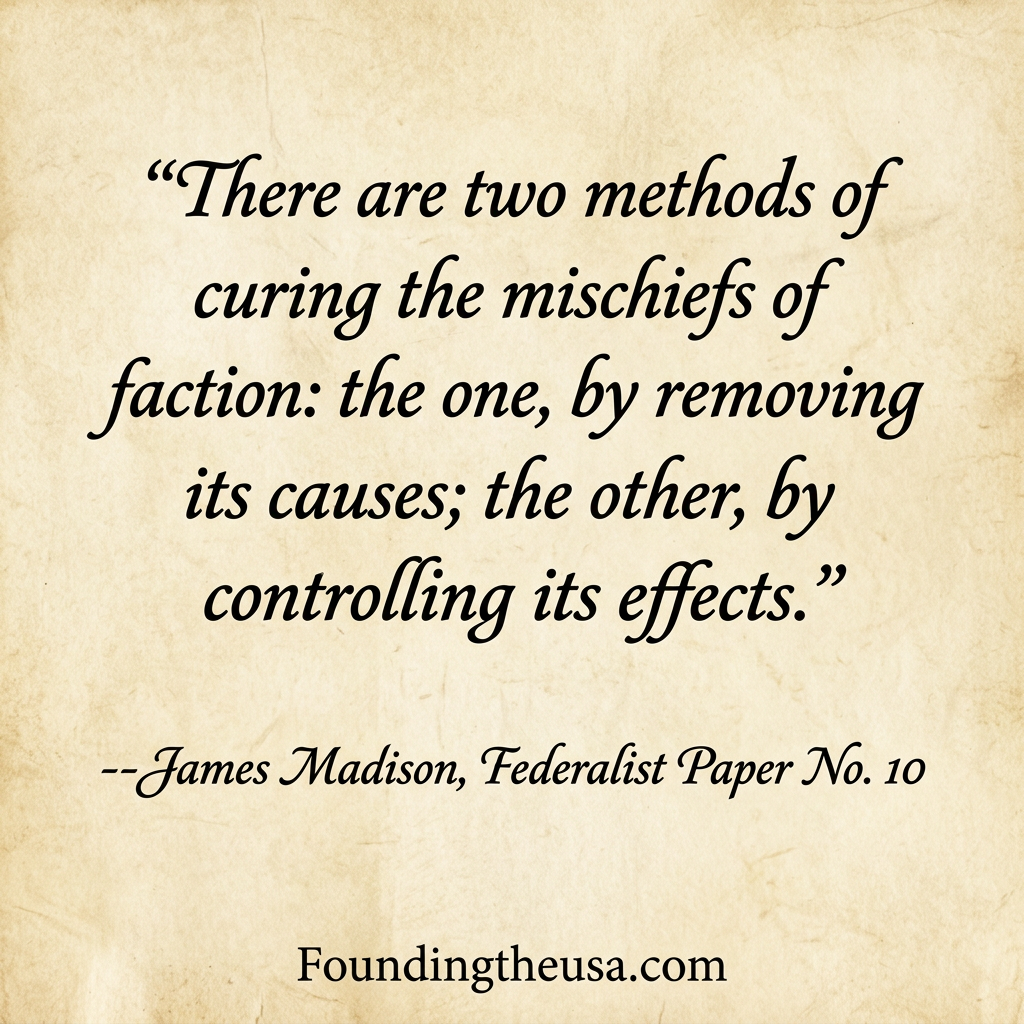
“There are two methods of curing the mischiefs of faction: the one, by removing its causes; the other, by controlling its effects.”
This is the skeleton of the essay. Madison lays out the options simply and then demolishes the first one before defending the second. Great quote because it shows the architecture of his reasoning.
6. The most famous line in the paper
“Liberty is to faction what air is to fire”
This is probably the most quoted line from Federalist No. 10. Madison is saying liberty gives faction room to exist, just as air lets fire burn. But removing liberty to get rid of faction would be madness, because liberty is essential to political life.
7. The first object of government
“The protection of these faculties is the first object of government.”
This line is huge. Madison is talking about the different faculties of human beings, especially their ability to acquire property and pursue their own interests. Government exists in part to protect those unequal faculties, not flatten them out into artificial sameness.
8. The causes are in human nature
“The latent causes of faction are thus sown in the nature of man”
This is Madison’s cold realism. Faction is not a glitch that can be engineered away forever. It is rooted in the basic structure of human nature, opinion, passion, and self-interest.
9. Property is the most durable source
“the most common and durable source of factions has been the various and unequal distribution of property.”
That line still hits hard. Madison is saying economic inequality and conflicting material interests are among the deepest and most persistent causes of political division. He is not pretending politics is just people calmly discussing abstract truth.
10. Modern legislation is managing conflict
“The regulation of these various and interfering interests forms the principal task of modern legislation”
Very strong line. Madison is basically saying politics is often the management of clashing interests, not the elimination of them. That is one reason this essay still feels so current.
11. Enlightened statesmen are not a permanent solution
“Enlightened statesmen will not always be at the helm.”
This is one of Madison’s most durable insights. A constitutional system cannot depend on wise, virtuous leaders always showing up on schedule like clockwork angels. Institutions have to be built for ordinary and flawed human beings.
12. The causes cannot be removed
“the causes of faction cannot be removed, and that relief is only to be sought in the means of controlling its effects.”
This is the turning point of the essay. Madison has ruled out destroying liberty and ruled out making everyone the same. So now the real question becomes how to structure government so faction does less damage.
13. The danger of majority faction
“To secure the public good and private rights against the danger of such a faction”
This is the heart of Madison’s constitutional concern. Minority factions can be voted down. The real danger comes when a majority becomes factious and uses its power to oppress others.
14. Pure democracy has no cure
“a pure democracy… can admit of no cure for the mischiefs of faction.”
Madison draws a hard line here. In a small pure democracy, majority passion can act too quickly and too directly. There is no sufficient barrier against oppression by the majority.
15. A republic opens a different prospect
“A republic… opens a different prospect, and promises the cure for which we are seeking.”
This is Madison’s answer. Representation changes the game. Instead of direct mass rule, the public voice passes through elected representatives, which can help refine and filter public judgment.
16. Refine and enlarge the public views
“to refine and enlarge the public views”
One of the most famous phrases in the essay. Madison is saying representation can improve public decision-making by passing popular opinion through a smaller body of chosen citizens. That is a central piece of his theory of republican government.
17. The larger republic advantage
“it is clearly decided in favor of the latter”
Here Madison answers the question whether small or extensive republics are better for choosing good representatives. He says the answer is the larger republic, because it offers a broader pool of candidates and makes manipulation harder.
18. Extend the sphere
“Extend the sphere, and you take in a greater variety of parties and interests”
This is one of the most famous lines in Federalist No. 10. Madison is saying a large republic is safer because it contains so many competing interests that no single faction can easily dominate the whole.
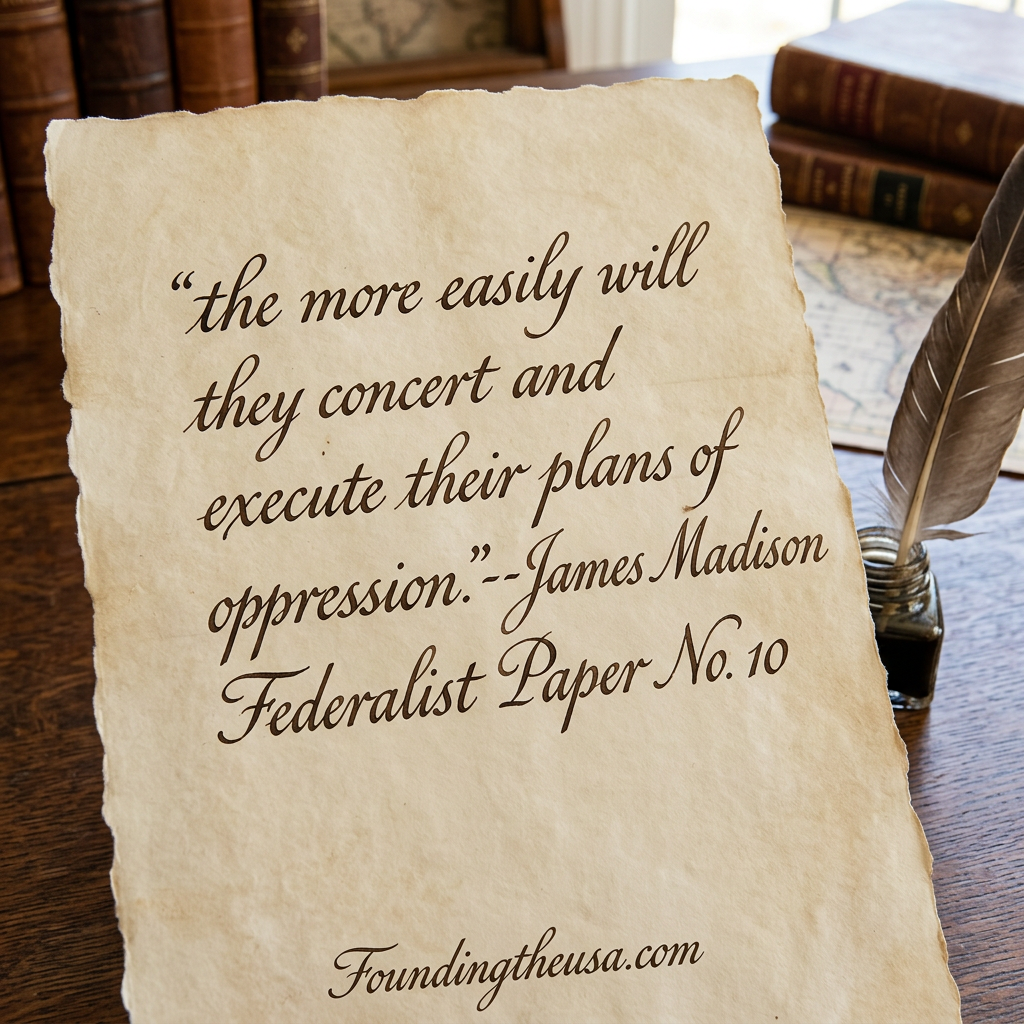
19. Oppression becomes harder
“the more easily will they concert and execute their plans of oppression.”
Madison says this about smaller societies, where majorities can organize more easily. The flip side is that in a larger republic, oppressive coordination becomes more difficult.
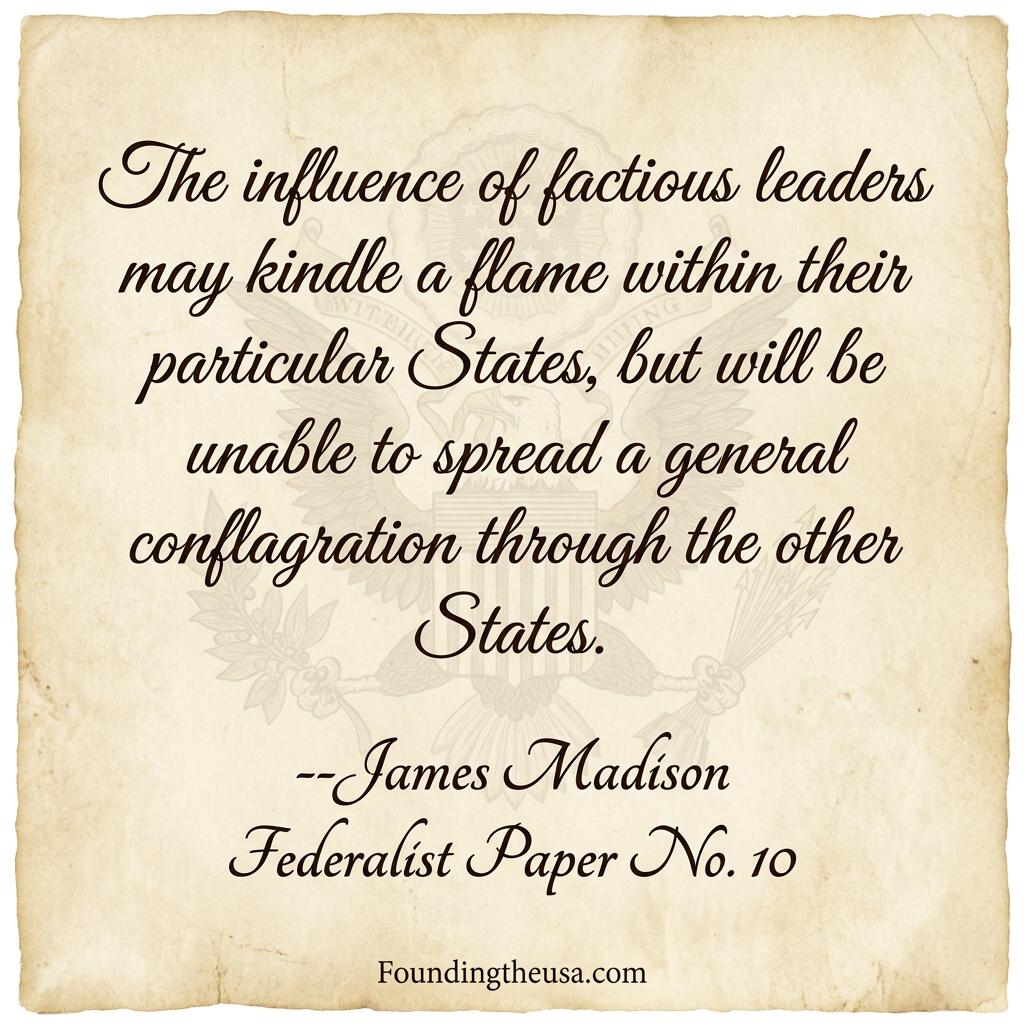
20. Local fire, not general conflagration
“The influence of factious leaders may kindle a flame within their particular States, but will be unable to spread a general conflagration through the other States.”
Fantastic line. Madison is saying faction may flare up locally, but the larger Union helps keep it from engulfing the entire republic. Very strong quote for a highlights page and a very strong meme candidate.
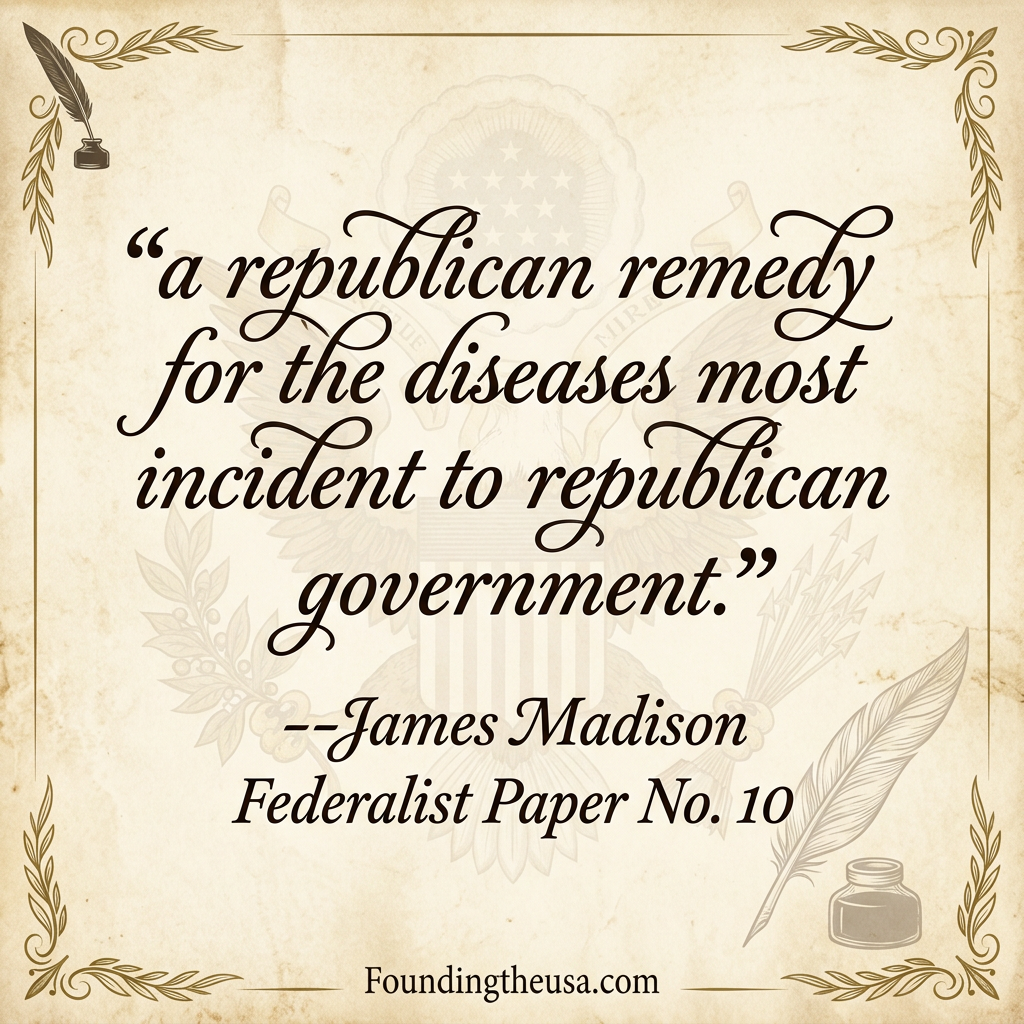
21. A republican remedy
“a republican remedy for the diseases most incident to republican government.”
This is the famous closing phrase. Madison’s argument is not that republics are doomed. It is that a properly structured republic can cure many of its own worst diseases. That is the deep promise of the Constitution in this essay.
Why Federalist No. 10 Works for Highlights
Federalist No. 10 works incredibly well as a highlights page because it is full of lines that are both theoretically important and highly quotable. It defines faction, explains why liberty cannot destroy it, rejects naïve faith in perfect leaders, and lays out the case for a large representative republic in some of the clearest language in the founding era.
This is not just one of the most important Federalist Papers. It is one of the most important essays in American political thought, period. It belongs in your high-importance category without hesitation.
Related Links
- Federalist No. 10 Full Text
- Federalist Papers
- James Madison
- Alexander Hamilton
- Articles of Confederation
- United States Constitution
- Anti-Federalists