

Federalist No. 22 matters because Hamilton identifies several more fatal weaknesses in the Articles of Confederation: no federal commerce power, an inefficient and unequal system for raising troops, equal voting for unequal states, supermajority rules that let tiny minorities obstruct national action, vulnerability to foreign corruption, and the absence of a national judiciary to secure uniform law and treaty enforcement. These were not decorative flaws. They went straight to the Union’s ability to act, defend itself, and preserve public faith.
It is also one of Hamilton’s sharpest papers on the difference between constitutional theory and constitutional reality. He argues that devices such as equal state suffrage and high voting thresholds may look protective in theory, but in practice they embarrass administration, invite intrigue, and place the public good at the mercy of small factions. For your internal note system, I’d mark Federalist No. 22 as:
- Very high importance
- Strong quote value
- High meme potential
- Major Articles-of-Confederation defect paper
- Important commerce / equal suffrage / supermajority / judiciary paper
Related Links
- Federalist No. 22 Highlights
- Federalist Papers
- Alexander Hamilton
- Federalist No. 21
- Articles of Confederation
- United States Constitution
- Anti-Federalists
Suggested SEO title
Federalist No. 22 Full Text | FoundingTheUSA.com
Suggested meta description
Read the full text of Federalist No. 22 by Alexander Hamilton, explaining major defects of the Articles of Confederation including equal state suffrage, supermajority paralysis, lack of commerce power, and the absence of a national judiciary.
NextThought for 11s
Absolutely. Here is a ready-to-post highlights page for Federalist No. 22 Highlights.
Federalist No. 22 Highlights
Federalist No. 22 was written by Alexander Hamilton under the name Publius and published on December 14, 1787. In this essay, Hamilton keeps tearing into the Articles of Confederation, focusing on several built-in defects: no federal power over commerce, a broken method for raising troops, unequal and irrational voting among the states, supermajority rules that let tiny minorities block action, vulnerability to foreign corruption, and the lack of a national judiciary.
This paper matters because Hamilton is stacking the case. He is no longer arguing that the Confederation has one fatal weakness. He is showing that it was weak in multiple directions at once: in commerce, in war, in representation, in decision-making, in resistance to bribery, and in the enforcement of treaties and national law.
1. Commerce needed federal control
“there is no object, either as it respects the interests of trade or finance, that more strongly demands a federal superintendence.”
Hamilton says commerce is an obvious national matter. Without federal control over it, the United States cannot negotiate effectively abroad or maintain harmony at home.
2. Foreign nations would not trust a government its members could ignore
“the engagements on the part of the Union might at any moment be violated by its members”
“it would be prudent to persist in the plan until it should appear whether the American government was likely or not to acquire greater consistency.”
That is a hard truth in the paper: other nations are not stupid. They will not give serious concessions to a union whose members can wreck agreements whenever they please.
3. Separate state trade policies breed resentment
“The interfering and unneighborly regulations of some States”
“serious sources of animosity and discord”
Hamilton argues that without national control over commerce, the states would start treating one another less like partners and more like rival countries.
4. Requisitions for troops created an “auction for men”
“It gave birth to a competition between the States which created a kind of auction for men.”
That is one of the best lines in the paper. Hamilton says the Confederation’s method of raising troops was inefficient, expensive, and chaotic, with states bidding against one another through enlistment bounties.
5. The result was delay, expense, and military weakness
“slow and scanty levies of men”
“short enlistments at an unparalleled expense”
“continual fluctuations in the troops”
This is Hamilton in full practical-war-manager mode. The old system did not just look bad. It endangered public safety.
6. Quotas and requisitions were weak, unequal, and unjust
“The system of quotas and requisitions, whether it be applied to men or money, is, in every view, a system of imbecility in the Union, and of inequality and injustice among the members.”
That is one of the load-bearing lines in the essay. Hamilton is saying the requisition system failed both as national administration and as fairness among the states.
7. Equal state suffrage violates fair representation
“Every idea of proportion and every rule of fair representation”
“gives to Rhode Island an equal weight… with Massachusetts”
Hamilton attacks the idea that tiny and large states should have equal power in all national deliberations. He sees that as irrational and unstable.
8. A minority of the people could rule the majority
“this majority of States is a small minority of the people of America”
“two thirds of the people of America could not long be persuaded… to submit their interests to the management and disposal of one third.”
That is a direct republican argument. Hamilton says equal-state voting can produce rule by a minority of the actual population, and that cannot last forever without breeding revolt.
9. Supermajority rules are poison, not protection
“what at first sight may seem a remedy, is, in reality, a poison.”
“To give a minority a negative upon the majority”
Excellent Hamilton line. He argues that requiring more than a majority often does not create safety. It gives obstructionists a veto over the public good.
10. Tiny minorities could stop everything
“a single VOTE has been sufficient to put a stop to all their movements.”
“A sixtieth part of the Union… has several times been able to oppose an entire bar to its operations.”
That is one of the paper’s sharpest practical complaints. A tiny slice of the Union could block the whole machine. That is not balance. That is paralysis.
11. Supermajority systems produce delay, intrigue, and bad compromise
“to embarrass the administration, to destroy the energy of the government”
“tedious delays; continual negotiation and intrigue; contemptible compromises of the public good.”
Hamilton says the real fruit of these rules is not wisdom, but stalling, bargaining, and limp half-measures.
12. Foreign corruption gets easier when fewer votes are needed to block action
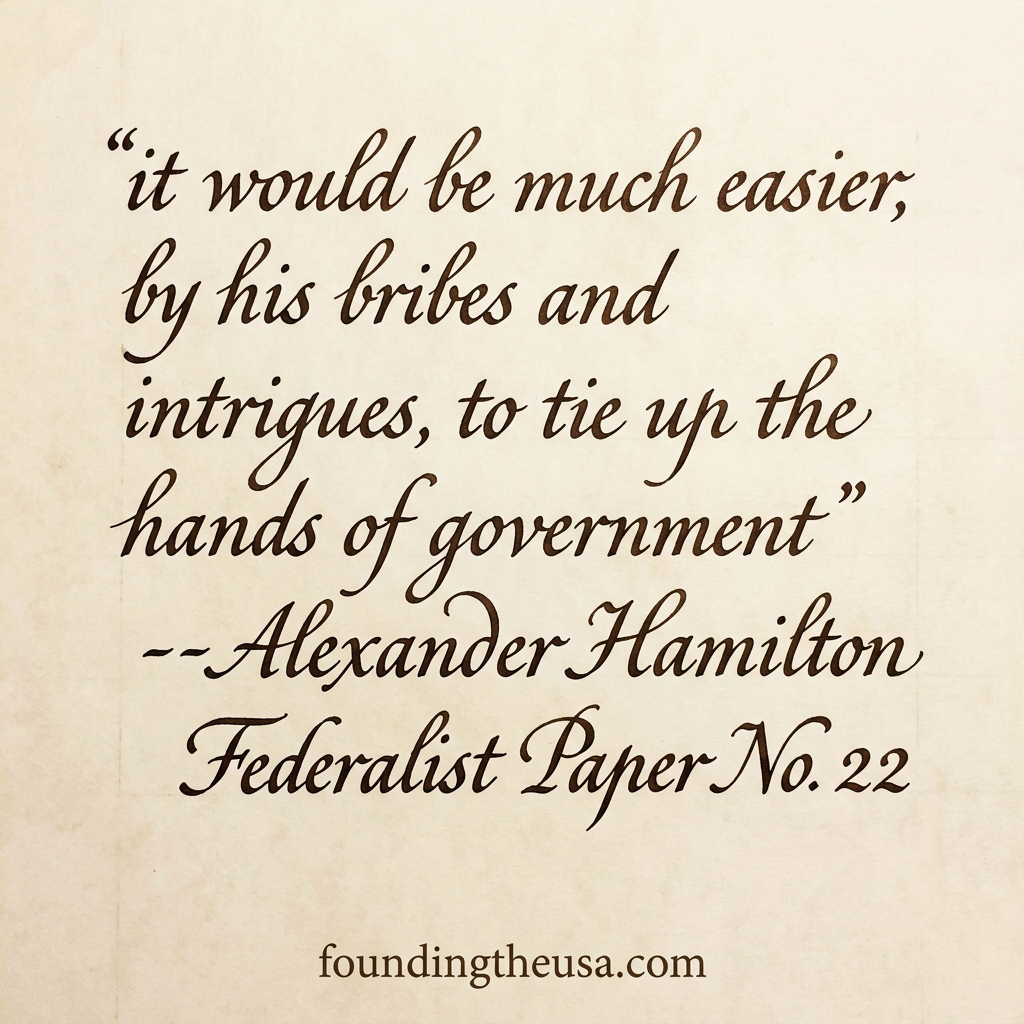
“it would be much easier, by his bribes and intrigues, to tie up the hands of government”
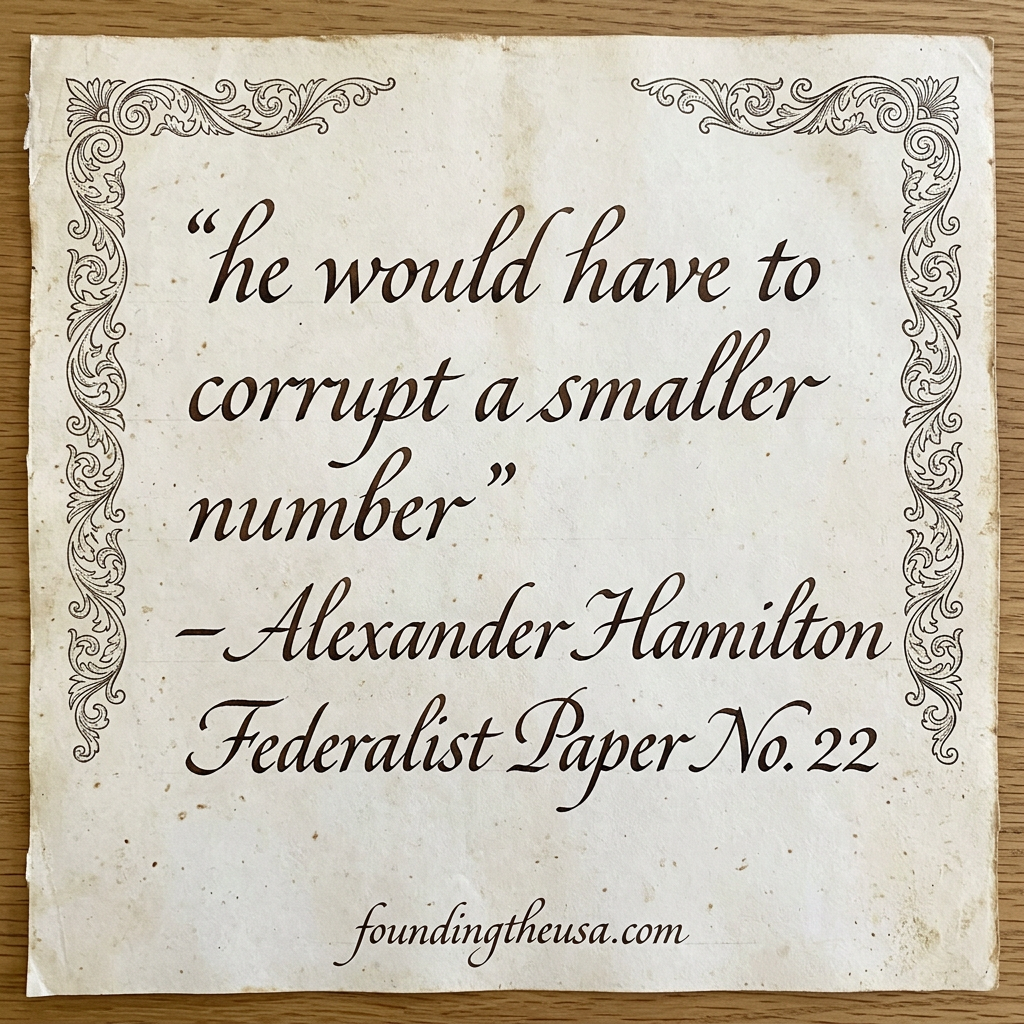
“he would have to corrupt a smaller number”
This is a sharp point: if a foreign power only needs to buy off a small blocking minority, supermajority rules make corruption cheaper.
13. Republics are especially open to foreign corruption
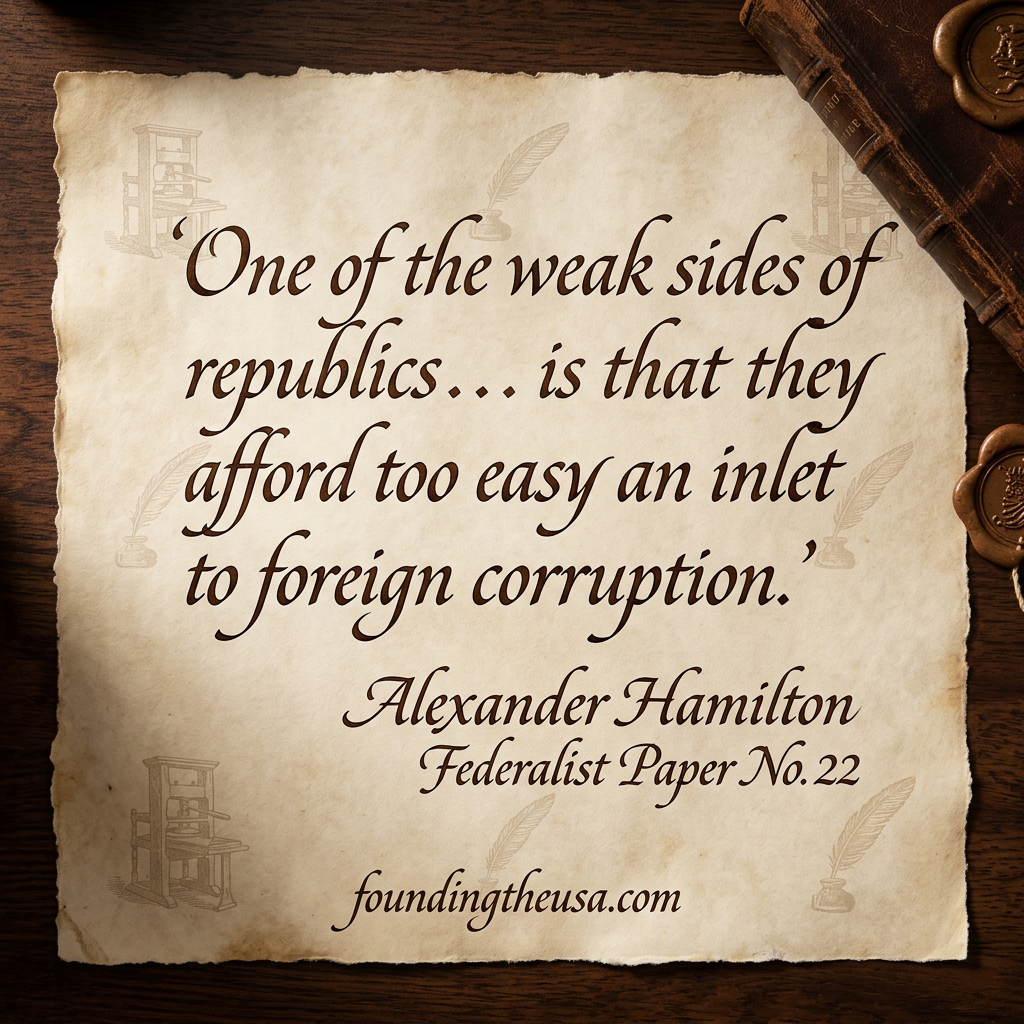
“One of the weak sides of republics… is that they afford too easy an inlet to foreign corruption.”
Hamilton is blunt here. Representative systems have many strengths, but one vulnerability is that ambitious officeholders can sometimes be bought.
14. Laws are dead letters without courts
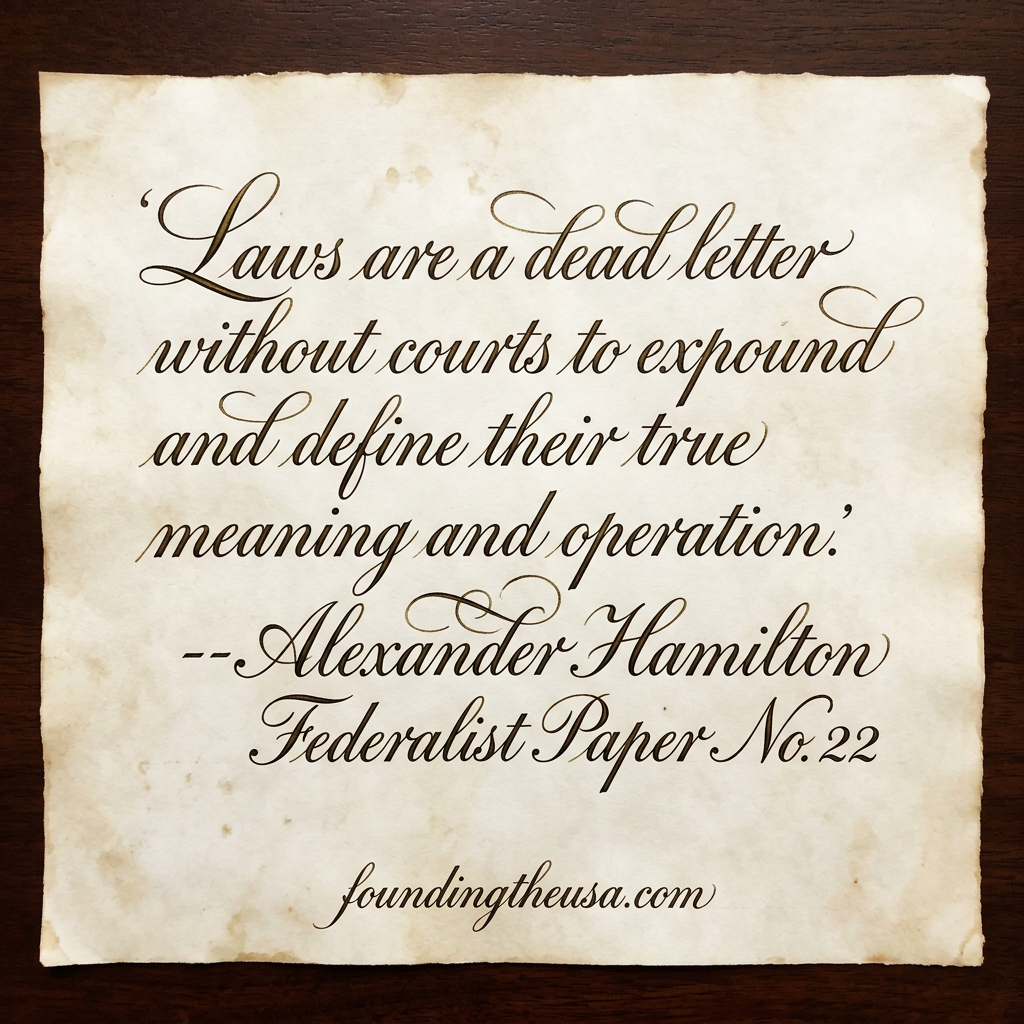
“Laws are a dead letter without courts to expound and define their true meaning and operation.”
This is one of the most famous lines in the paper. Hamilton is setting up the case for a real federal judiciary. Without courts, law is just ink.
15. There must be one supreme tribunal
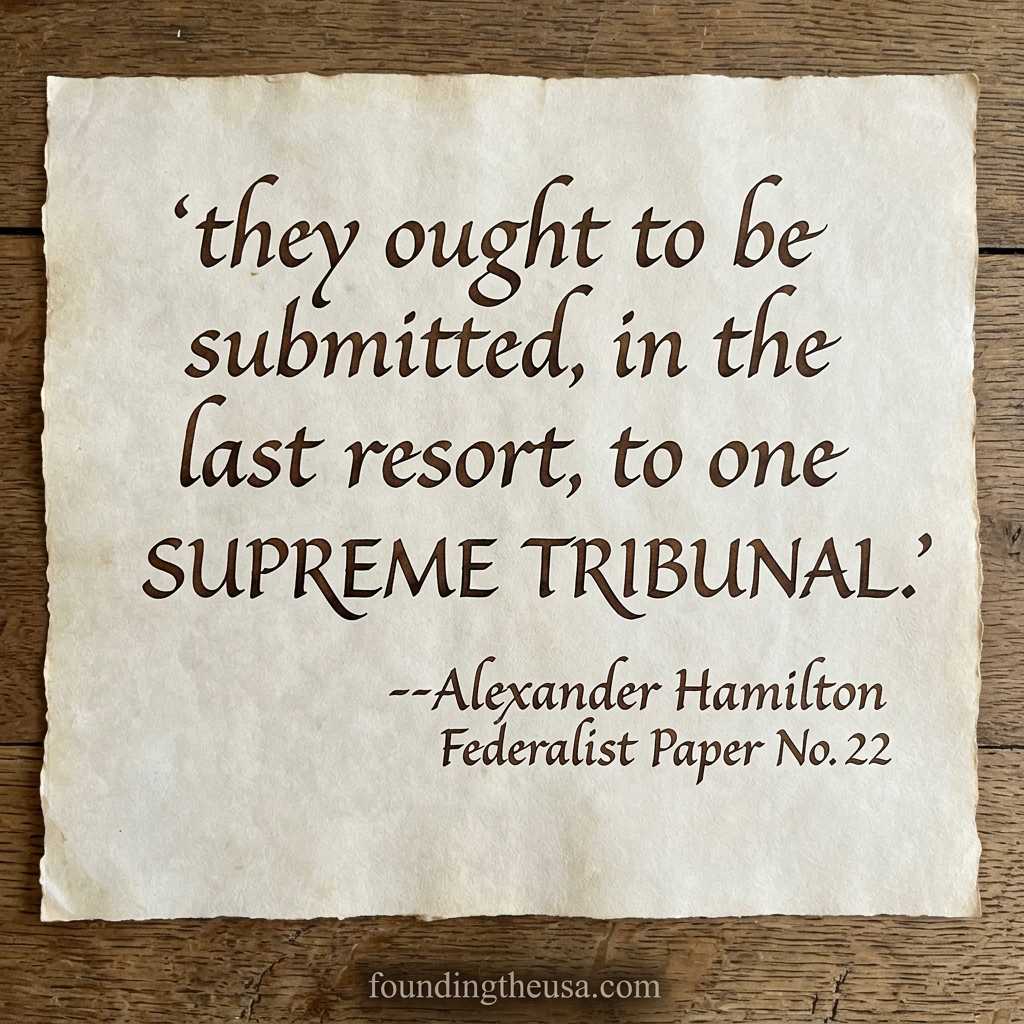
“they ought to be submitted, in the last resort, to one SUPREME TRIBUNAL.”
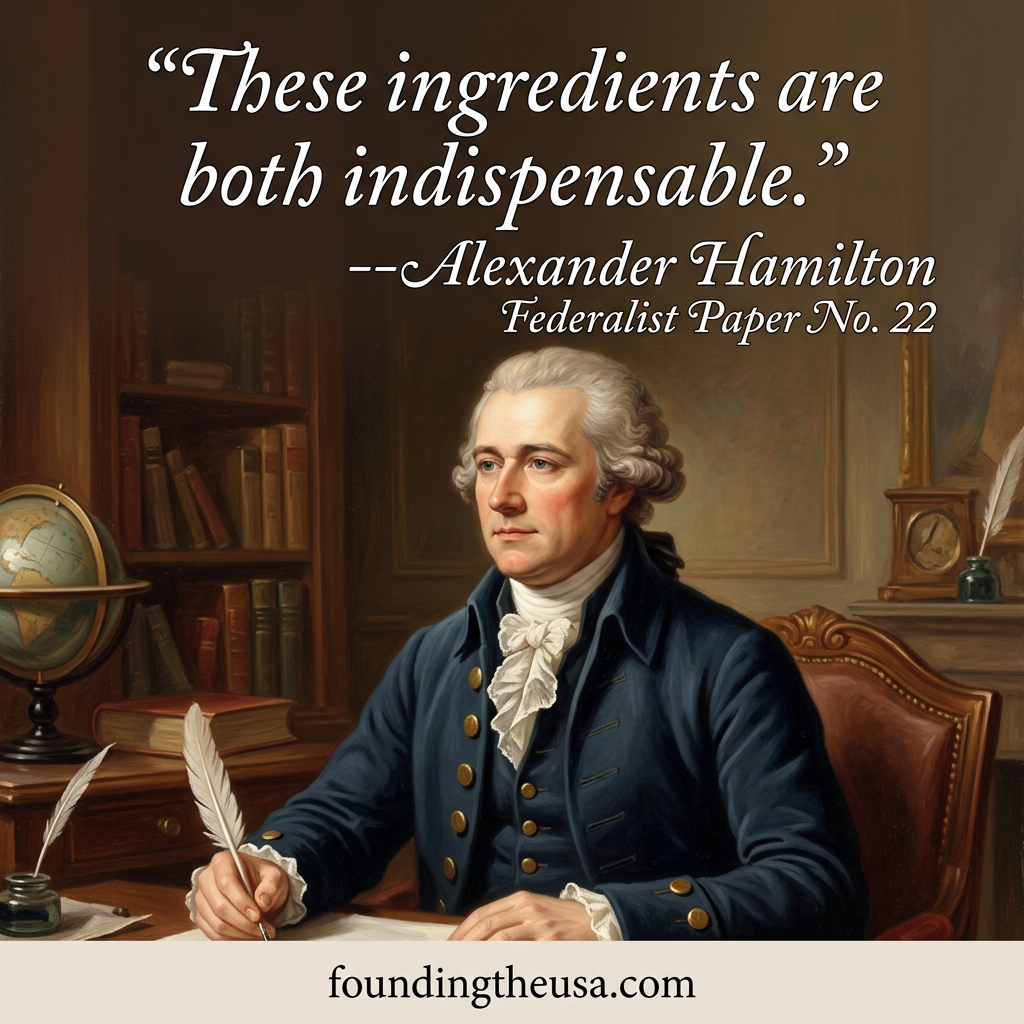
“These ingredients are both indispensable.”
Hamilton argues that treaties and national law need one final, uniform interpreter. Otherwise every state court becomes its own little final authority.
16. Without that, the Union’s honor is at the mercy of local passions
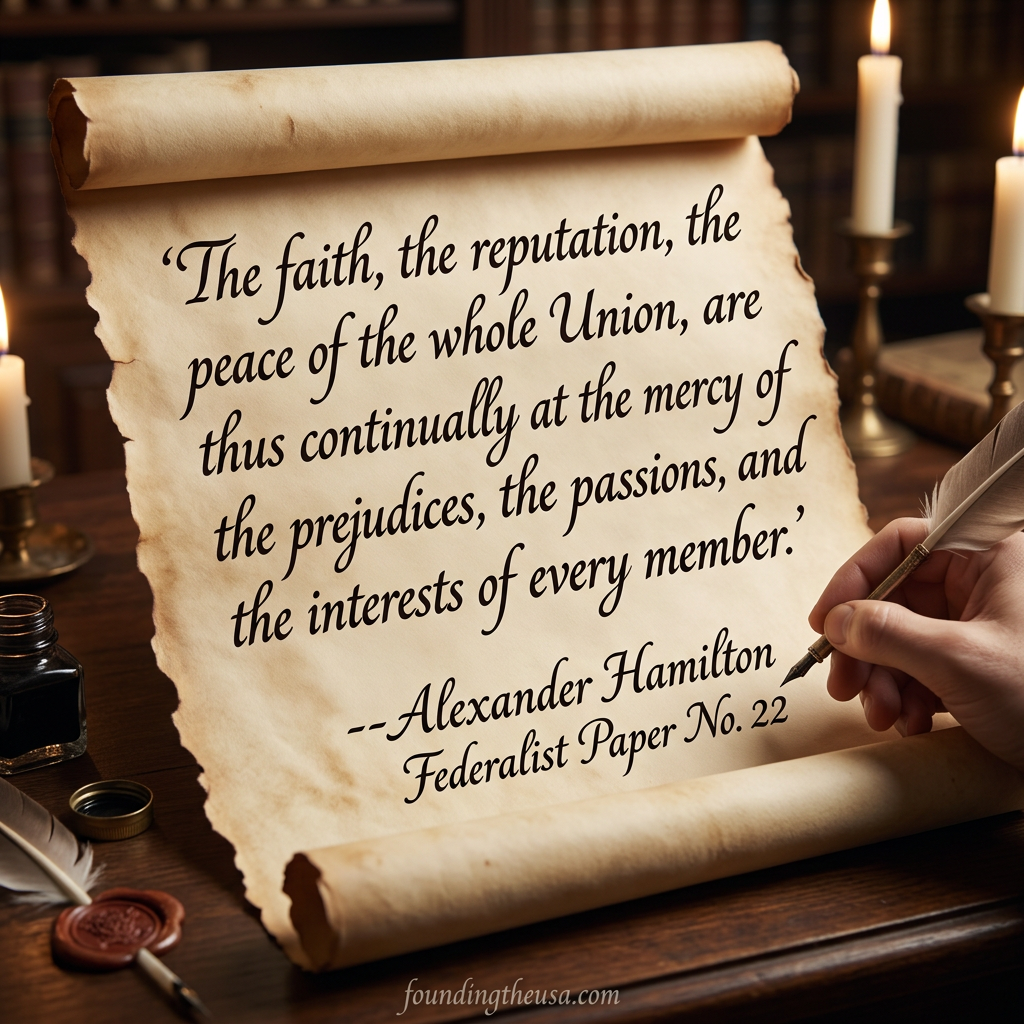
“The faith, the reputation, the peace of the whole Union, are thus continually at the mercy of the prejudices, the passions, and the interests of every member”
That is a tremendous closing line. Hamilton says national honor and safety cannot rest on thirteen separate legislatures and thirteen separate court systems all pulling in different directions.
Why Federalist No. 22 Works for Highlights
Federalist No. 22 works especially well as a highlights page because it is packed with quotable lines and practical arguments. It shows Hamilton at full speed: not theorizing in a fog, but pointing to concrete defects in commerce, war, voting rules, corruption, and the judiciary.
It is also one of the most important anti-Articles papers because it shows how several different structural flaws all fed the same result: a union too weak to act with consistency, justice, or dignity.
Related Links
- Federalist No. 22 Full Text
- Federalist Papers
- Alexander Hamilton
- Federalist No. 21
- Articles of Confederation
- United States Constitution