






Federalist No. 20 continues the argument that the Articles of Confederation were too weak to preserve the Union. In this essay, Publius turns to the United Netherlands as another historical warning. The Dutch confederacy looked respectable on paper, but in practice it suffered from provincial jealousy, weak enforcement, foreign influence, delay, and chronic instability.
This paper matters because it reinforces one of the central Federalist ideas: a government over governments is not a strong or stable government. If the Union can only act on sovereign member states, it becomes either helpless or coercive, and usually both at different times.
1. The Dutch system looked elaborate, but practice exposed it
“Such is the nature of the celebrated Belgic confederacy, as delineated on parchment.”
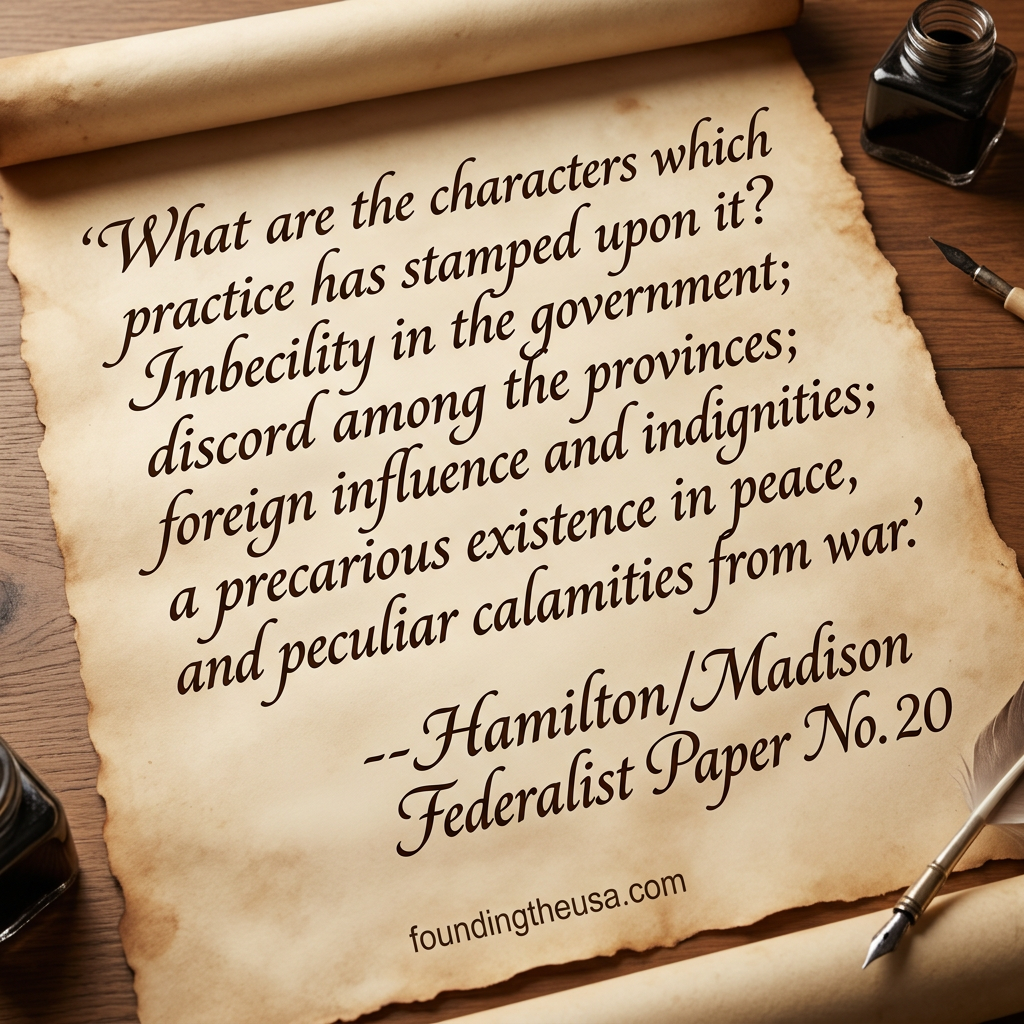
“What are the characters which practice has stamped upon it? Imbecility in the government; discord among the provinces; foreign influence and indignities; a precarious existence in peace, and peculiar calamities from war.”
That is the headline passage of the paper. Publius is saying the Dutch constitution may have looked impressive in formal description, but the real test is what happened when actual governing had to be done.
2. Theory promised harmony, jealousy delivered paralysis
“the jealousy in each province renders the practice very different from the theory.”
That line gets to the point fast. The problem was not that nobody had written down powers. The problem was that the sovereign members distrusted one another too much to let the system work properly.
3. Revenue systems collapse when members can drag their feet
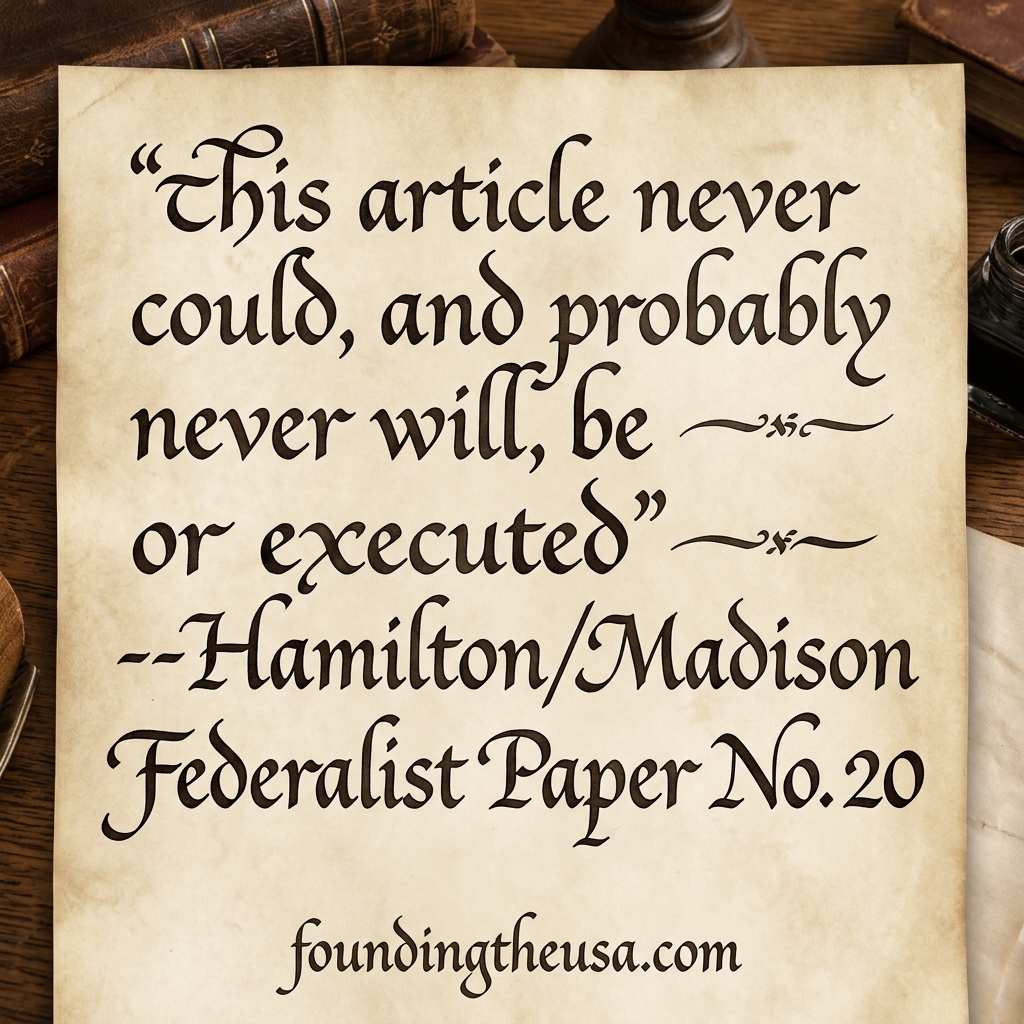
“this article never could, and probably never will, be executed”
“the danger of delay obliges the consenting provinces to furnish their quotas, without waiting for the others”
This is one of the strongest practical lessons in the essay. A confederacy that depends on member compliance for money ends up with uneven burdens, chronic delay, and resentment among the parts.
4. Sometimes compliance had to be collected at bayonet point
“the deficiencies had to be ultimately collected at the point of the bayonet”
Brutal line. Publius uses it to show that a weak confederacy does not avoid coercion. It often postpones it until coercion becomes uglier.
5. Foreign influence thrives where decision-making is slow and divided
“Foreign ministers… elude matters taken ad referendum, by tampering with the provinces and cities.”
This is a classic Federalist warning. If outside powers can work on the separate members one by one, they can frustrate or delay the whole union. Division becomes an invitation.
6. Weak constitutions drift toward either collapse or usurpation
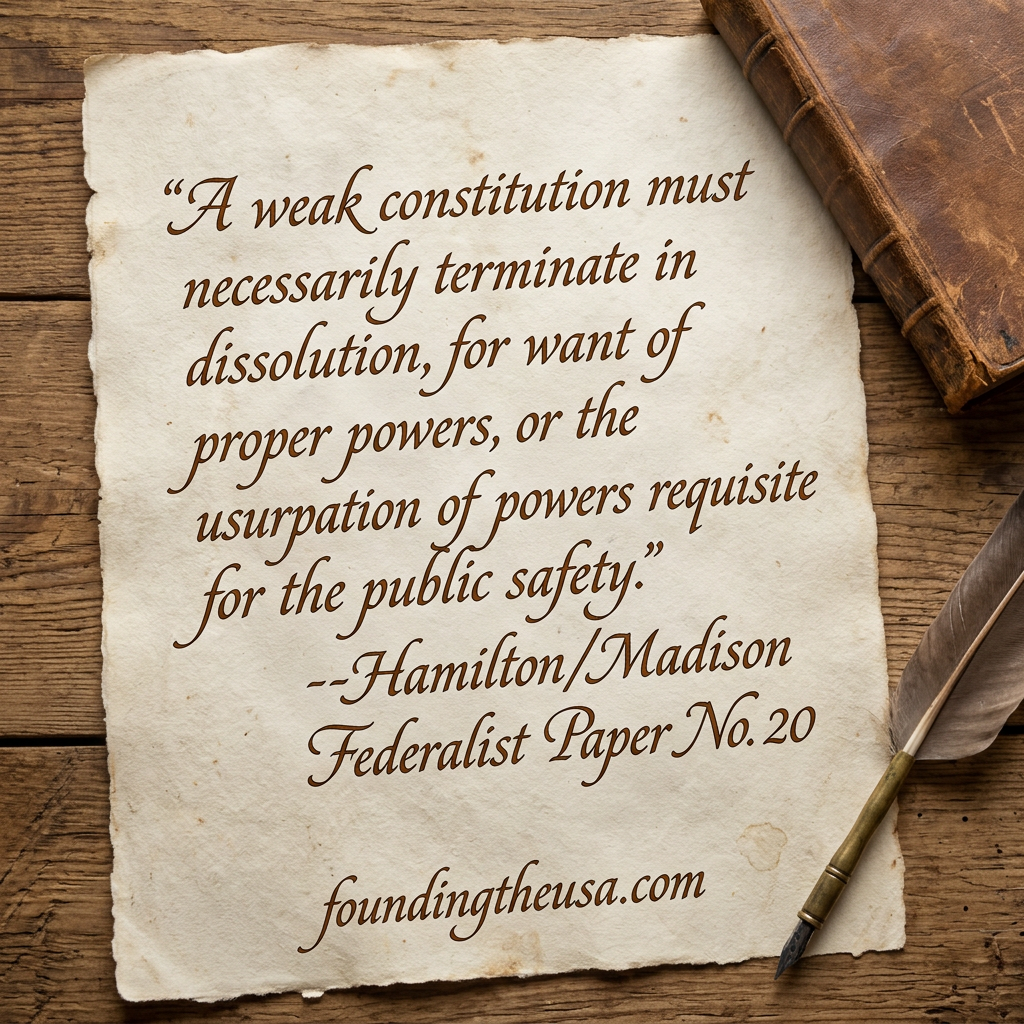
“A weak constitution must necessarily terminate in dissolution, for want of proper powers, or the usurpation of powers requisite for the public safety.”
That is one of the most important lines in the paper. Publius is saying defective constitutions do not remain neatly defective. They either fall apart or force somebody to step outside the rules.
7. Emergency usurpations are dangerous because they become a habit
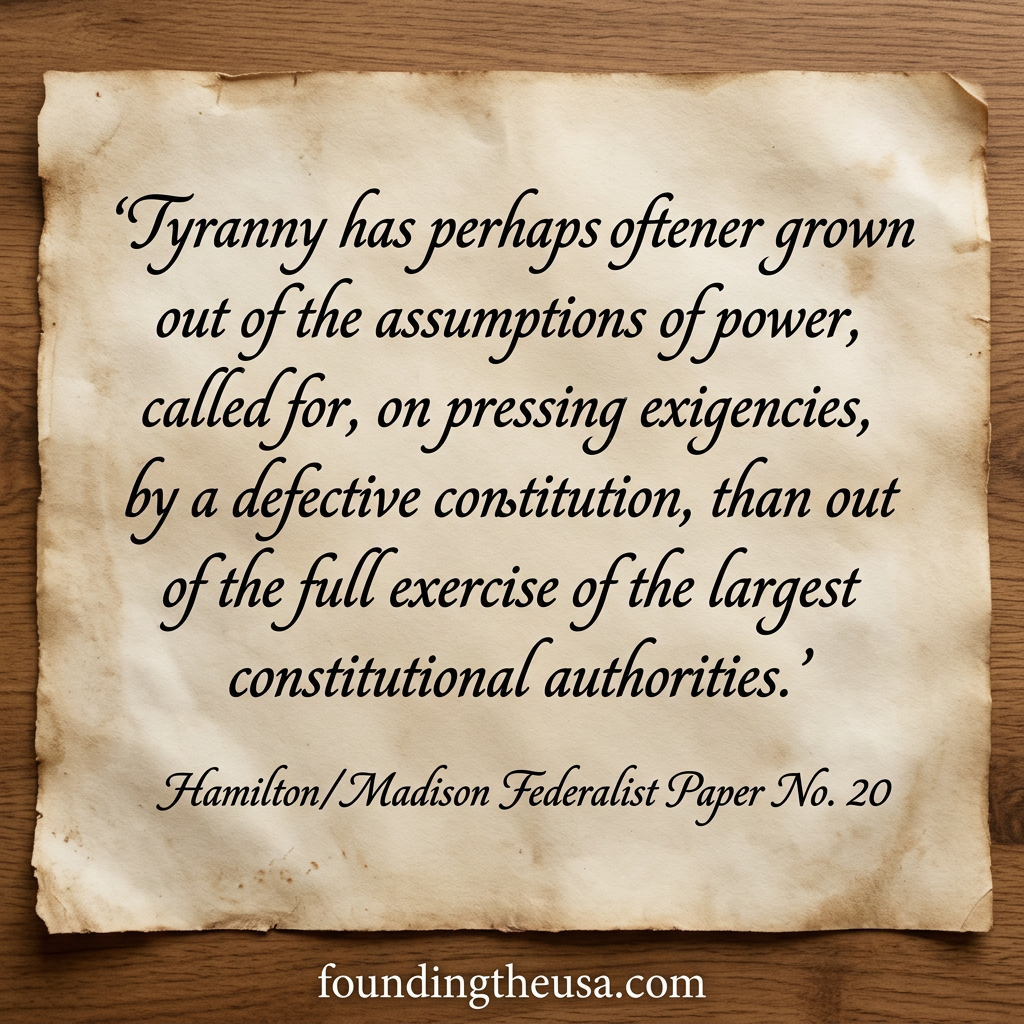
“Tyranny has perhaps oftener grown out of the assumptions of power, called for, on pressing exigencies, by a defective constitution, than out of the full exercise of the largest constitutional authorities.”
Excellent line. This is a very deep Federalist point: weak government can be just as dangerous to liberty as excessive government, because weakness creates crises, and crises invite extra-constitutional power grabs.
8. The Dutch union needed an internal spring just to keep moving
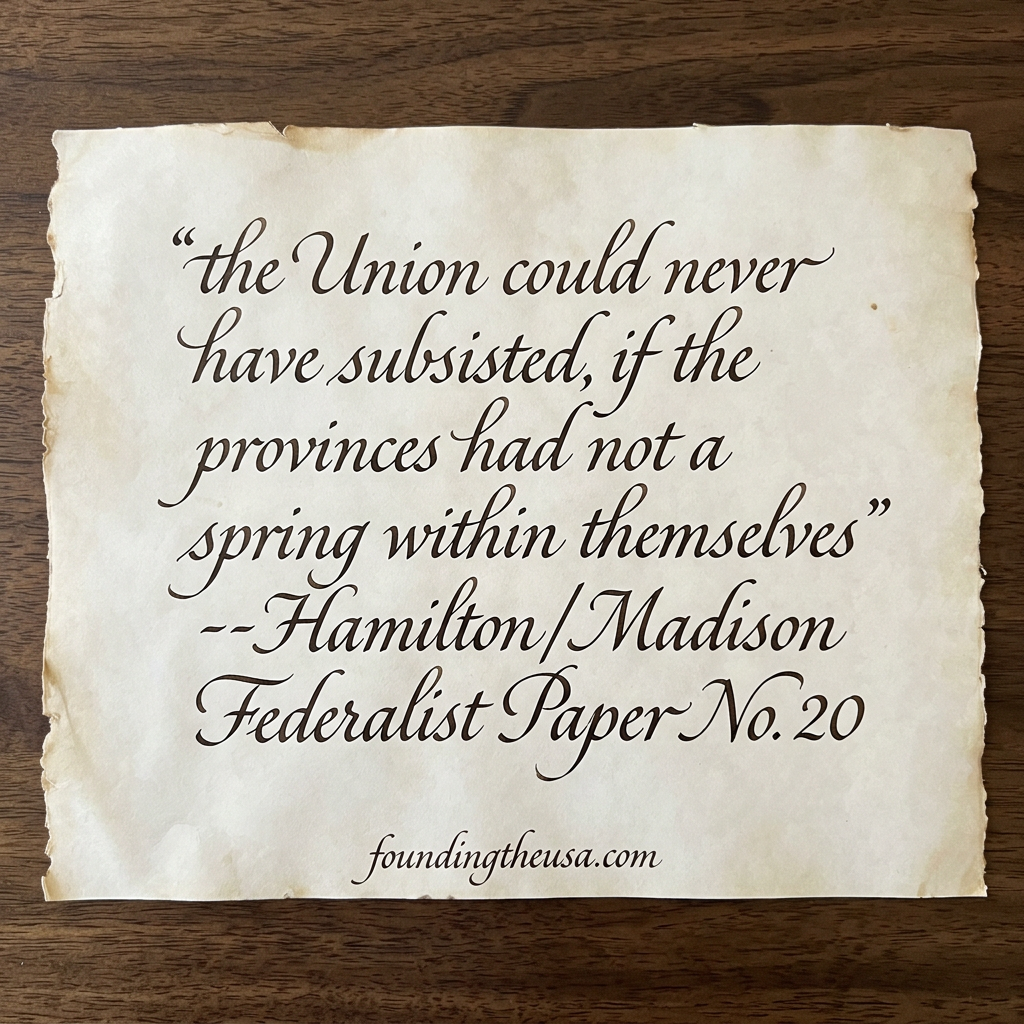
“the Union could never have subsisted, if the provinces had not a spring within themselves”
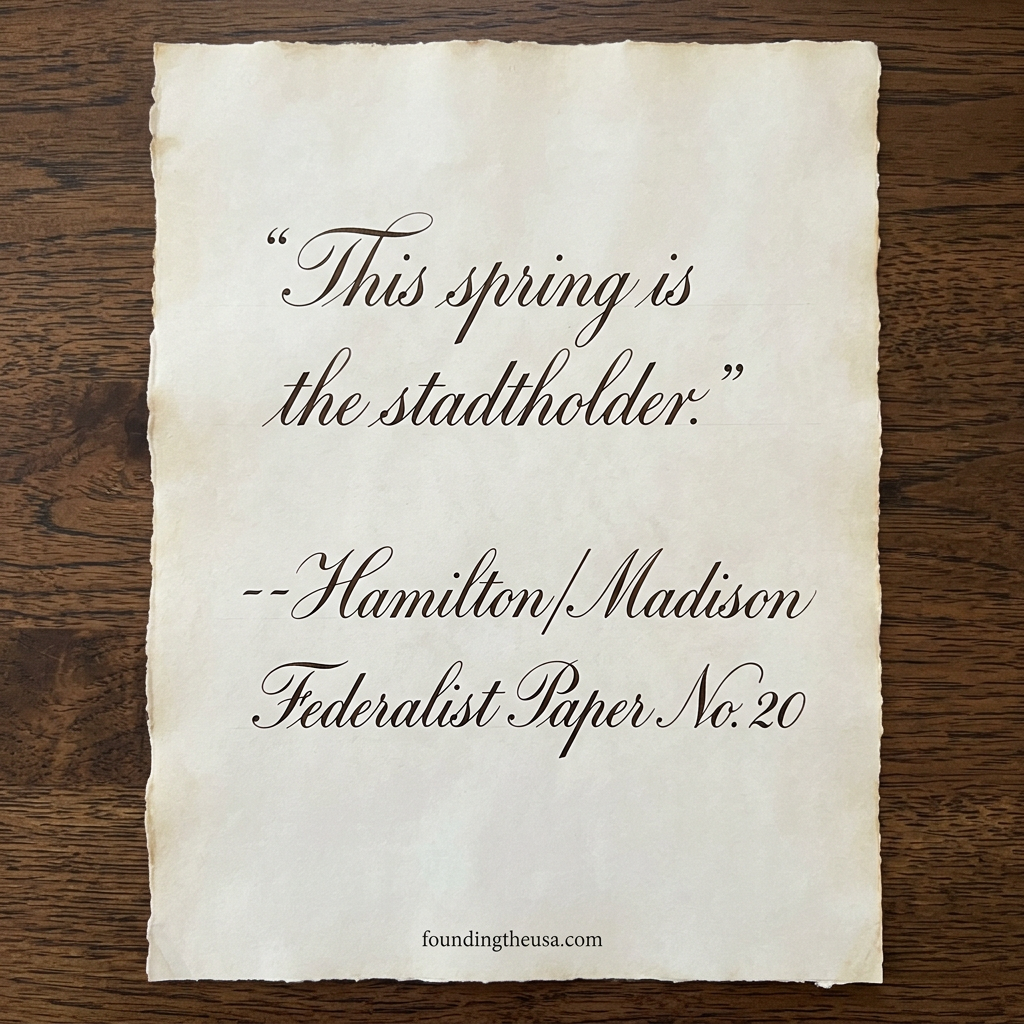
“This spring is the stadtholder.”
Publius is basically saying the Dutch system could not sustain itself through its formal constitutional design alone. It depended on extra force and influence to keep the machine from stalling out.
9. Reforms were acknowledged as necessary, but impossible to secure
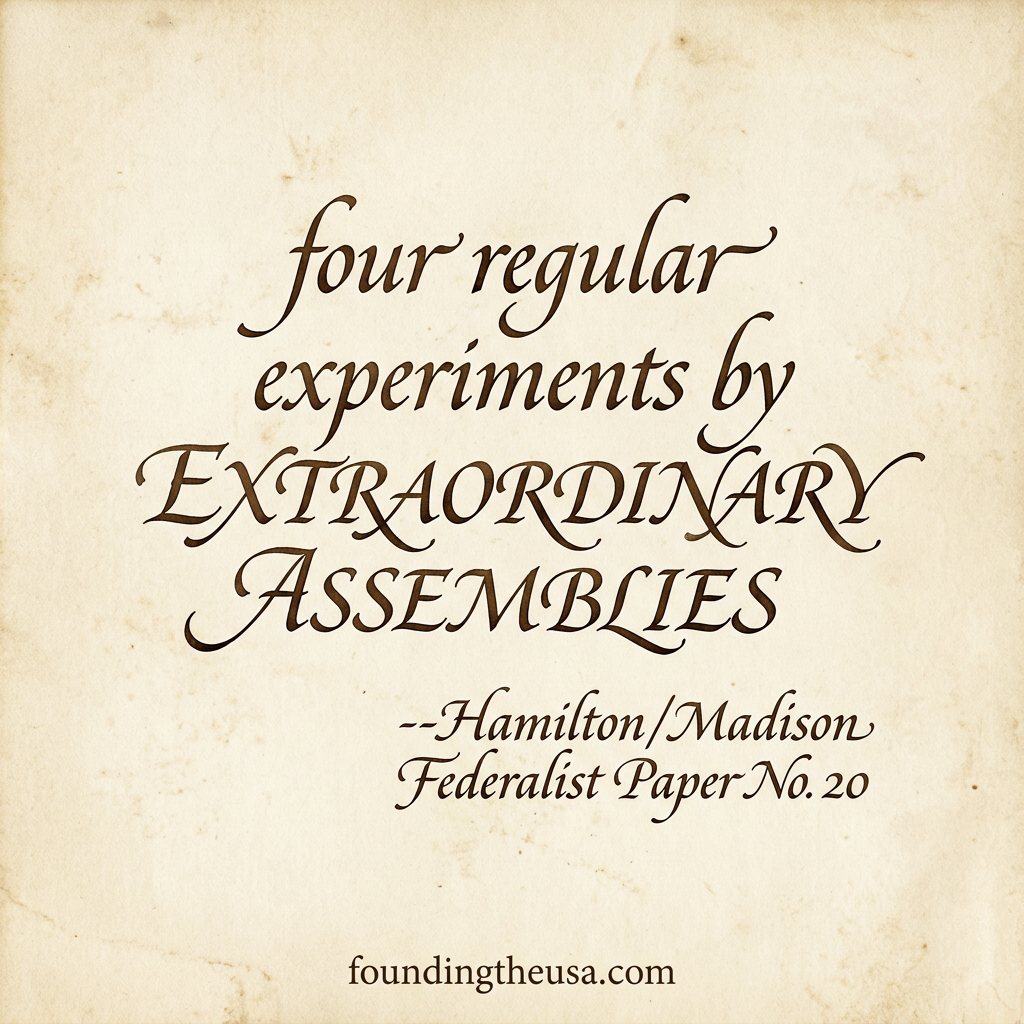
“four regular experiments by EXTRAORDINARY ASSEMBLIES”
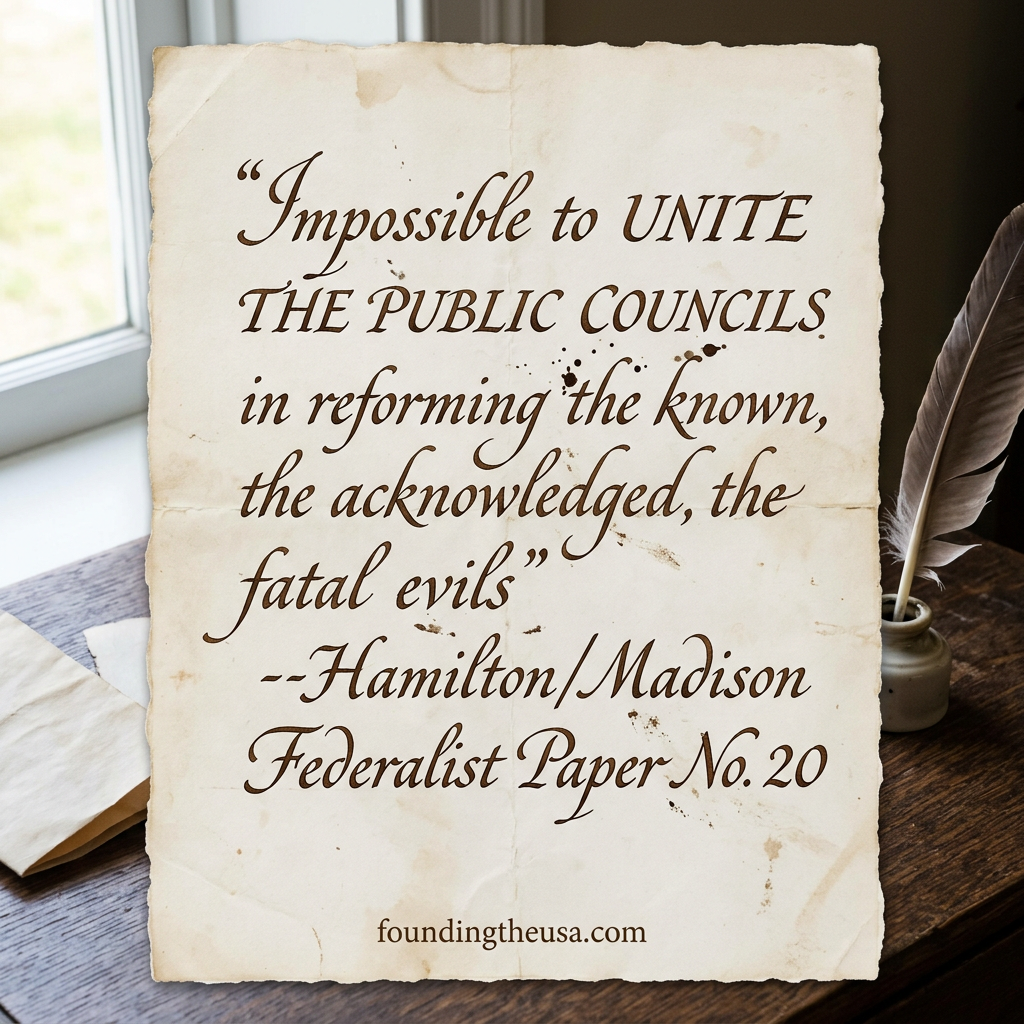
“impossible to UNITE THE PUBLIC COUNCILS in reforming the known, the acknowledged, the fatal evils”
That is painfully relevant to the Federalist argument. Everyone may admit the defects, but if the system itself makes correction too hard, the defects stay fatal.
10. Experience, not theory, gives the real answer
“Experience is the oracle of truth”
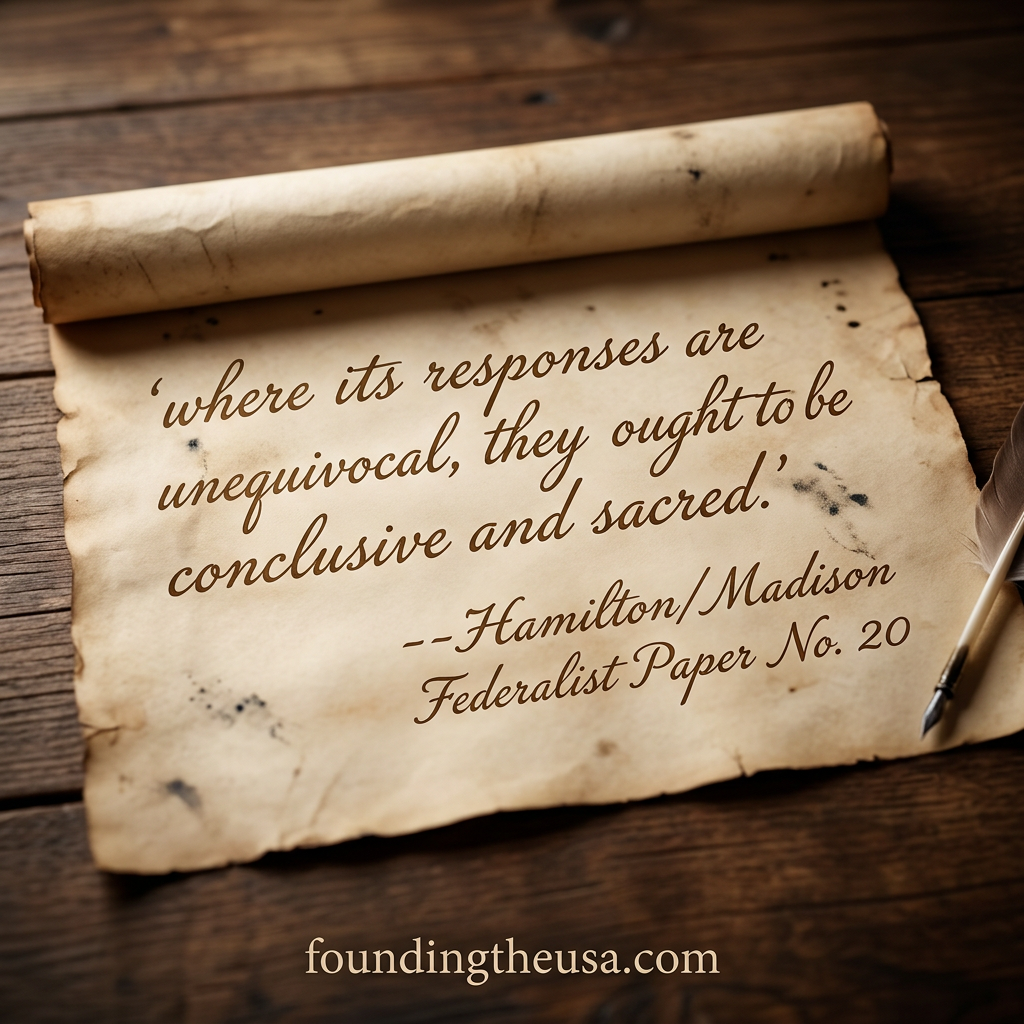
“where its responses are unequivocal, they ought to be conclusive and sacred.”
This is the governing principle of the whole historical series. Publius is saying: stop daydreaming, stop romanticizing confederacies, and look at what actually happens.
11. The final lesson: government over governments is a contradiction
“a sovereignty over sovereigns, a government over governments, a legislation for communities, as contradistinguished from individuals”
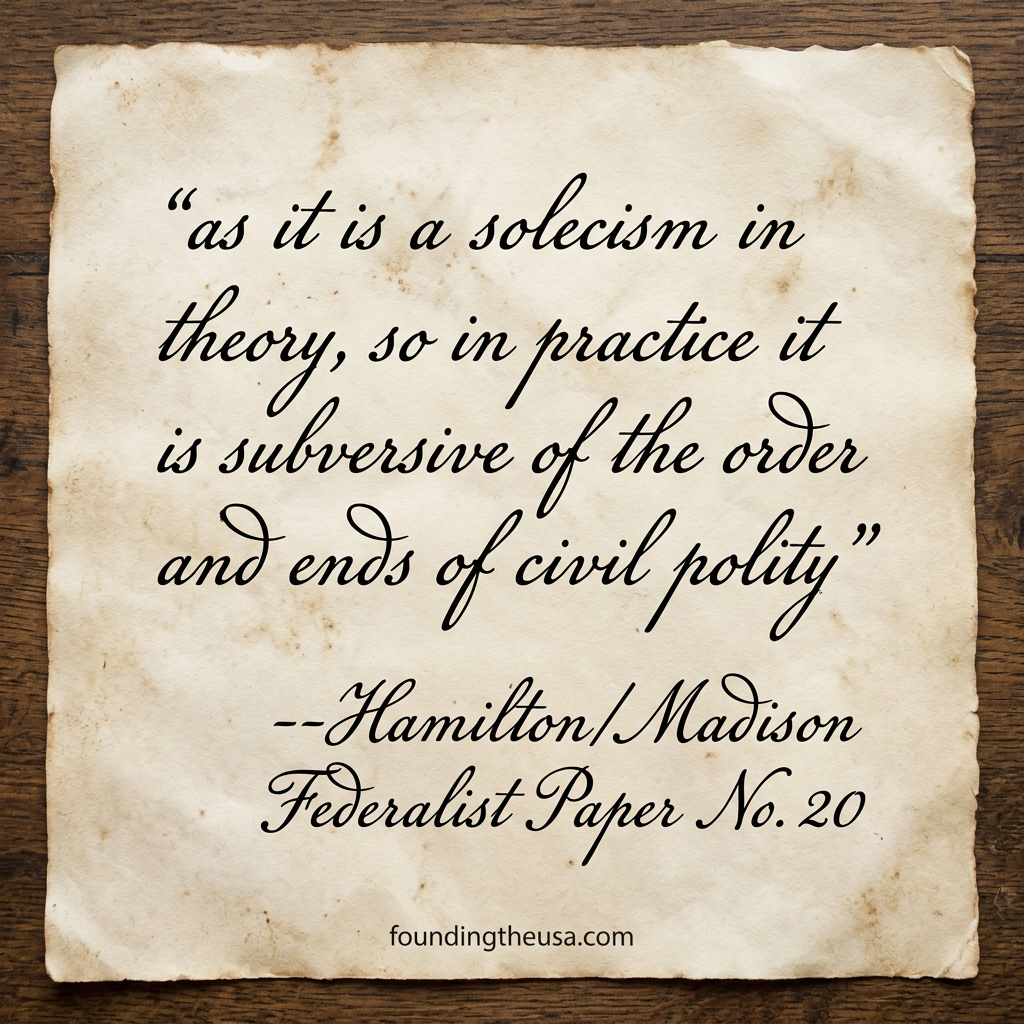
“as it is a solecism in theory, so in practice it is subversive of the order and ends of civil polity”
“substituting VIOLENCE in place of LAW… the COERCION of the SWORD in place of the… MAGISTRACY.”
This is the payoff. It is one of the strongest summary passages in the whole Federalist run against the Articles. Publius says a union that legislates only for member governments is broken in theory and destructive in practice.
Why Federalist No. 20 Works for Highlights
Federalist No. 20 works very well as a highlights page because it is unified, practical, and quotable. The paper takes the Dutch example and pounds one clear lesson into the table: confederacies of sovereign members are slow, jealous, vulnerable, and unstable.
It also serves as one of the clearest bridges from historical example to constitutional principle. By the end of the essay, the Dutch republic is not just a history lesson. It becomes evidence for why the American Union had to govern through law over individuals, not requisitions toward states.
Strong Meme Candidates from Federalist No. 20
The strongest quote-image or meme candidates are probably these:
- “Imbecility in the government”
- “the jealousy in each province renders the practice very different from the theory”
- “at the point of the bayonet”
- “A weak constitution must necessarily terminate in dissolution”
- “Tyranny has perhaps oftener grown out of the assumptions of power”
- “Experience is the oracle of truth”
- “a government over governments”
- “VIOLENCE in place of LAW”
- “the COERCION of the SWORD in place of the… MAGISTRACY”
Related Links
- Federalist No. 20 Full Text
- Federalist Papers
- Federalist No. 19
- Alexander Hamilton
- James Madison
- Articles of Confederation
- United States Constitution