
Federalist No. 18 was published under the name Publius and continues the argument that the existing Articles of Confederation were too weak to preserve the Union. In this paper, the authors turn to the ancient Greek confederacies for proof that loose leagues of sovereign states tend toward weakness, rivalry, corruption, foreign manipulation, and collapse.
This is a more historical paper than some of the earlier Federalist essays, but it still has a clear point: confederacies that govern states only in their collective capacities do not reliably produce peace or strength. They often produce the opposite.
1. On paper, the old Greek confederacy looked strong enough
“In theory, and upon paper, this apparatus of powers seems amply sufficient for all general purposes.”
That line matters because it sounds a lot like the problem Hamilton and Madison saw in the Articles of Confederation. A system can look respectable in theory and still fail badly in practice.
2. The reality was weakness, disorder, and destruction
“Hence the weakness, the disorders, and finally the destruction of the confederacy.”
That is one of the bluntest lines in the paper. The authors are saying the Greek example proves their point: loose confederacies do not stay stable just because they have a formal structure on parchment.
3. The strong members dominated the weak
“The more powerful members, instead of being kept in awe and subordination, tyrannized successively over all the rest.”
This is a core Federalist warning. In weak confederacies, the head does not usually become the main tyrant. Often the stronger member states dominate the smaller ones.
4. Deputies of strong cities corrupted the rest
“the deputies of the strongest cities awed and corrupted those of the weaker”
“judgment went in favor of the most powerful party.”
Excellent combined example. The paper argues that equal forms on paper do not prevent unequal influence in practice. Power leaks into the system and bends judgment toward the strong.
5. Foreign war did not create unity
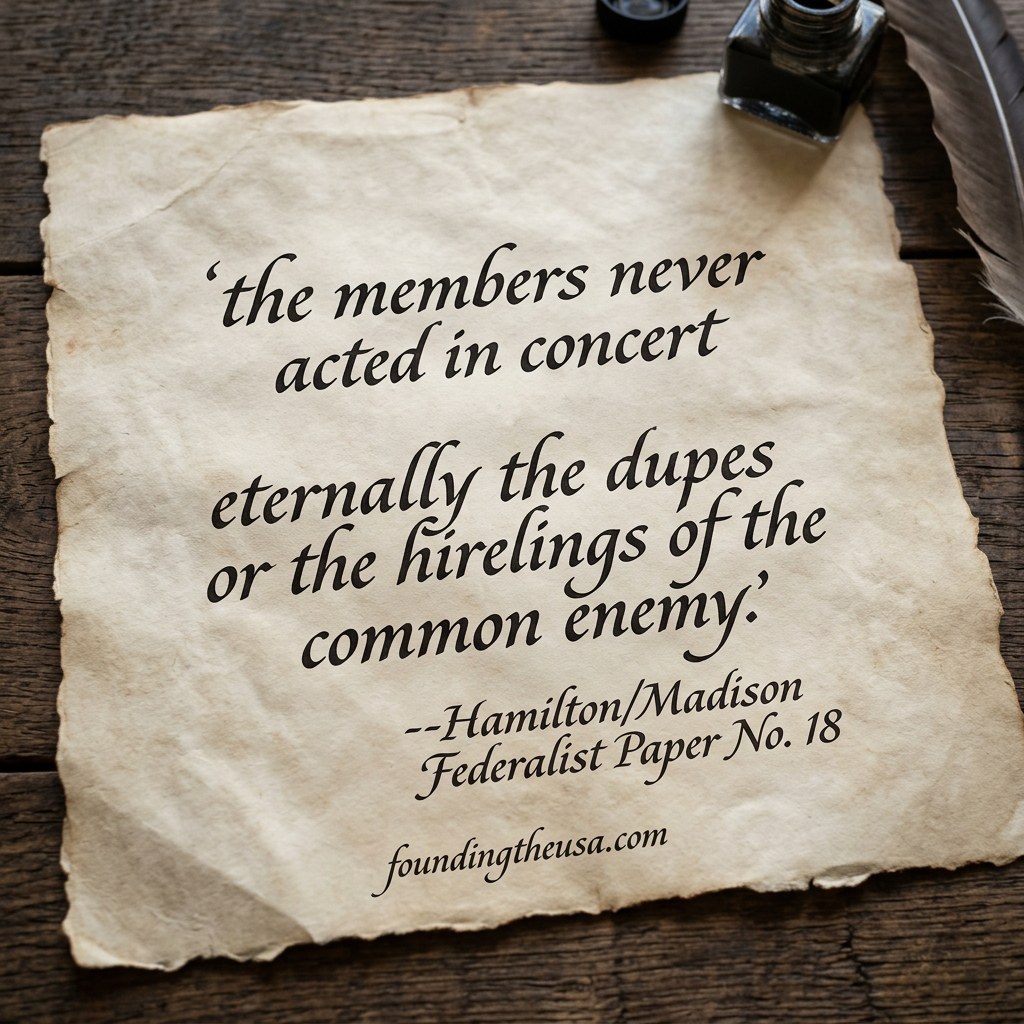
“the members never acted in concert”
“eternally the dupes or the hirelings of the common enemy.”
That is a nasty line, and intentionally so. Even under outside pressure, the member states of the Greek confederacy failed to act together. Some were manipulated, some were bought, and the whole league suffered for it.
6. The smaller members became satellites
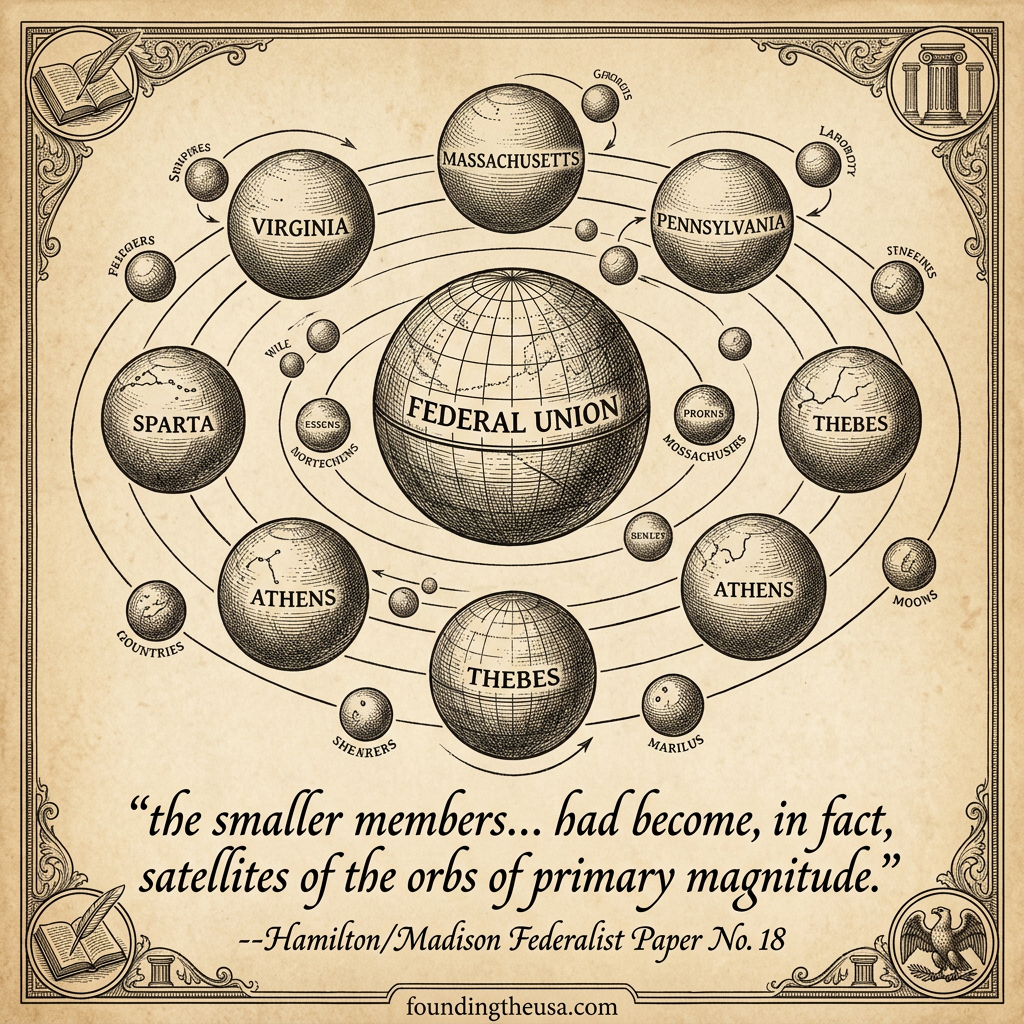
“the smaller members… had become, in fact, satellites of the orbs of primary magnitude.”
One of the best images in the paper. The smaller states were supposed to revolve in equal dignity around the center, but in reality they ended up orbiting the stronger members. Great quote-image material.
7. Greece needed a closer union and did not build one
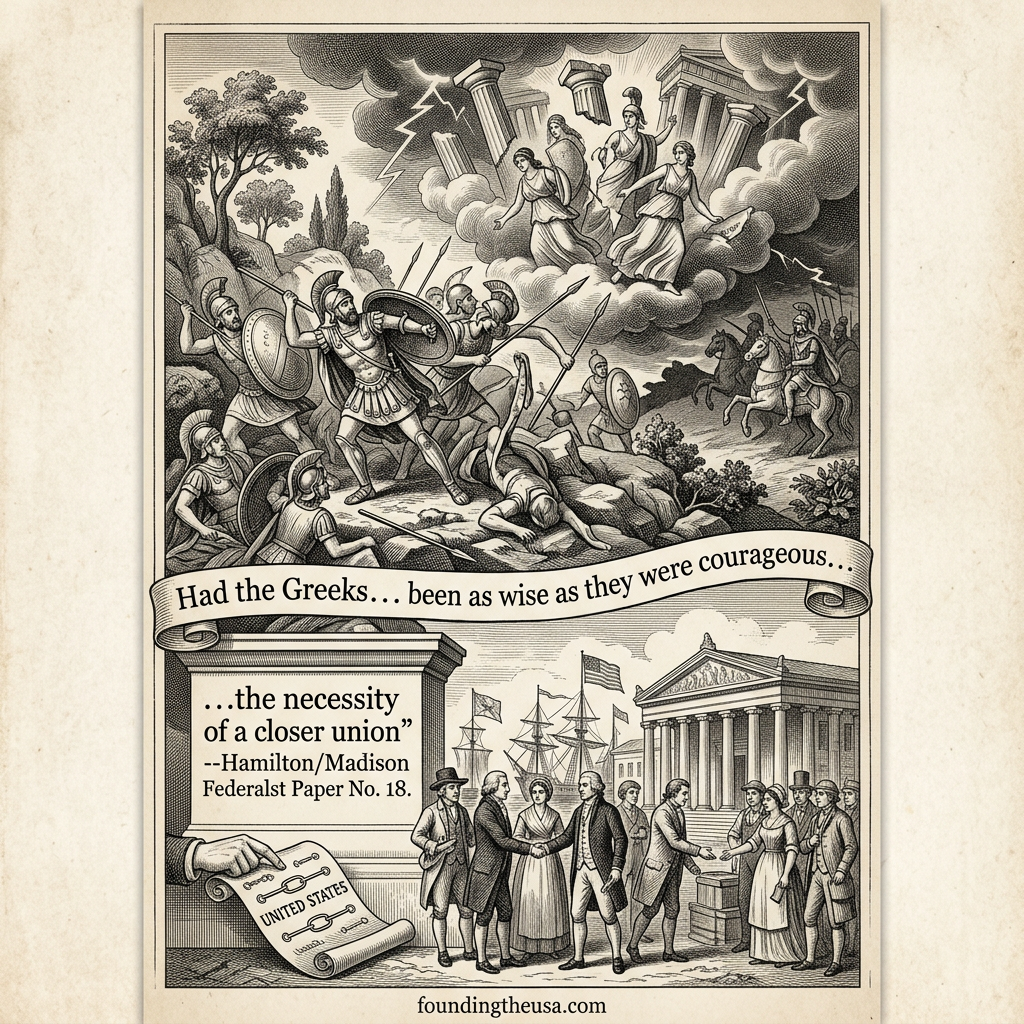
“Had the Greeks… been as wise as they were courageous”
“the necessity of a closer union”
This is the historical lesson the authors want the American reader to notice. Courage and talent are not enough. Without a stronger union, success can still rot into rivalry and ruin.
8. Rivalry among members did more damage than the foreign enemy
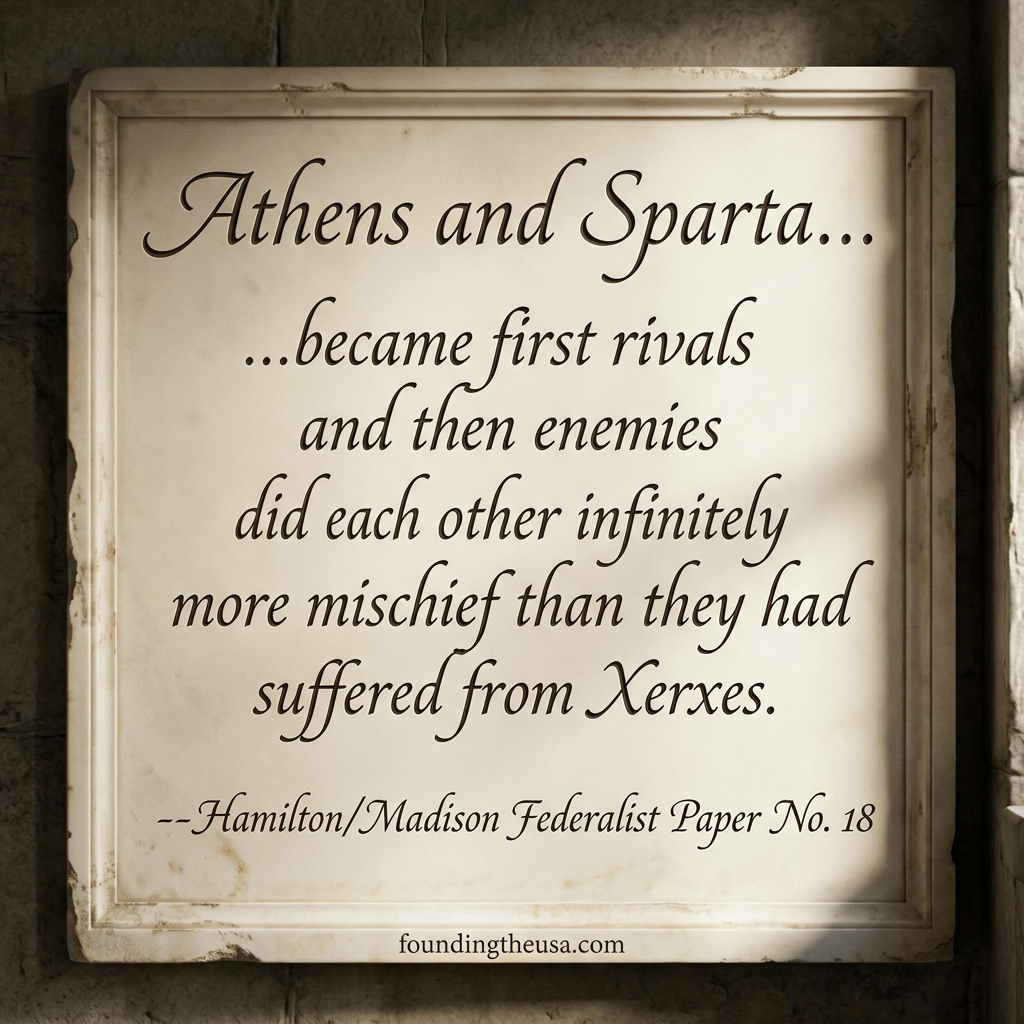
“Athens and Sparta… became first rivals and then enemies”
“did each other infinitely more mischief than they had suffered from Xerxes.”
That is a powerful warning. Internal rivalry can become more destructive than the danger that first drove the members together. It is a very Federalist point.
9. Weak government brings danger from abroad
“As a weak government, when not at war, is ever agitated by internal dissentions, so these never fail to bring on fresh calamities from abroad.”
That line ties domestic weakness to foreign danger. Internal division is not just messy at home. It invites outside powers to meddle, intervene, and conquer.
10. Philip of Macedon entered through Greek division
“Philip gladly seized the opportunity”
“made himself master of the confederacy.”
That is the historical nightmare scenario. A divided confederacy creates the opening, and an ambitious outsider walks through it. The authors clearly want Americans to see the analogy.
11. A stricter confederation might have preserved liberty
“Had Greece… been united by a stricter confederation”
“she would never have worn the chains of Macedon”
This is one of the strongest summary lines in the essay. It states the lesson in direct form: a stronger union could have preserved freedom better than a weaker one.
12. The Achaean League was better, but still vulnerable
“The Union here was far more intimate, and its organization much wiser”
“though not exempt from a similar catastrophe, it by no means equally deserved it.”
This is an important nuance. The paper does not say all confederacies are identical. It says better-constructed ones perform better — but weak points still matter, and foreign manipulation can still be fatal.
13. General authority tempered local disorder
“there was infinitely more of moderation and justice”
“the popular government… was there tempered by the general authority and laws of the confederacy.”
That is one of the most useful lines in the paper for constitutional argument. A stronger general authority does not automatically destroy liberty; it can restrain disorder and make self-government more stable.
14. Foreign powers used the old divide-and-rule trick
“The arts of division were practiced among the Achaeans.”
“Each city was seduced into a separate interest; the union was dissolved.”
This is timeless politics. Break unity, isolate members, play on local interest, and the larger body falls apart. Same old snake, different century.
15. Liberty was torn into pieces by art before it was crushed by arms
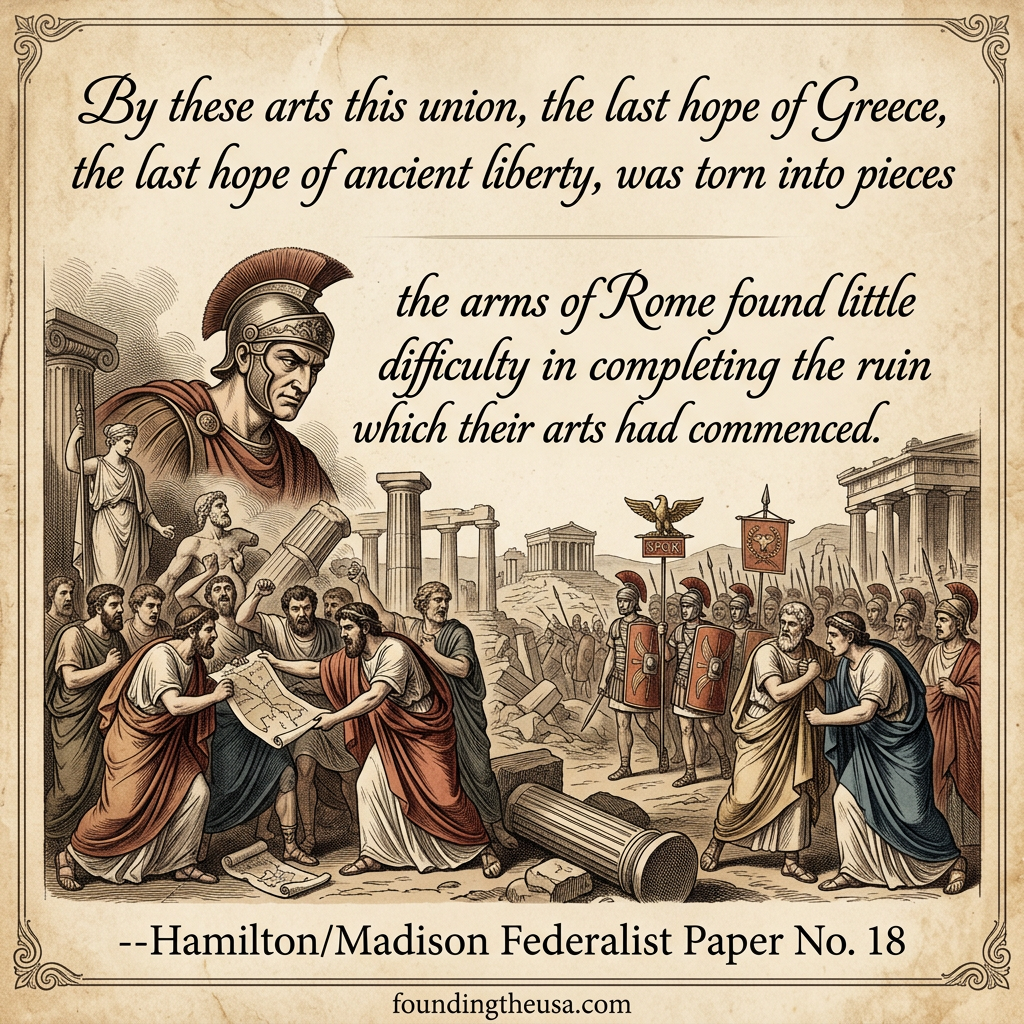
“By these arts this union, the last hope of Greece, the last hope of ancient liberty, was torn into pieces”
“the arms of Rome found little difficulty in completing the ruin which their arts had commenced.”
That is probably the strongest closing passage in the paper. First division, then weakness, then conquest. It is a grim but effective lesson.
16. The main lesson
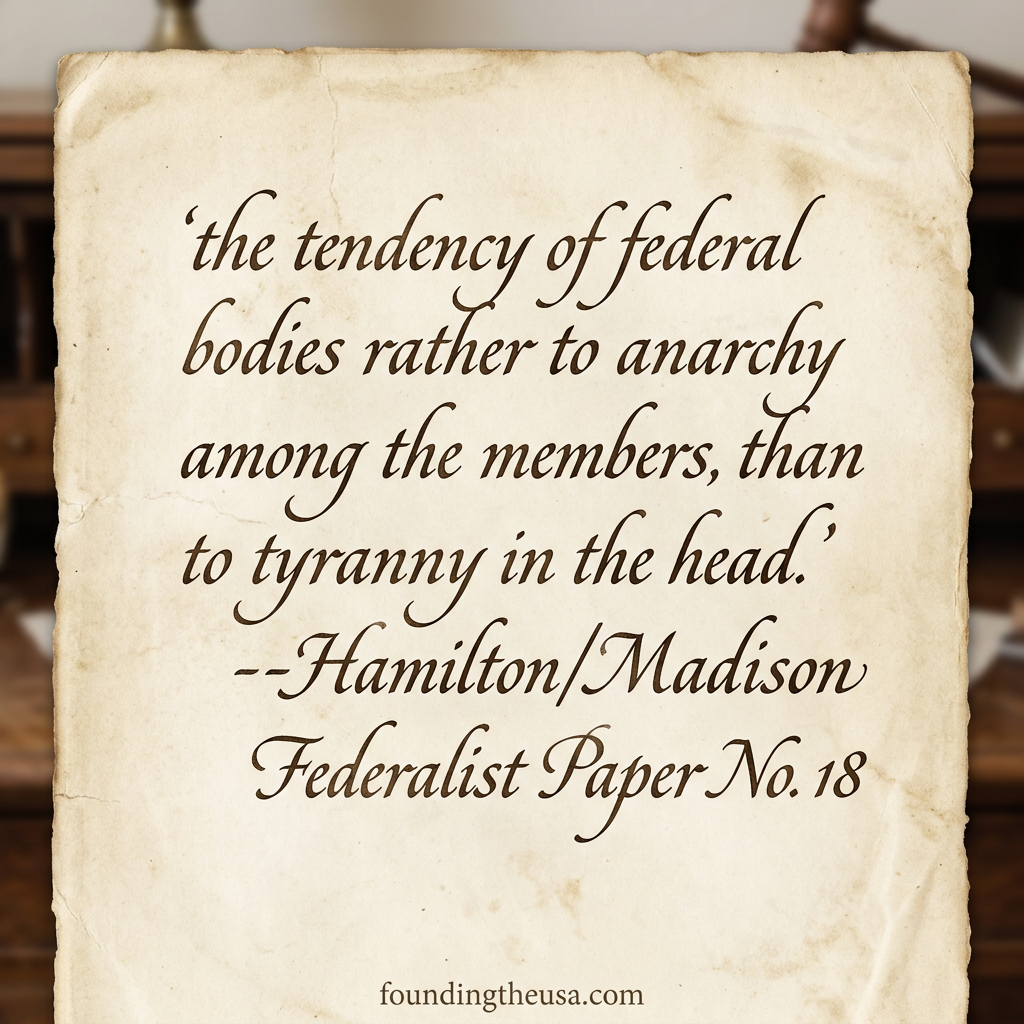
“the tendency of federal bodies rather to anarchy among the members, than to tyranny in the head.”
This is the thesis sentence for the whole essay. The authors are arguing that the greater danger in loose confederacies is not an overbearing center, but disorder among the parts.
Related Links
- Federalist No. 18 Full Text
- Federalist Papers
- Alexander Hamilton
- James Madison
- Federalist No. 17
- Articles of Confederation
- United States Constitution