Federalist No. 6 was written by Alexander Hamilton under the name Publius and published on November 14, 1787. In this essay, Hamilton argues against the comforting fantasy that the American states could safely split apart and still live in peace. His point is that republics, commercial nations, and neighboring governments are not naturally peaceful. Human beings remain ambitious, jealous, vindictive, and greedy, and political communities are made of human beings.
This is one of Hamilton’s more sharp-edged essays. He is basically taking a hammer to naïve political optimism. If America breaks into multiple confederacies, he argues, it should expect rivalry, conflict, and eventually war.
1. Not peace, but dissension
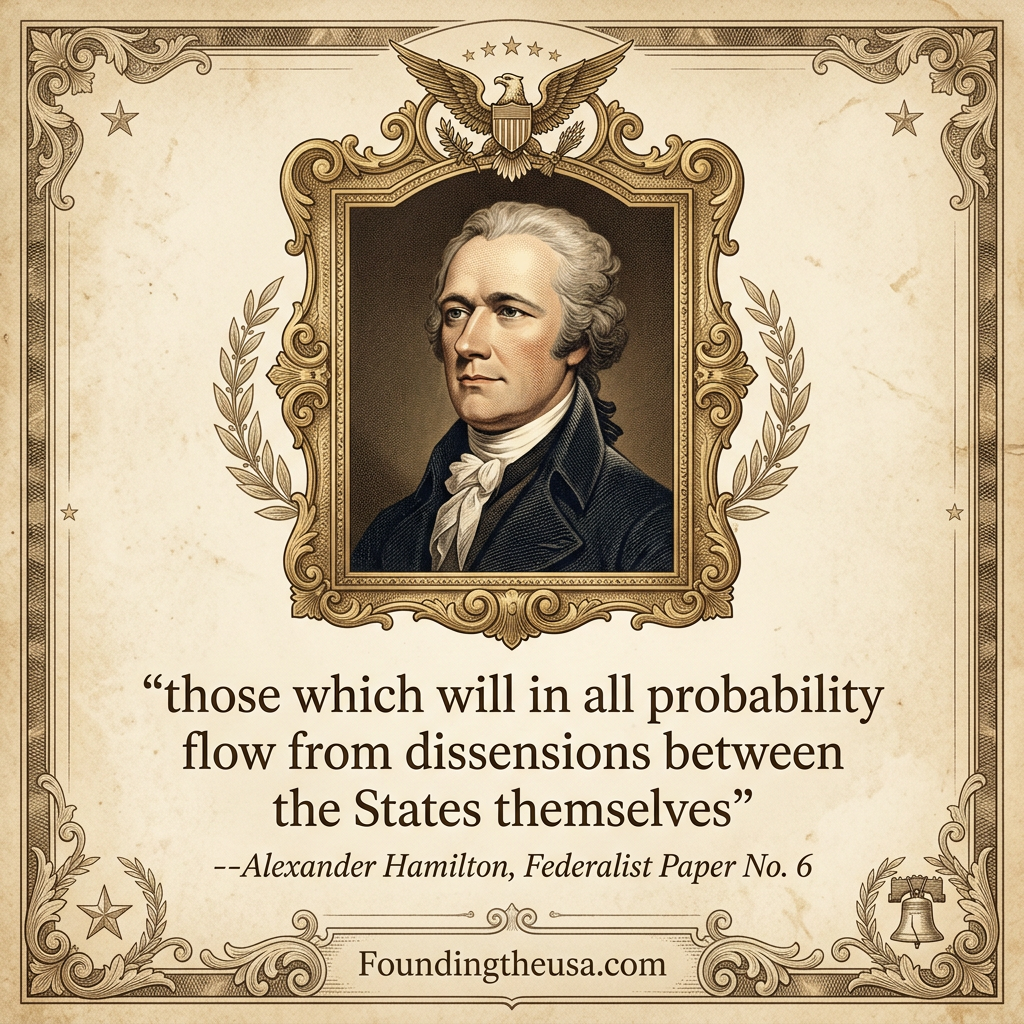
“those which will in all probability flow from dissensions between the States themselves”
Hamilton opens by turning attention away from foreign danger and toward domestic rivalry. He wants readers to understand that disunion would not just expose America to outside threats. It would create new threats among the states themselves.
2. The anti-utopian line
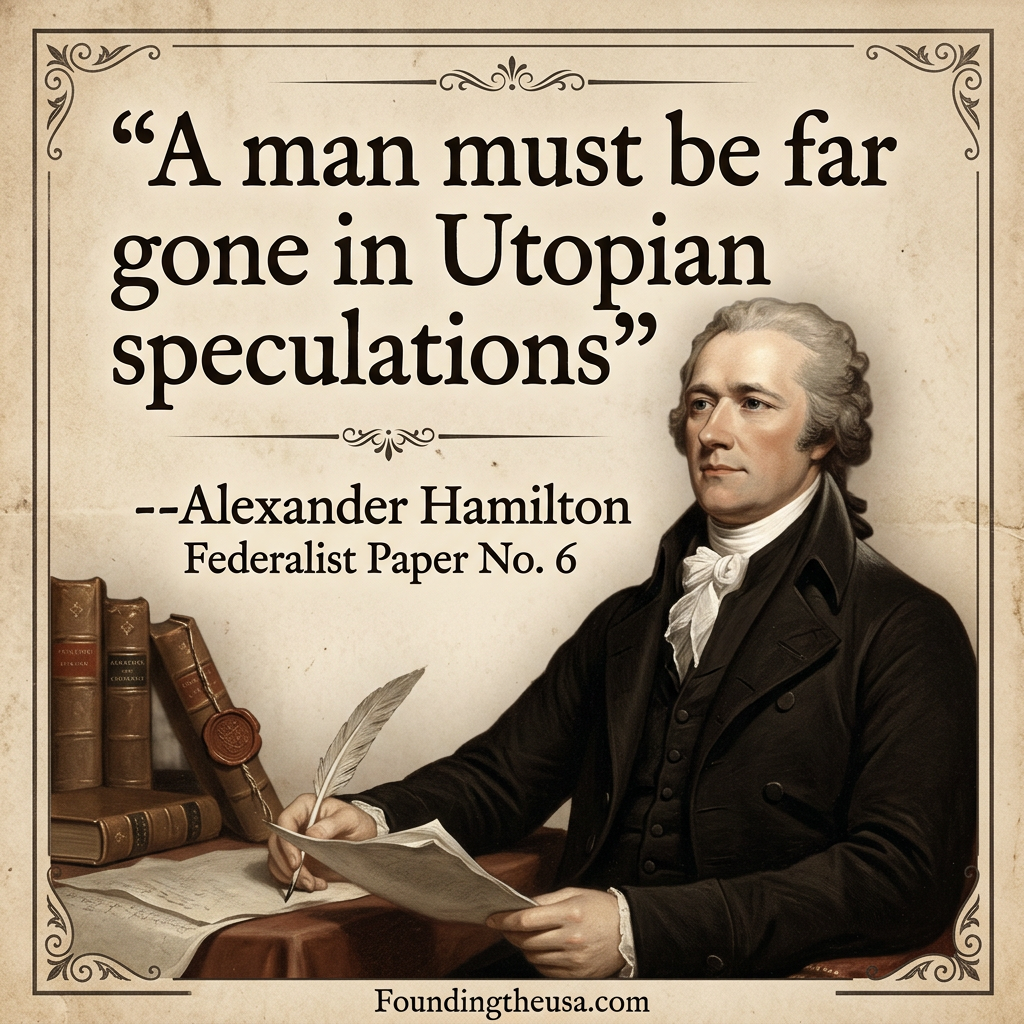
“A man must be far gone in Utopian speculations”
That is classic Hamilton. He has no patience for dreamy political theories that ignore human nature. This line is short, sharp, and very meme-worthy.
3. Human nature has not improved itself
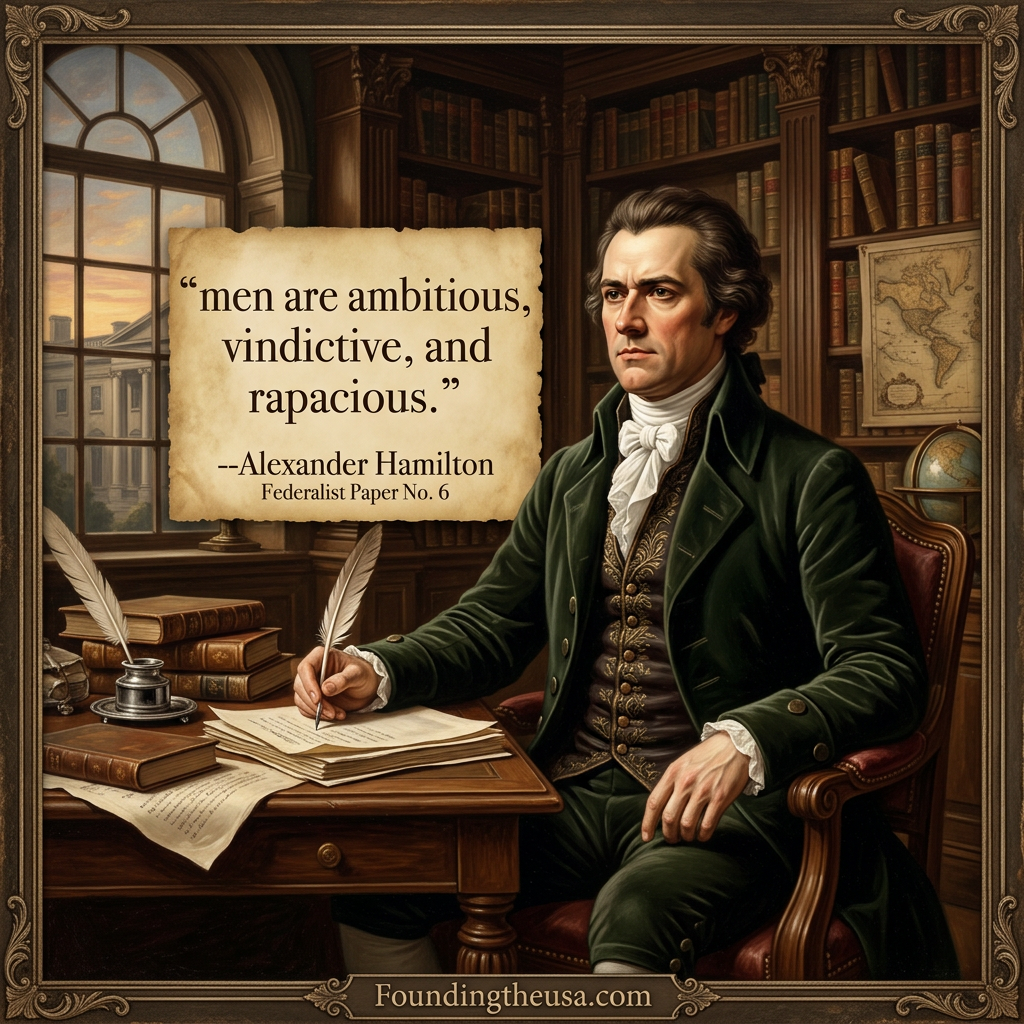
“men are ambitious, vindictive, and rapacious.”
This is one of the strongest lines in the essay. Hamilton crushes the idea that states or nations will avoid conflict just because people know better. His answer is brutally simple: no, they won’t, because people are still people.
4. History says otherwise
“To look for a continuation of harmony between a number of independent, unconnected sovereignties situated in the same neighborhood, would be to disregard the uniform course of human events”
This is one of the core arguments of the paper. Hamilton says history gives us no reason to expect long-term peace among neighboring powers that are politically separate. Disunion would not be a clever new experiment. It would be a repeat of an old human pattern.
5. The causes of hostility are endless
“The causes of hostility among nations are innumerable.”
That line hits the center of Hamilton’s realism. He is saying conflict does not require some rare, dramatic cause. Nations quarrel for all kinds of reasons, large and small, noble and petty.
6. Power, jealousy, and commerce
“the love of power or the desire of pre-eminence and dominion—the jealousy of power, or the desire of equality and safety.”
Hamilton here lays out some of the permanent motives of conflict. Some nations want superiority. Others fear superiority in their neighbors. Either way, conflict grows easily.
7. Private passions can start public wars
“take their origin entirely in private passions”
This is one of Hamilton’s nastier observations. Wars do not always begin from national necessity. Sometimes they begin because leaders are vain, angry, ambitious, frightened, or personally invested in some grievance.
8. The passions of leaders matter
“have not scrupled to sacrifice the national tranquillity to personal advantage or personal gratification.”
Hamilton is warning that political leaders can drag whole nations into conflict for selfish reasons. That is one of the reasons he distrusts easy assumptions about peace between separated states.
9. Commerce does not save anybody
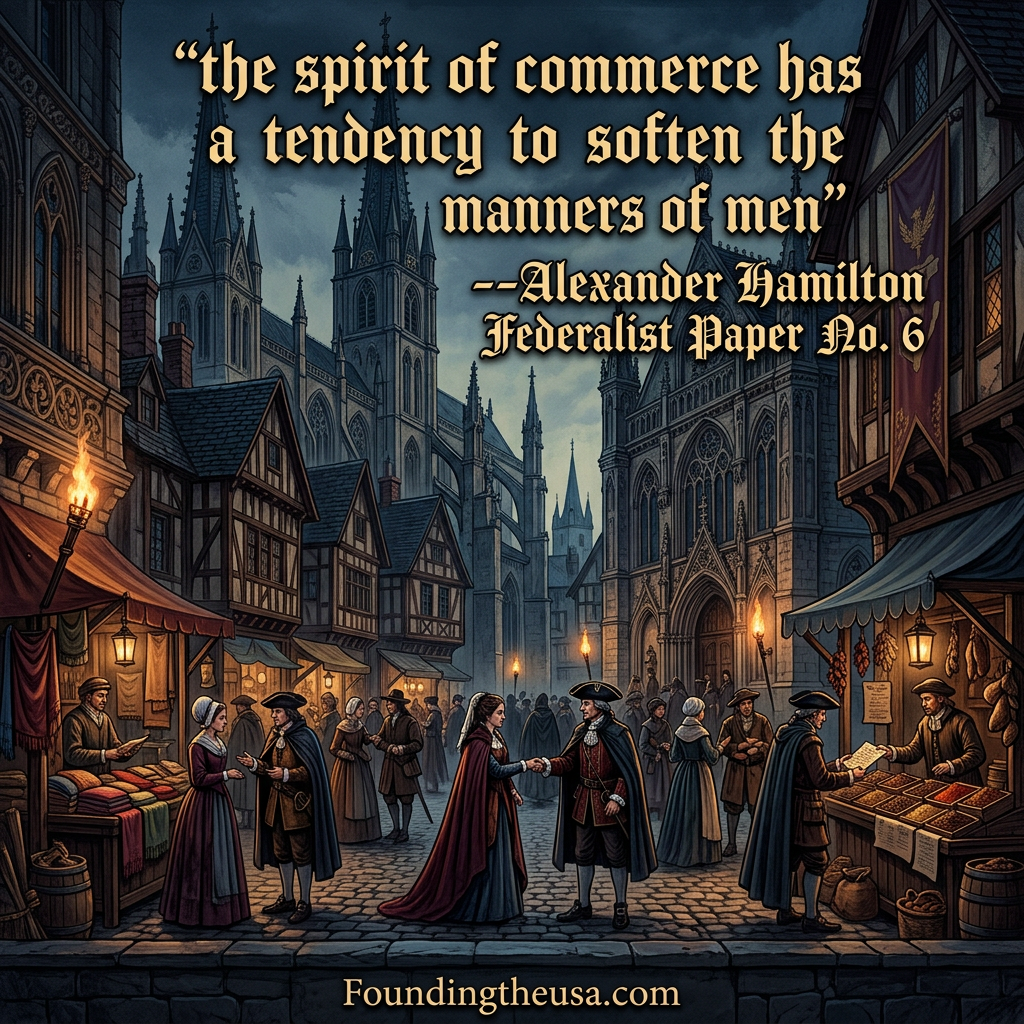
“the spirit of commerce has a tendency to soften the manners of men”
Hamilton is quoting an argument he rejects. He knows some people think commercial republics will be too practical to fight. He is setting that claim up so he can knock it flat.
10. Immediate interests beat long-term wisdom
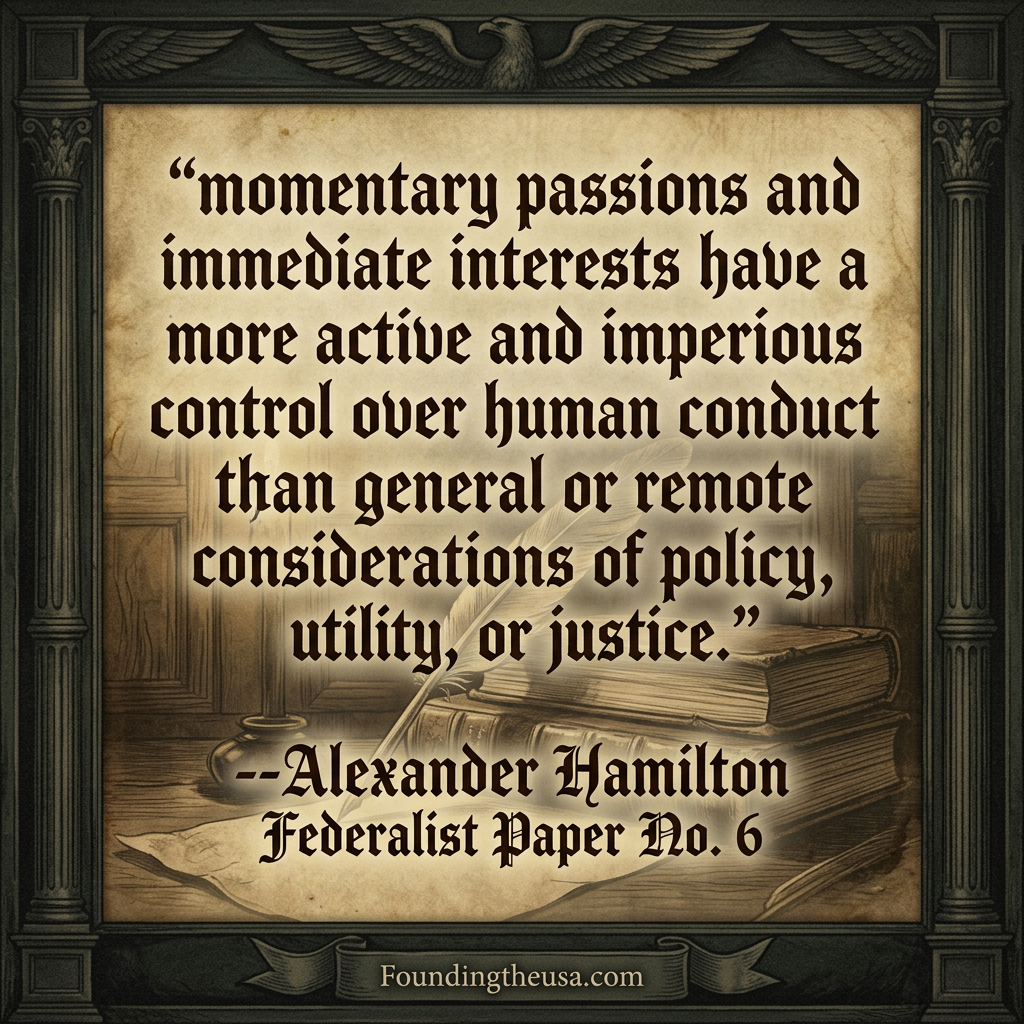
“momentary passions and immediate interests have a more active and imperious control over human conduct than general or remote considerations of policy, utility, or justice.”
That is one of the strongest lines in the whole essay. It explains not only Hamilton’s argument about war, but a lot of politics in general. People often choose what feels urgent and advantageous now over what is wiser in the long run.
11. Republics are not magically peaceful
“Have republics in practice been less addicted to war than monarchies?”
This is one of the central questions of Federalist No. 6. Hamilton is attacking the myth that republics are naturally gentler than monarchies. His answer is clearly no.
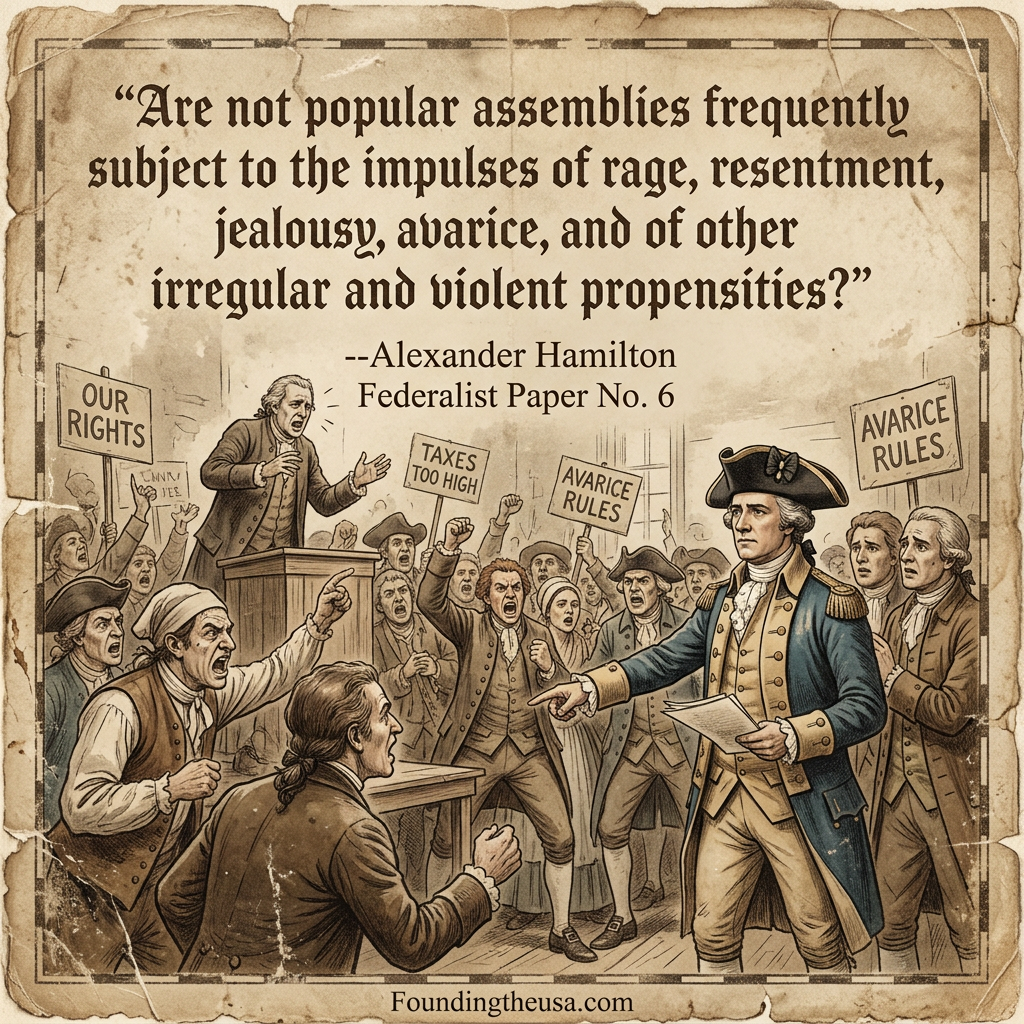
12. Popular assemblies are still human
“Are not popular assemblies frequently subject to the impulses of rage, resentment, jealousy, avarice, and of other irregular and violent propensities?”
Hamilton is saying democracy does not erase dangerous passions. Popular bodies can be just as emotional, irrational, and destructive as kings.
13. Commerce changes the object, not the appetite
“Has commerce hitherto done anything more than change the objects of war?”
This is one of the smartest lines in the essay. Hamilton is saying commerce does not abolish conflict. It just gives nations new reasons to fight.
14. Wealth is as dangerous as glory
“Is not the love of wealth as domineering and enterprising a passion as that of power or glory?”
That is a very strong Hamilton line. He is arguing that greed is no more peaceful than ambition. Commercial societies are not safe just because they are commercial.
15. Wars of trade are still wars
“The wars of these two last-mentioned nations have in a great measure grown out of commercial considerations”
This is Hamilton pressing the point that trade competition itself can become a source of conflict. Commerce is not some magic peace potion. It can be fuel.
16. The fallacy of peaceful separation
“those idle theories which have amused us with promises of an exemption from the imperfections, weaknesses, and evils incident to society in every shape”
That is a very Hamilton ending. He is mocking the fantasy that political separation could somehow free Americans from the ordinary flaws of human society. In his view, disunion would not transcend those flaws. It would magnify them.
17. War strengthens the executive
“It is of the nature of war to increase the executive at the expense of the legislative authority.”
This is one of the most important lines in the essay, and one of the most lasting. Hamilton is pointing out that war tends to shift power toward executive authority. That observation reaches far beyond the ratification debate.
Why Federalist No. 6 Works for Highlights
Federalist No. 6 works very well as a highlights page because it is full of hard, quotable lines about human nature, ambition, commerce, and political conflict. It is less about constitutional mechanics and more about Hamilton’s underlying realism. He is warning readers not to build political hopes on fairy tales about peace, virtue, or commercial gentleness.
This paper also feels strikingly modern. Strip away the eighteenth-century language and Hamilton is saying something very familiar: do not assume institutions become peaceful just because they use nicer words about themselves.
Related Links
- Federalist No. 6 Full Text
- Federalist Papers
- Alexander Hamilton
- Federalist No. 5
- Articles of Confederation
- United States Constitution