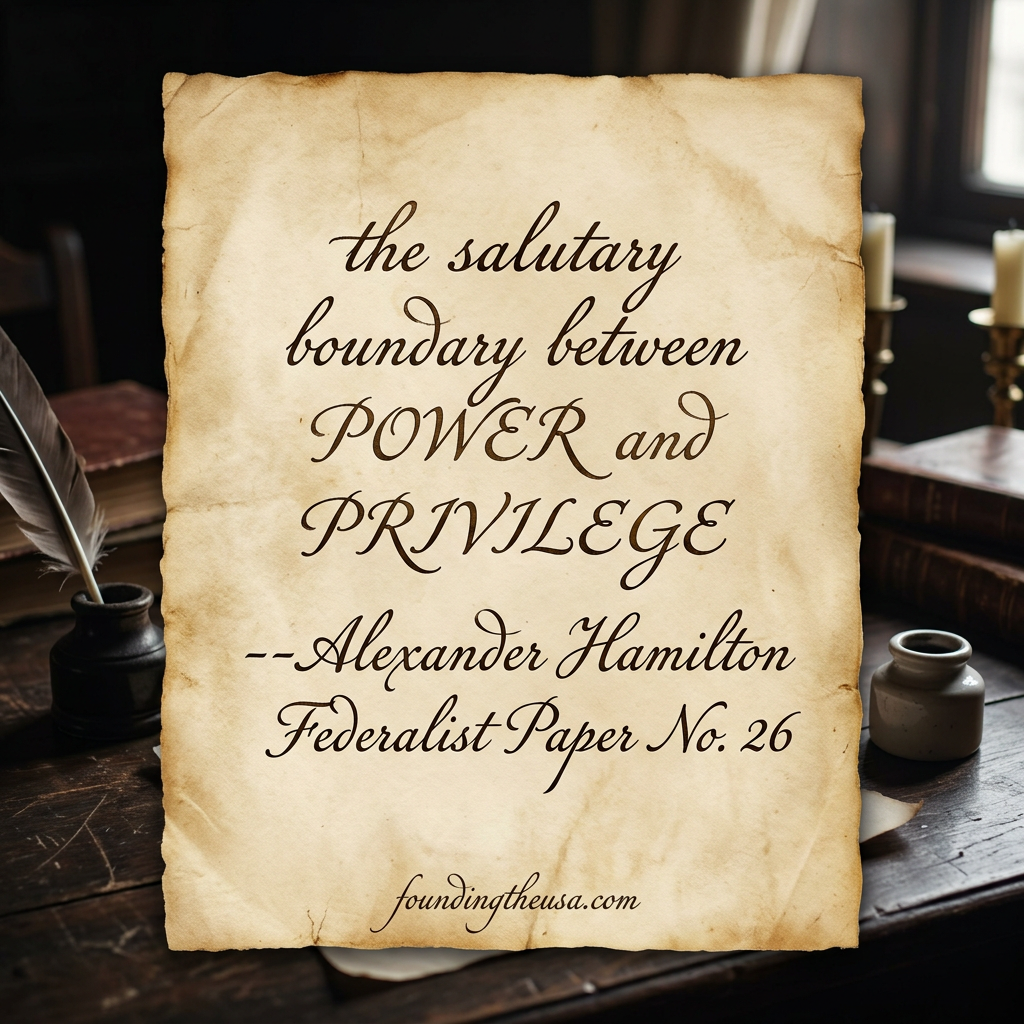
Federalist No. 26 was written by Alexander Hamilton under the name Publius. In this essay, Hamilton continues answering fears about standing armies by arguing that the real safeguard of liberty is not a rigid constitutional ban on peacetime military establishments, but legislative control, regular elections, public scrutiny, and the people’s ability to react before danger matures.
This paper matters because Hamilton shifts the argument a bit. In Federalist No. 24 and No. 25, he argued that some peacetime military precautions may be necessary. Here he asks the next question: how do free people keep those powers from becoming dangerous? His answer is that Congress controls the army purse, appropriations expire after two years, elections keep lawmakers dependent on the people, state governments remain watchful, and large conspiracies take time to grow. In plain English: liberty has alarm bells.
1. Free government requires a balance between power and rights
“the salutary boundary between POWER and PRIVILEGE”
“combines the energy of government with the security of private rights.”
Hamilton starts with a big principle. A healthy constitution does not destroy power, and it does not destroy liberty. It tries to hold both together without tumbling into either weakness or oppression.
2. Some liberty slogans are more hot than wise
“a zeal for liberty more ardent than enlightened.”
That is one of the best lines in the paper. Hamilton is saying some constitutional ideas sound freedom-loving but are actually based on overheated judgment rather than sober thinking.
3. Confidence has to be placed somewhere
“confidence must be placed somewhere”
“it is better to hazard the abuse of that confidence than to embarrass the government and endanger the public safety”
This is classic Hamilton realism. He says no political system can work if the people refuse to trust any institution with real authority.
4. America is not likely to be talked into anarchy
“The citizens of America have too much discernment to be argued into anarchy.”
Strong line. Hamilton is saying the public is not so foolish that it will permanently embrace doctrines that make effective government impossible.
5. The English lesson was about restraining the executive, not crippling Parliament
“UNLESS WITH THE CONSENT OF PARLIAMENT”
“The patriots… were too temperate, too well-informed, to think of any restraint on the legislative discretion.”
This is one of the most important arguments in the paper. Hamilton points to England after 1688 and says the real historical safeguard was keeping military power from the crown alone, not forbidding Parliament from acting for defense.
6. The English understood that some peacetime forces are unavoidable
“guards and garrisons were indispensable”
“no precise bounds could be set to the national exigencies”
Hamilton says the wiser statesmen understood reality. A country may need troops in peace, and national emergencies cannot be reduced to a neat little list in advance.
7. Some American states copied the fear but misapplied the lesson
“The principles which had taught us to be jealous of the power of an hereditary monarch were by an injudicious excess extended to the representatives of the people in their popular assemblies.”
That is a sharp critique. Hamilton says Americans took a fear that made sense against kings and stretched it too far against elected legislatures.
8. “Ought not” is not the same as “shall not”
“It is not said, that standing armies SHALL NOT BE kept up, but that they OUGHT NOT to be kept up”
Excellent constitutional point. Hamilton notices that even the states most suspicious of standing armies often stopped short of an absolute prohibition.
9. That ambiguity reveals a deeper truth
“the result of a conflict between jealousy and conviction”
“that an absolute exclusion would be unwise and unsafe.”
Hamilton says the vague wording gives the game away. Even the people writing these anti-army provisions knew that a total ban would be foolish.
10. Provisions that aim too high often do nothing
“The former, by aiming at too much, is calculated to effect nothing”
“the latter… will have a salutary and powerful operation.”
This is one of the central contrasts in the paper. Hamilton says a sweeping anti-army declaration is mostly theater, while the Constitution’s two-year appropriations rule is an actual working restraint.
11. The two-year appropriations rule forces repeated accountability
“once at least in every two years, to deliberate upon the propriety of keeping a military force on foot”
“by a formal vote in the face of their constituents.”
That is one of the strongest passages in the essay. Hamilton says the Constitution forces Congress to keep coming back to the question in public, not just once and forever.
12. Congress cannot legally hand the executive a permanent army fund
“They are not AT LIBERTY to vest in the executive department permanent funds for the support of an army”
Very important line. Hamilton argues that this is a real barrier against executive military independence.
13. Opposition politics can help protect liberty
“The provision for the support of a military force will always be a favorable topic for declamation.”
Hamilton is basically saying political opposition is not always a bug. On this issue, party conflict can help expose danger and stir public attention.
14. Public attention will be repeatedly awakened
“the public attention will be roused and attracted to the subject”
“the community will be warned of the danger”
This is part of Hamilton’s safeguard argument. Because army appropriations must recur, so does the public debate. That gives the people more than one chance to react.
15. The state governments would sound the alarm too
“the State legislatures… will always be not only vigilant but suspicious and jealous guardians”
“ready enough… to sound the alarm to the people”
Hamilton is reminding readers that the states do not vanish under the Constitution. They remain political watchdogs with every incentive to bark loudly if the federal government overreaches.
16. And if needed, the states could become more than a voice
“not only to be the VOICE, but, if necessary, the ARM of their discontent.”
That is one of the most memorable lines in the paper. Hamilton is saying resistance would not begin at the last possible second. Political and institutional counterforces would exist well before full tyranny arrived.
17. Tyranny on a national scale takes time
“Schemes to subvert the liberties of a great community REQUIRE TIME to mature them for execution.”
This is a major structural point. Hamilton argues that large-scale military despotism cannot usually appear overnight. It would require gradual expansion, repeated votes, and a long-running conspiracy.
18. Such a conspiracy would have to survive multiple elections
“a continued conspiracy for a series of time.”
“biennial elections would naturally produce changes in the legislature.”
Hamilton thinks this makes the danger less likely. A plot would have to survive not just one bad set of rulers, but repeated turnover in representative bodies.
19. If you really assume every representative is a traitor, self-government is impossible
“there ought at once to be an end of all delegated authority.”
This is one of Hamilton’s strongest logical punches. If the public cannot trust elected representatives with anything, then constitutional government itself becomes impossible.
20. Massive peacetime expansion would expose the plot
“It would be announced, by the very circumstance of augmenting the army to so great an extent in time of profound peace.”
Hamilton says a genuinely dangerous army buildup would not stay secret for long. The buildup itself would be the warning.
21. If extreme danger truly requires a huge force, no parchment rule can save liberty anyway
“this is one of those calamities for which there is neither preventative nor cure.”
“It cannot be provided against by any possible form of government”
This is one of Hamilton’s more hard-nosed points. If a crisis becomes so severe that the nation needs an army large enough to threaten liberty, that danger comes from circumstances bigger than constitutional drafting tricks.
22. Disunion would make military danger worse, not better
“it is an evil infinitely less likely to attend us in a united than in a disunited state”
Hamilton flips the fear again. He argues that a stronger Union actually reduces the likelihood of the very military dangers critics are worried about.
Why Federalist No. 26 Works for Highlights
Federalist No. 26 works especially well as a highlights page because the paper has a clean argument: liberty is protected less by grandiose anti-army slogans than by repeated accountability, elections, divided institutions, public alarm, and the practical difficulty of organizing large-scale tyranny in secret.
It also works nicely as a third step after Federalist Nos. 24 and 25. Those papers defended the necessity of military discretion in some circumstances. This one explains why that discretion does not automatically destroy freedom.
Related Links
- Federalist No. 26 Full Text
- Federalist Papers
- Alexander Hamilton
- Federalist No. 25
- Articles of Confederation
- United States Constitution