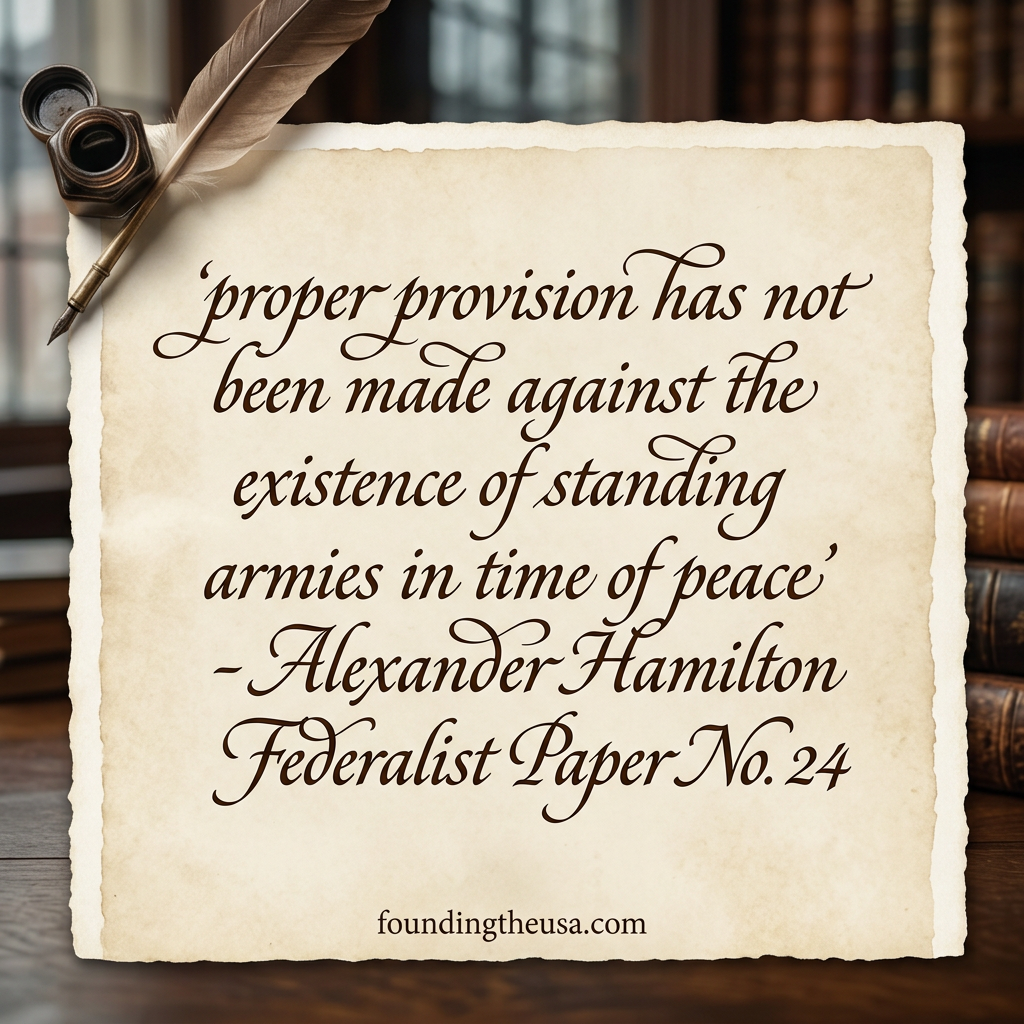
Federalist No. 24 was written by Alexander Hamilton under the name Publius. In this essay, Hamilton answers a major objection to the proposed Constitution: the fear that it does not do enough to prevent standing armies in time of peace. His answer is that this criticism is overheated and badly aimed, because the Constitution places the army power in the legislature, not the executive, and adds a real safeguard by limiting army appropriations to two years at a time.
This paper matters because Hamilton is trying to pull the debate out of melodrama and back into reality. He argues that the Constitution does not order peacetime armies into existence, but it also does not foolishly forbid small garrisons, frontier defenses, and military precautions that real national safety may require.
1. The objection is weak from the start
“proper provision has not been made against the existence of standing armies in time of peace”
“rests on weak and unsubstantial foundations.”
Hamilton opens by saying the objection sounds dramatic but is poorly grounded. He thinks the criticism is much louder than it is solid.
2. The Constitution gives the army power to Congress, not a president acting alone
“the whole power of raising armies was lodged in the LEGISLATURE, not in the EXECUTIVE”
This is one of the key lines in the paper. Hamilton says the public rhetoric makes it sound as if the Constitution created a military-minded executive, but the actual text gives the crucial power to the elected legislature.
3. The two-year appropriations rule is a real safeguard
“forbids the appropriation of money for the support of an army for any longer period than two years”
“a great and real security against the keeping up of troops without evident necessity.”
That is one of the strongest points in the essay. Hamilton says the Constitution does not leave the matter open-ended forever. It forces repeated legislative renewal.
4. The public outcry exaggerates what the Constitution actually says
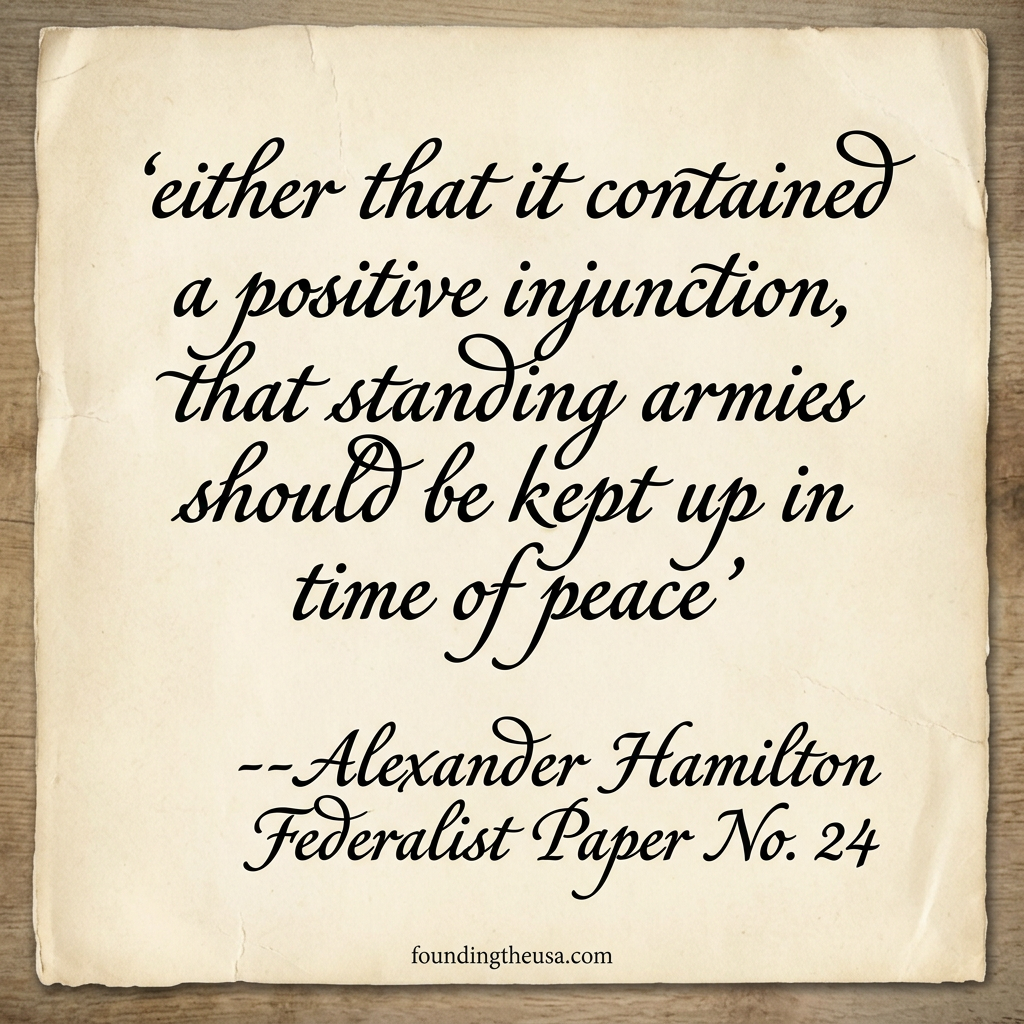
“either that it contained a positive injunction, that standing armies should be kept up in time of peace”
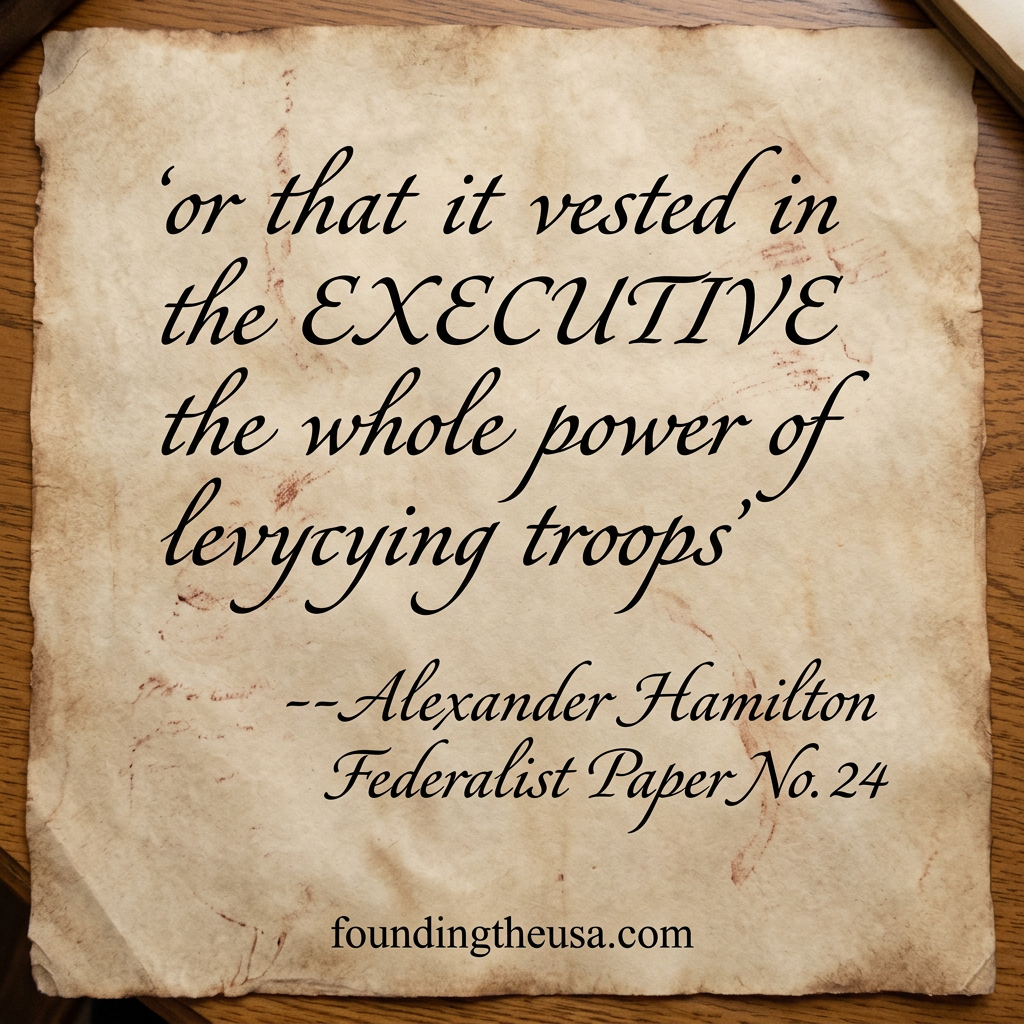
“or that it vested in the EXECUTIVE the whole power of levying troops”
Hamilton mocks the tone of the opposition a bit here. He says someone listening only to the panic would think the Constitution openly commanded peacetime armies or handed military power straight to the executive, when it did neither.
5. Most state constitutions did not ban standing armies either
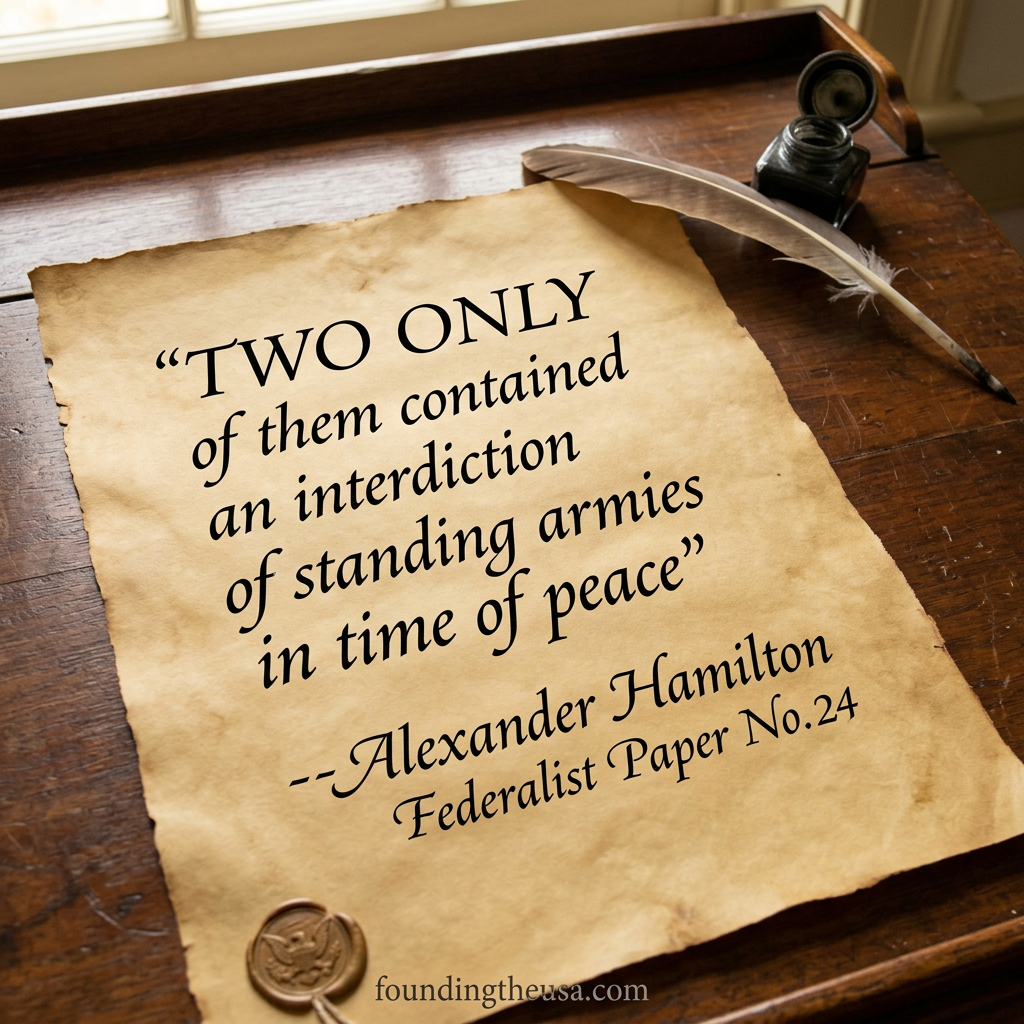
“TWO ONLY of them contained an interdiction of standing armies in time of peace”
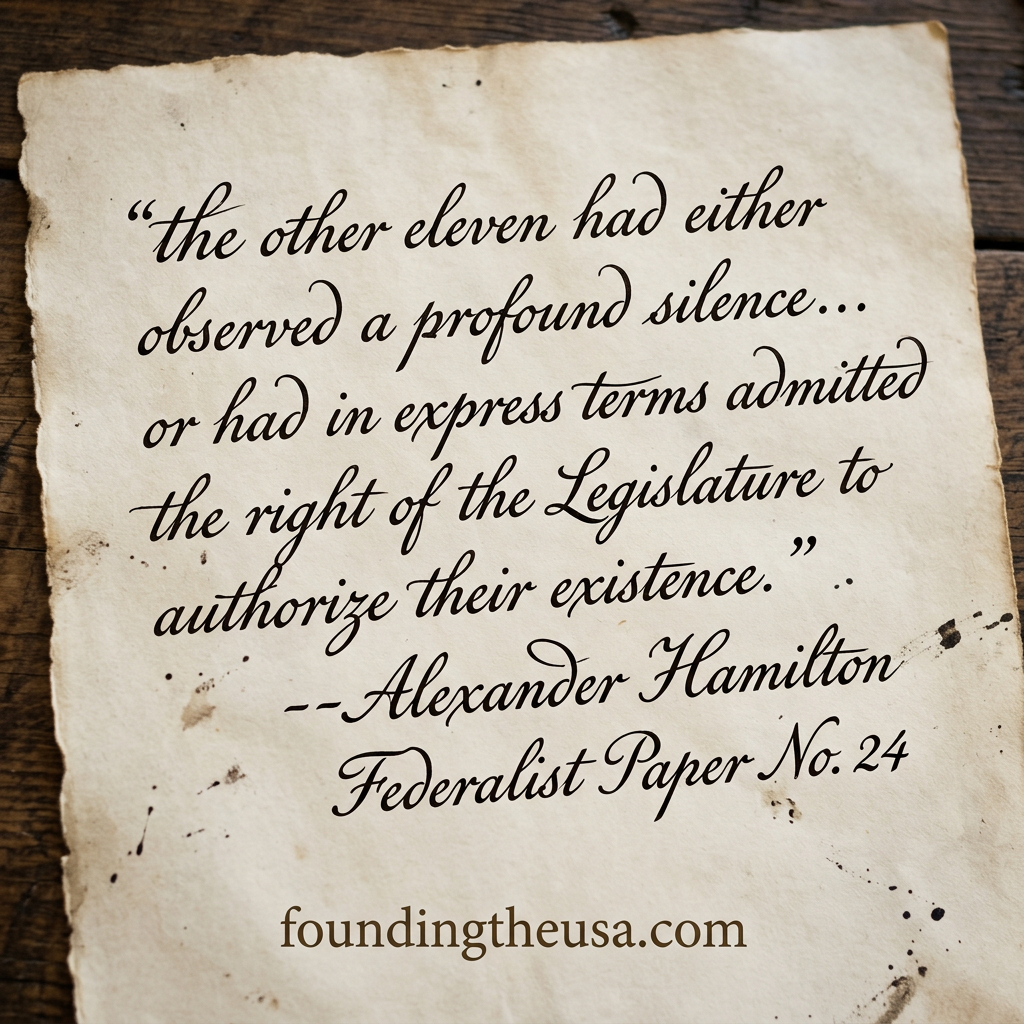
“the other eleven had either observed a profound silence… or had in express terms admitted the right of the Legislature to authorize their existence.”
This is a very Hamilton move: drag the receipts onto the table. He argues that the Constitution was not some shocking outlier, because most state constitutions did not impose the rigid ban critics now pretend was standard.
6. Even the Articles of Confederation did not impose this restraint on Congress
“had not imposed a single restraint on that of the United States.”
That line matters because Hamilton is calling out a double standard. Critics were attacking the Constitution for lacking a restriction that the Articles themselves had not imposed on the national authority.
7. Some of the clamor is just political theater
“an experiment upon the public credulity”
“an intention to mislead the people by alarming their passions”
Hamilton is not being shy here. He says at least some of the anti-Constitution rhetoric on this point looks less like honest argument and more like an attempt to scare people.
8. Absolute constitutional bans are bad policy because real dangers are unpredictable
“restraints upon the discretion of the legislature in respect to military establishments in time of peace, would be improper to be imposed”
“from the necessities of society, would be unlikely to be observed.”
This is one of the deeper points in the paper. Hamilton says rigid constitutional bans can be dangerous because circumstances change, threats arise, and governments may end up breaking the rules in emergencies anyway.
9. America is not safely outside the reach of danger
“These circumstances combined, admonish us not to be too sanguine in considering ourselves as entirely out of the reach of danger.”
Hamilton warns against lazy optimism. Britain and Spain still held nearby territories, western threats were real, and oceans did not make the United States invulnerable.
10. Frontier garrisons are a practical necessity
“there has been a constant necessity for keeping small garrisons on our Western frontier.”
“these will continue to be indispensable”
That is one of the most practical passages in the essay. Hamilton says a blanket peacetime prohibition makes no sense when actual frontier defense requires actual men in actual forts.
11. Using rotating militia instead would be worse
“The first is impracticable; and if practicable, would be pernicious.”
“The militia would not long, if at all, submit to be dragged from their occupations and families”
Hamilton argues that replacing small permanent garrisons with constantly rotating militia detachments would be costly, disruptive, and miserable for ordinary citizens.
12. A small peacetime force is still a standing army, but that does not make it irrational
“amounts to a standing army in time of peace; a small one, indeed, but not the less real for being small.”
This is a good Hamilton line because he does not dodge the label. He says yes, small permanent corps are still standing armies in one sense — and that is exactly why a total constitutional ban would be foolish.
13. Prudence requires guarding key posts
“particular posts… will include the command of large districts of territory”
“To act this part would be to desert all the usual maxims of prudence and policy.”
Hamilton says it would be reckless to leave strategically important frontier positions exposed just because someone wants a clean-sounding constitutional slogan.
14. A commercial nation also needs naval infrastructure and protection
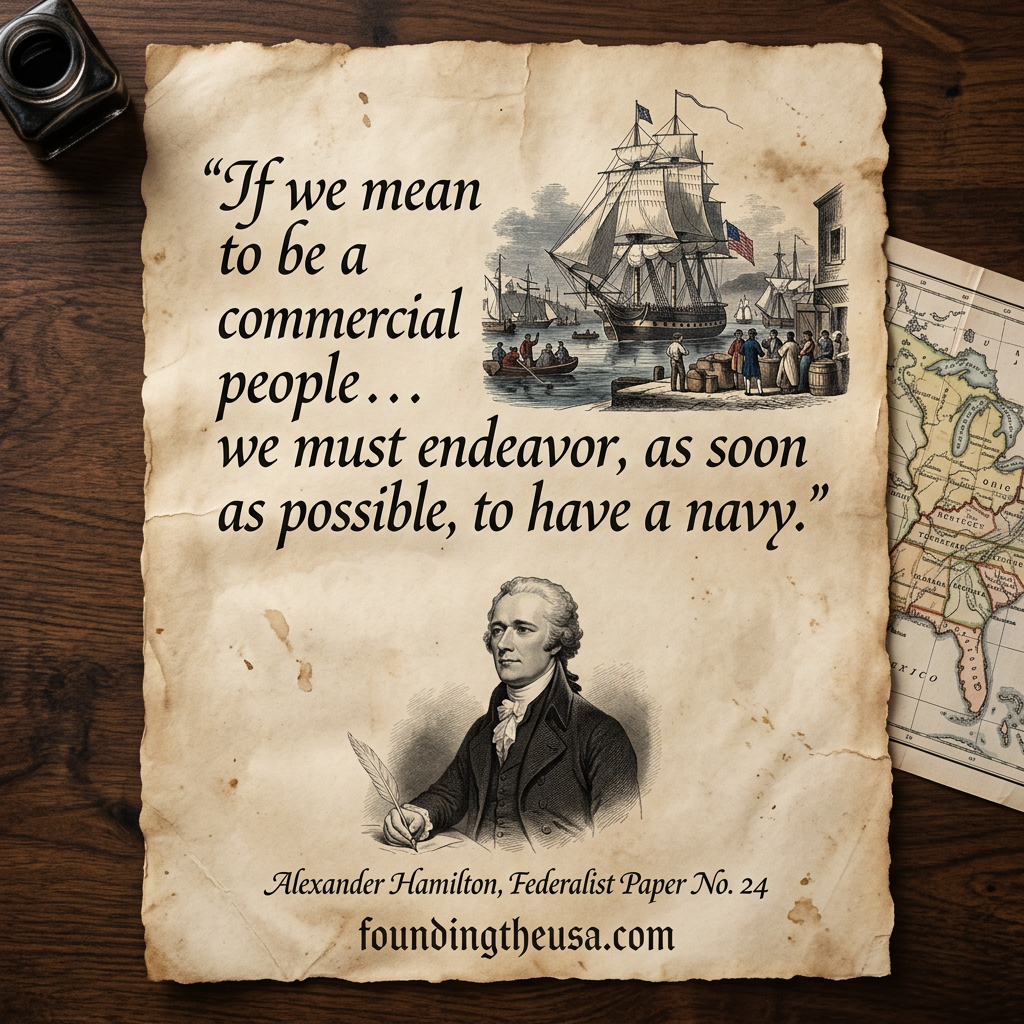
“If we mean to be a commercial people… we must endeavor, as soon as possible, to have a navy.”
“there must be dock-yards and arsenals; and for the defense of these, fortifications, and probably garrisons.”
This expands the argument beyond the frontier. Hamilton says national defense is not just about land armies. A serious commercial country will need naval installations, and those also need protection.
15. Until naval power matures, moderate garrisons remain necessary
“moderate garrisons will, in all likelihood, be found an indispensable security”
That is Hamilton’s bottom line. He is not asking for permanent militarization as a principle. He is arguing for legislative flexibility to meet obvious and recurring security needs.
Why Federalist No. 24 Works for Highlights
Federalist No. 24 works well as a highlights page because it has one strong, coherent theme: fear of standing armies should not be allowed to harden into an irrational ban on every peacetime military precaution. Hamilton keeps the paper grounded in concrete things — legislatures, appropriations, garrisons, frontier posts, dockyards, and arsenals — which makes it easier to follow than some of the more abstract constitutional essays.
It is also a good example of Hamilton trying to be both hard-headed and politically sharp. He accuses some critics of theatrical scare tactics, but he also offers a real institutional safeguard: legislative control and biennial appropriations.
Related Links
- Federalist No. 24 Full Text
- Federalist Papers
- Alexander Hamilton
- Federalist No. 23
- Articles of Confederation
- United States Constitution