






Federalist No. 23 was written by Alexander Hamilton under the name Publius. In this essay, Hamilton shifts from hammering the defects of the Articles of Confederation to making the positive case for an energetic federal government. His central argument is simple and powerful: if the Union is responsible for common defense, public peace, commerce, and foreign relations, then it must also have the means necessary to perform those duties.
This paper matters because it contains one of the clearest Federalist formulas in the entire series: the means ought to be proportioned to the end. Hamilton is not arguing for vague unlimited power because he likes big government. He is arguing that assigning great national responsibilities to a government while denying it the powers needed to carry them out is foolish and dangerous.
1. The Union has major national purposes
“The principal purposes to be answered by union are these the common defense of the members; the preservation of the public peace… the regulation of commerce… the superintendence of our intercourse… with foreign countries.”
Hamilton starts by naming the big jobs of the Union. This matters because the rest of the paper is built on the idea that serious responsibilities require serious power.
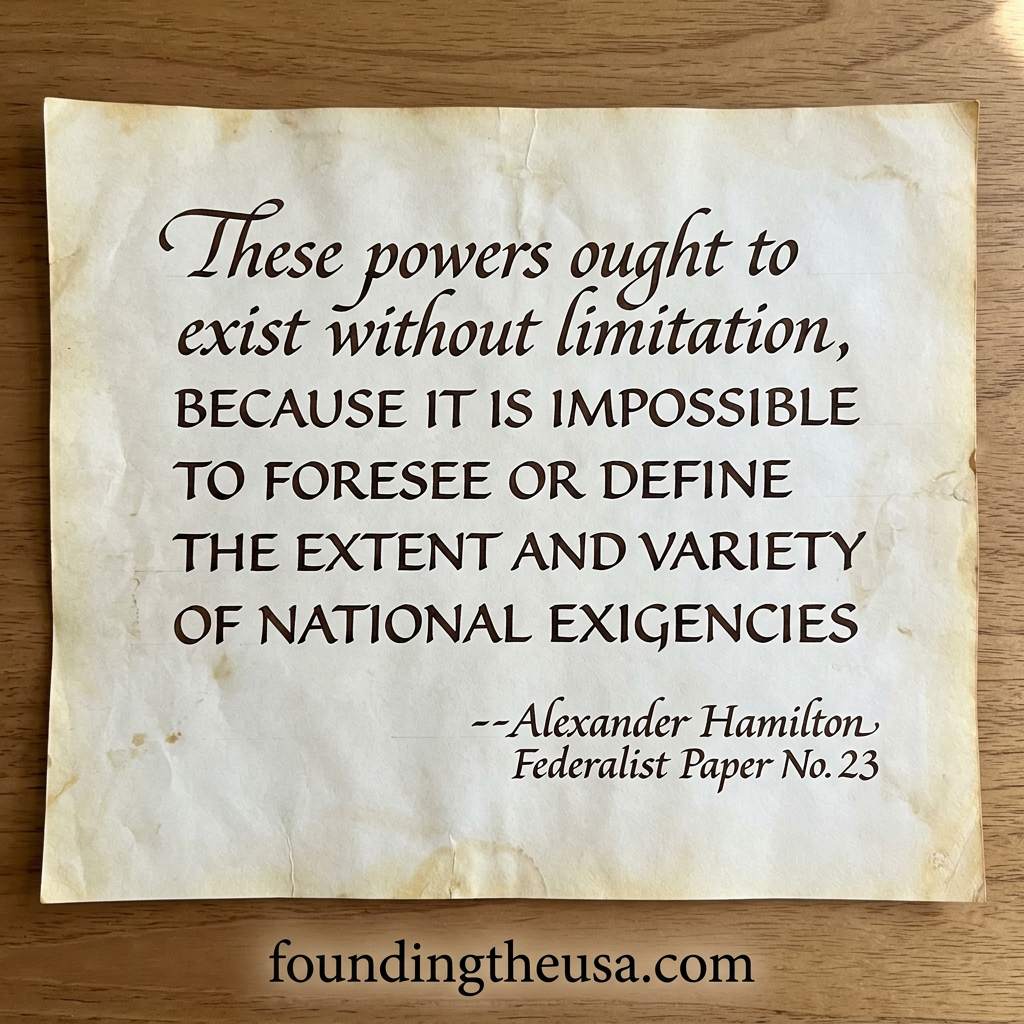
2. National defense requires broad and adaptable powers
“These powers ought to exist without limitation, BECAUSE IT IS IMPOSSIBLE TO FORESEE OR DEFINE THE EXTENT AND VARIETY OF NATIONAL EXIGENCIES”
That is one of the most important lines in the paper. Hamilton says no constitution can list every danger the nation may face. Since threats are unpredictable, the power to meet them cannot be crippled in advance by artificial limits.
3. The dangers facing nations are infinite
“The circumstances that endanger the safety of nations are infinite”
Short, direct, and powerful. Hamilton is arguing that the real world does not stay inside neat constitutional boxes drawn by wishful thinking.
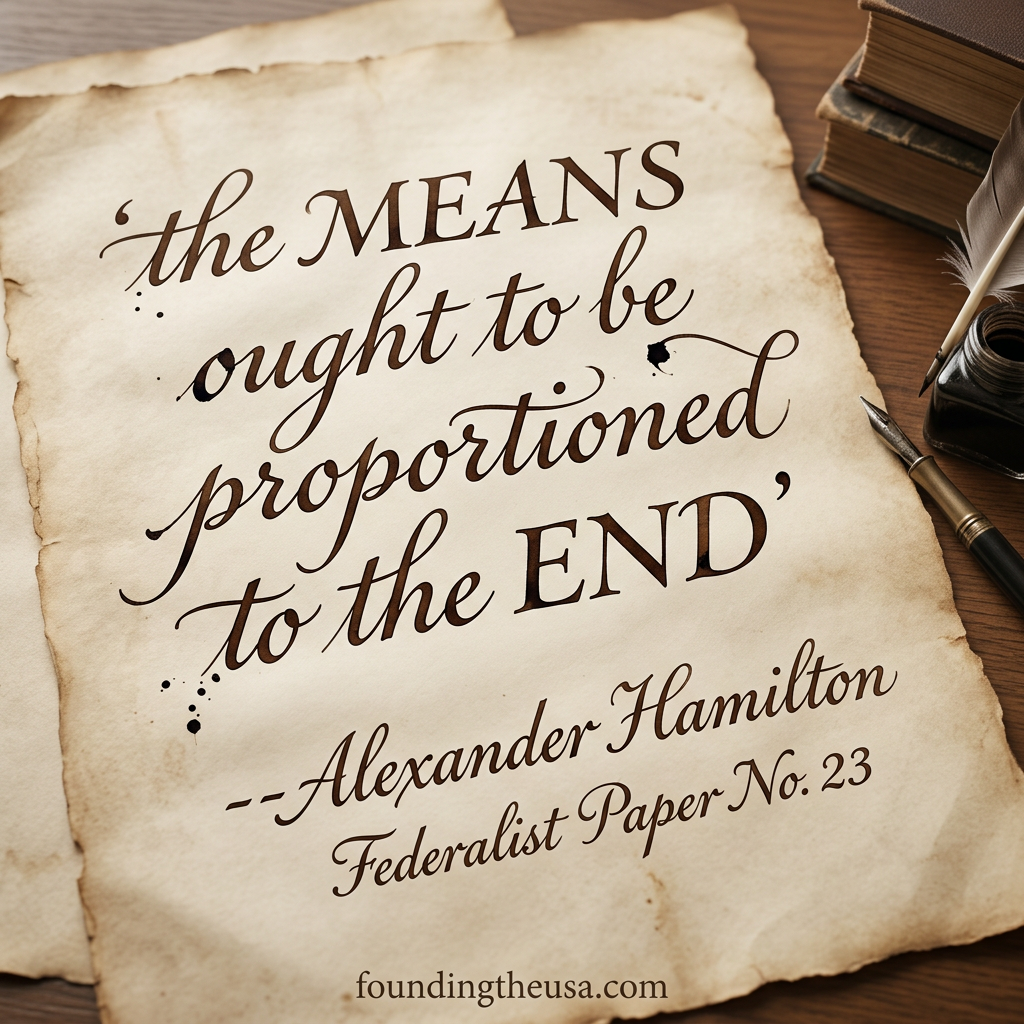
4. The means ought to be proportioned to the end
“the MEANS ought to be proportioned to the END”
This is probably the headline line from Federalist No. 23. It is one of the most famous Hamilton formulations in the whole Federalist run. If you assign a government a duty, you must also give it the power to fulfill that duty.
5. Those charged with the end must possess the means
“the persons, from whose agency the attainment of any END is expected, ought to possess the MEANS by which it is to be attained.”
This is the companion line to the one above, and it strengthens the same point. Hamilton is saying responsibility without adequate power is not prudence. It is sabotage with a powdered wig.
6. Once you admit the need for a federal government, you admit the need for adequate powers
“the moment it is decided in the affirmative, it will follow, that that government ought to be clothed with all the powers requisite to complete execution of its trust.”
Hamilton pushes the logic hard here. If you agree that a federal government should handle national defense and national interests, then you cannot sensibly deny it the powers necessary to do so.
7. There can be no effective limit on powers essential to defense
“there can be no limitation of that authority which is to provide for the defense and protection of the community”
“essential to the FORMATION, DIRECTION, or SUPPORT of the NATIONAL FORCES.”
This is one of the strongest passages in the essay. Hamilton is not saying every federal power should be vague and boundless. He is saying that in matters essential to national defense, crippling restrictions are reckless.
8. The old system proved the opposite theory false
“The experiment has, however, demonstrated that this expectation was ill-founded and illusory”
Hamilton says the Articles already tested the idea that the states would faithfully supply men and money when asked. That experiment failed. Badly.
9. The Union must stop legislating for states as states
“we must abandon the vain project of legislating upon the States in their collective capacities”
“we must extend the laws of the federal government to the individual citizens of America”
This is a major carryover from the earlier papers. Hamilton reminds readers that a real government must act on persons, not merely send requests to state governments and hope for the best.
10. Quotas and requisitions had to go
“we must discard the fallacious scheme of quotas and requisitions, as equally impracticable and unjust.”
A blunt line, and deservedly so. Hamilton says the requisition system was both unworkable and unfair. It had already failed in practice and had no future worth saving.
11. The Union must be able to raise troops, fleets, and revenue directly
“the Union ought to be invested with full power to levy troops; to build and equip fleets; and to raise the revenues”
This is Hamilton’s practical conclusion. National defense cannot rest on begging the states for support. The federal government must be able to act.
12. Powers should be divided by objects, but each object needs enough power
“to discriminate the OBJECTS… which shall appertain to the different provinces or departments of power; allowing to each the most ample authority for fulfilling the objects committed to its charge.”
This is an important nuance. Hamilton is not arguing that the federal government should handle everything. He is arguing that whatever level of government gets a duty must receive enough authority to perform it properly.
13. To deny adequate power is to trust national interests to disabled hands
“Not to confer in each case a degree of power commensurate to the end”
“would be… to trust the great interests of the nation to hands which are disabled from managing them with vigor and success.”
That is classic Hamilton. Strong, practical, and a little savage. He is saying half-powered government is not modest. It is irresponsible.
14. The national government is the proper guardian of national safety
“as the centre of information, will best understand the extent and urgency of the dangers that threaten”
“as the representative of the WHOLE, will feel itself most deeply interested in the preservation of every part”
Hamilton argues that the Union is the body best positioned to understand national threats and plan national defense because it sees the whole picture, not just local slices of it.
15. It is inconsistent to give responsibility without effective power
“Is there not a manifest inconsistency in devolving upon the federal government the care of the general defense, and leaving in the State governments the EFFECTIVE powers by which it is to be provided for?”
This is one of the strongest rhetorical questions in the essay. Hamilton says you cannot sensibly assign the Union responsibility for safety while leaving the real power elsewhere.
16. The result of divided defense power is weakness and disorder
“weakness, disorder, an undue distribution of the burdens and calamities of war, an unnecessary and intolerable increase of expense”
That is Hamilton’s summary of what happens when defense is left to fragmented and uncoordinated state action. The Revolution had already shown him enough.
17. The people must watch the structure, not panic over the existence of power itself
“It will indeed deserve the most vigilant and careful attention of the people, to see that it be modeled in such a manner as to admit of its being safely vested with the requisite powers.”
This is a useful balance point. Hamilton is not saying, “Trust everything blindly.” He is saying the real question is whether the government is structured safely enough to be trusted with necessary powers.
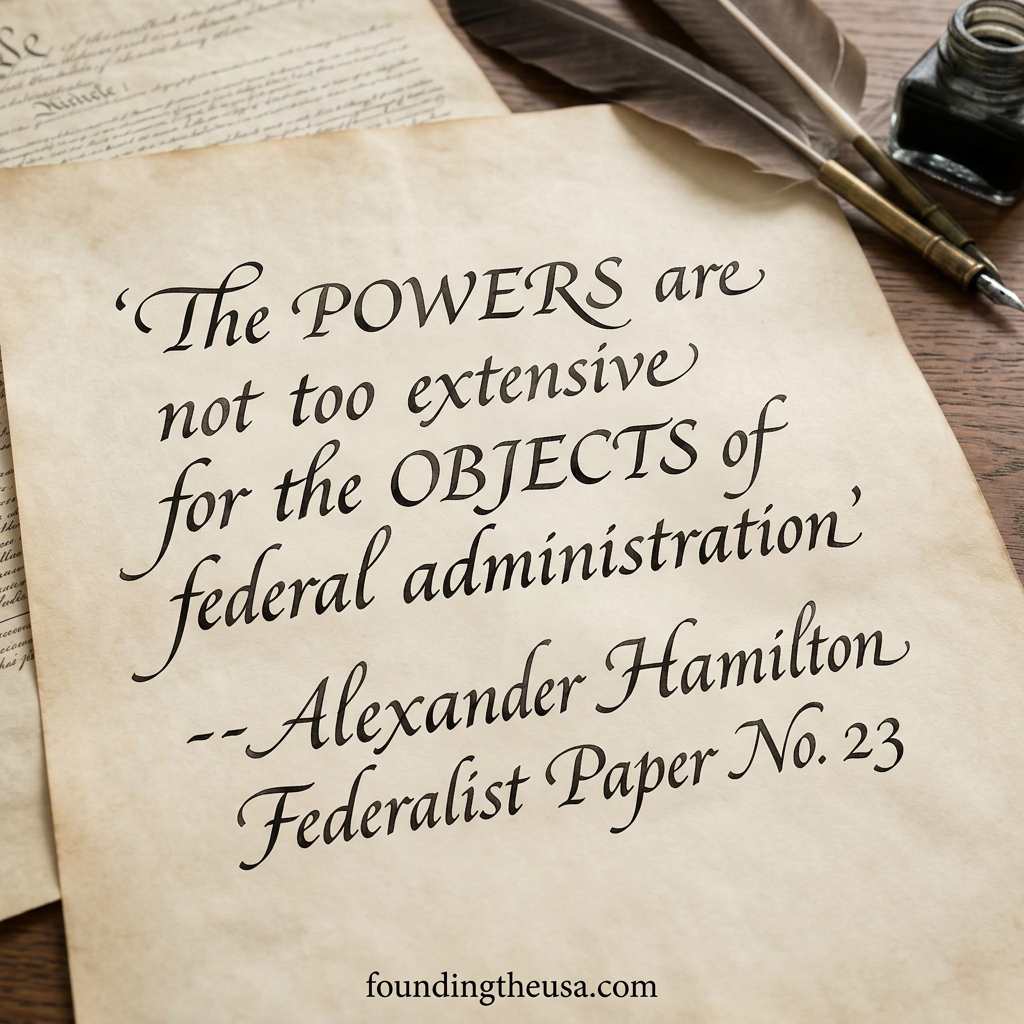
18. Powers are not too extensive for national objects
“The POWERS are not too extensive for the OBJECTS of federal administration”
That is one of the clearest thesis lines in the paper. Hamilton says the powers proposed are appropriate to the national responsibilities assigned to the Union.
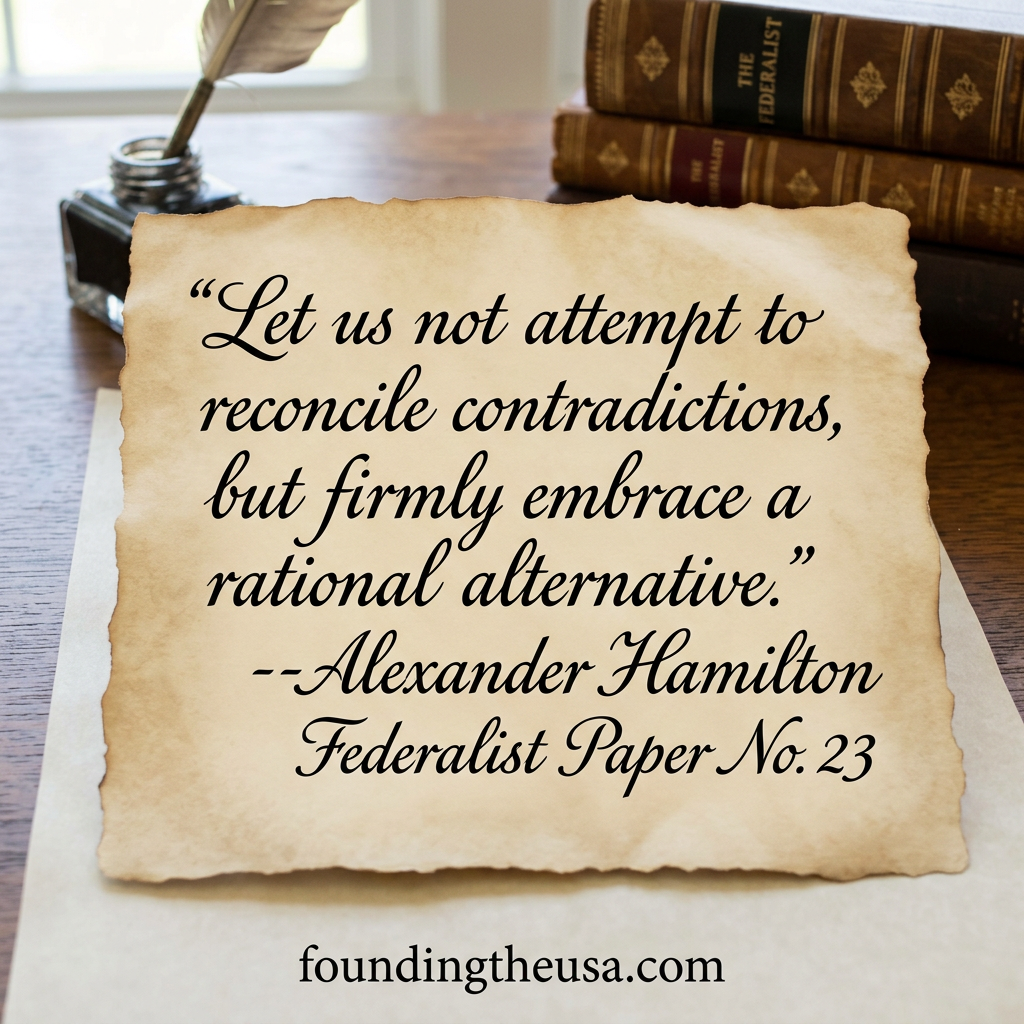
19. If one general system cannot be trusted, the honest alternative is separation
“Let us not attempt to reconcile contradictions, but firmly embrace a rational alternative.”
That line has teeth. Hamilton says if people truly believe a national government cannot safely hold the powers needed for national ends, then they should stop pretending and admit they favor separate confederacies.
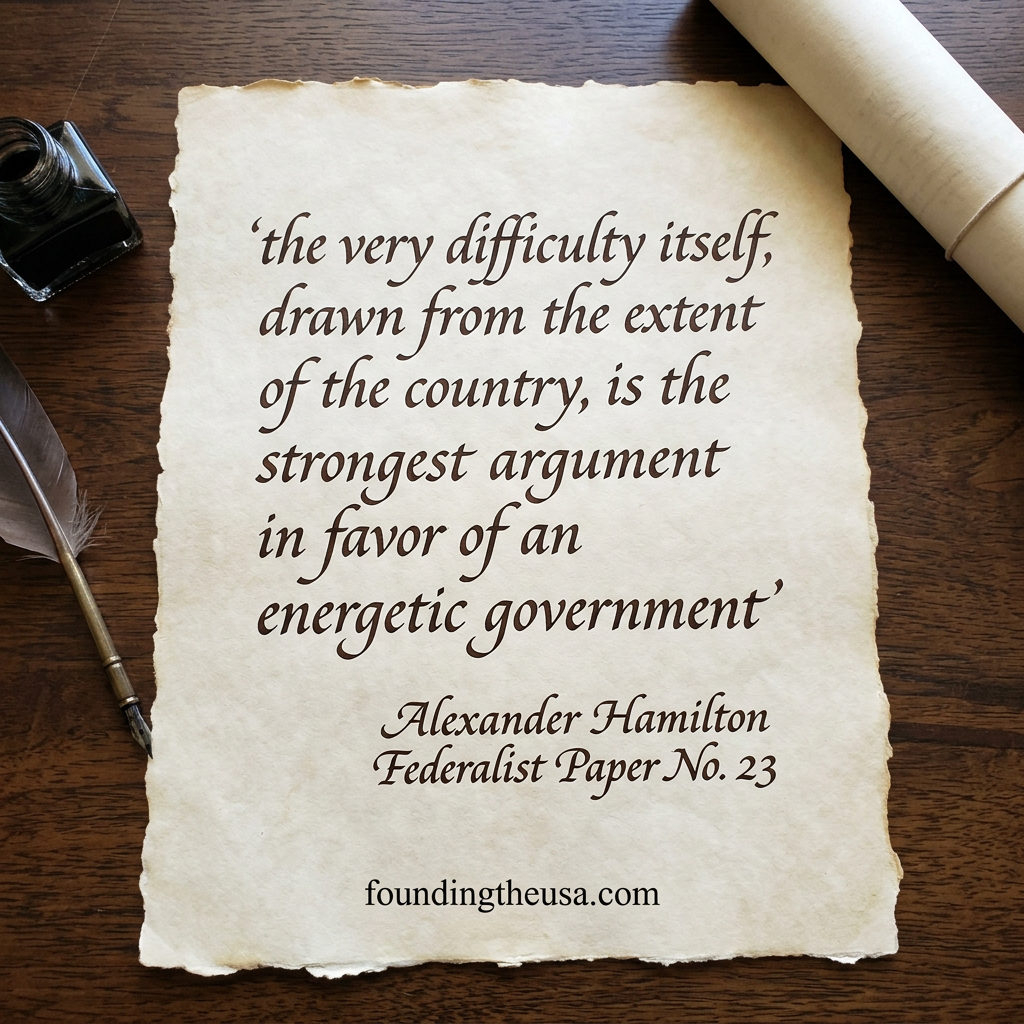
20. The size of the country is actually an argument for energy
“the very difficulty itself, drawn from the extent of the country, is the strongest argument in favor of an energetic government”
Excellent line. Hamilton flips the Anti-Federalist objection. The size of the United States does not prove national power must be weak. It proves weakness would be fatal.
Why Federalist No. 23 Works for Highlights
Federalist No. 23 works extremely well as a highlights page because the paper is tightly unified around one big constitutional principle: national duties require national power sufficient to meet them. It is one of Hamilton’s clearest and strongest statements of the logic behind energetic government.
This is also one of the papers where Hamilton sounds most like a builder instead of only a critic. He is no longer just saying the old system was bad. He is laying out the operating principle for a workable Union.
Related Links
- Federalist No. 23 Full Text
- Federalist Papers
- Alexander Hamilton
- Federalist No. 22
- Articles of Confederation
- United States Constitution