

Federalist No. 21 was written by Alexander Hamilton under the name Publius. In this essay, Hamilton continues exposing the defects of the Articles of Confederation, focusing on three major failures: the lack of a constitutional sanction behind federal laws, the lack of a federal guarantee against violent internal upheaval in the states, and the broken system of quotas and requisitions for revenue.
This paper matters because Hamilton is still tearing the old system apart, but here he does it with nuts-and-bolts precision. He is asking: how do laws get enforced, how do governments survive internal convulsions, and how does a union pay its bills fairly? Under the Articles, his answer is basically: badly, weakly, and unevenly.
1. The Confederation had no real sanction behind its laws
“The next most palpable defect of the subsisting Confederation, is the total want of a SANCTION to its laws.”
“The United States, as now composed, have no powers to exact obedience, or punish disobedience”
That is one of the biggest blows in the essay. Hamilton is saying the Confederation had resolutions, but not enough constitutional machinery to make obedience real.
2. A government without enforcement is barely a government
“the United States afford the extraordinary spectacle of a government destitute even of the shadow of constitutional power to enforce the execution of its own laws.”
That line lands hard. Hamilton is not calling the old system mildly defective. He is saying it lacks even the shadow of the force a government is supposed to have.
3. The Union could legally watch a state collapse into tyranny
“Usurpation may rear its crest in each State”
“while the national government could legally do nothing more than behold its encroachments with indignation and regret.”
That is a powerful warning. Hamilton says the Articles gave the Union no clear constitutional means to rescue a state if violence or usurpation overturned lawful government there.
4. A successful faction could build tyranny on chaos
“A successful faction may erect a tyranny on the ruins of order and law”
“while no succor could constitutionally be afforded by the Union”
This is Hamilton tying the lack of federal guarantee to real danger. Disorder inside one state would not stay politely contained there forever.
5. The guarantee is against violence, not peaceful reform
“It could be no impediment to reforms of the State constitution by a majority of the people in a legal and peaceable mode.”
“The guaranty could only operate against changes to be effected by violence.”
Important distinction. Hamilton is not saying the Union should freeze the states in amber. He is saying it should be able to resist coups, insurrections, and violent overthrow.
6. The natural cure in a republic is a change of men
“The natural cure for an ill-administration, in a popular or representative constitution, is a change of men.”
That is a very clean line. In a free government, the answer to bad administration is elections and lawful correction, not mobs and armed upheaval.
7. The quota system was a fundamental error
“The principle of regulating the contributions of the States to the common treasury by QUOTAS is another fundamental error in the Confederation.”
Hamilton moves from enforcement to money, and he does not soften it. The quota system is not awkward. It is fundamentally wrong.
8. There is no single fair measure of wealth
“there is no common standard or barometer by which the degrees of it can be ascertained.”
“Neither the value of lands, nor the numbers of the people… has any pretension to being a just representative.”
This is one of the smartest parts of the paper. Hamilton says wealth is too complicated to be fairly reduced to one fixed formula like land values or population alone.
9. Wealth depends on too many variables
“The wealth of nations depends upon an infinite variety of causes.”
“situation, soil, climate… the nature of the government, the genius of the citizens, the degree of information they possess, the state of commerce, of arts, of industry”
That is classic Hamilton state-builder thinking. He is saying public finance has to deal with reality, and reality is more complicated than a quota chart.
10. Fixed quotas create inequality and oppression
“cannot fail to be productive of glaring inequality and extreme oppression.”
A direct punch. Hamilton argues that once you force unequal states into fixed contribution formulas, the burden will land unfairly and breed resentment.
11. If quotas could actually be enforced, they might break the Union
“The suffering States would not long consent to remain associated upon a principle which distributes the public burdens with so unequal a hand”
That is an important twist. Hamilton is saying the quota system is so bad that if it were truly enforceable, it might destroy the Union by making the burden intolerable for some states.
12. The national government must raise its own revenue
“There is no method of steering clear of this inconvenience, but by authorizing the national government to raise its own revenues in its own way.”
This is one of the load-bearing lines in the essay. Hamilton’s answer is not better begging. It is actual taxing authority.
13. Consumption taxes naturally find their own level
“all duties upon articles of consumption, may be compared to a fluid, which will, in time, find its level with the means of paying them.”
That is one of the best images in the paper. Hamilton argues that indirect taxes are more flexible and self-adjusting than rigid quotas imposed on states.
14. The rich can indulge, the poor can restrain themselves
“The rich may be extravagant, the poor can be frugal”
Simple and sharp. Hamilton likes consumption taxes because, at least in part, individuals can control how heavily they bear them by controlling what they consume.
15. These taxes contain a built-in limit
“It is a signal advantage of taxes on articles of consumption, that they contain in their own nature a security against excess.”
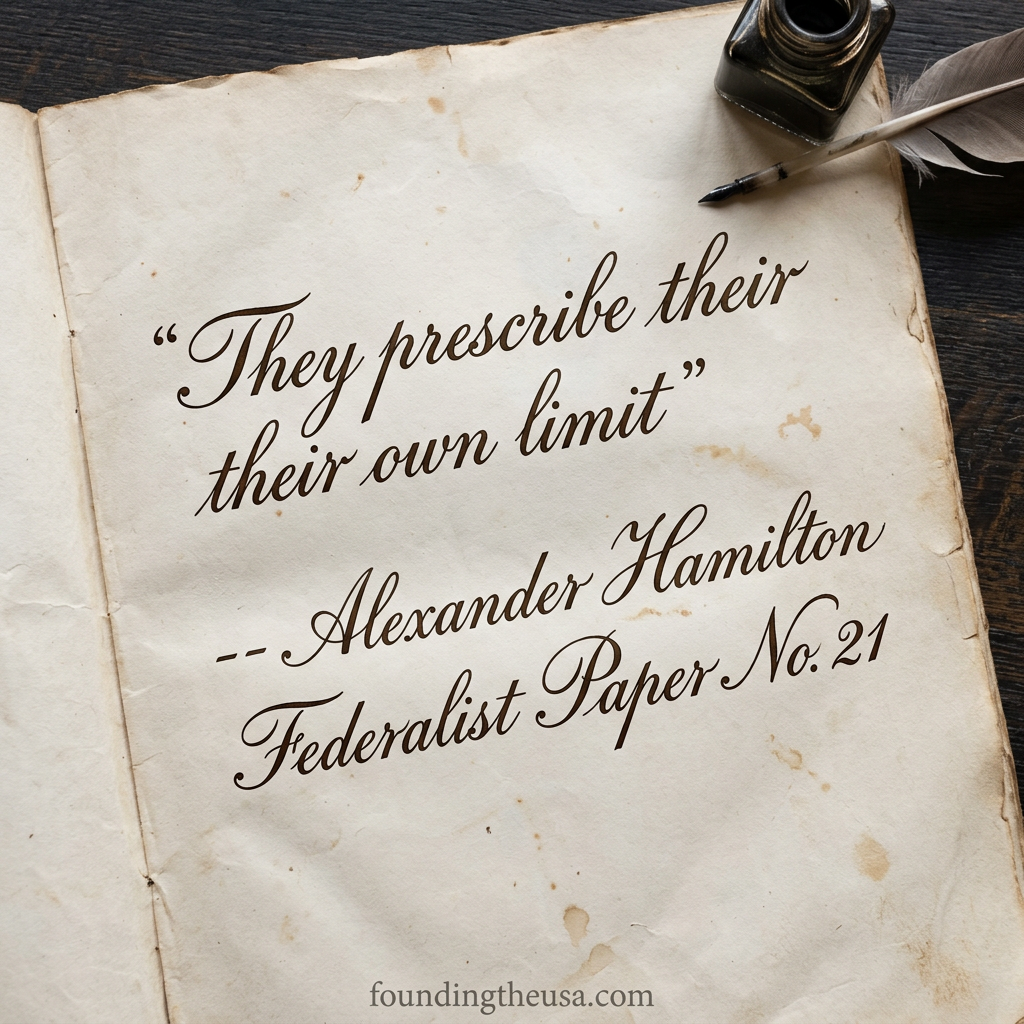
“They prescribe their own limit”
This is a very Hamilton line. He is arguing that indirect taxes have a natural ceiling because if they get too high, consumption drops and evasion rises.
16. Political arithmetic is not always neat
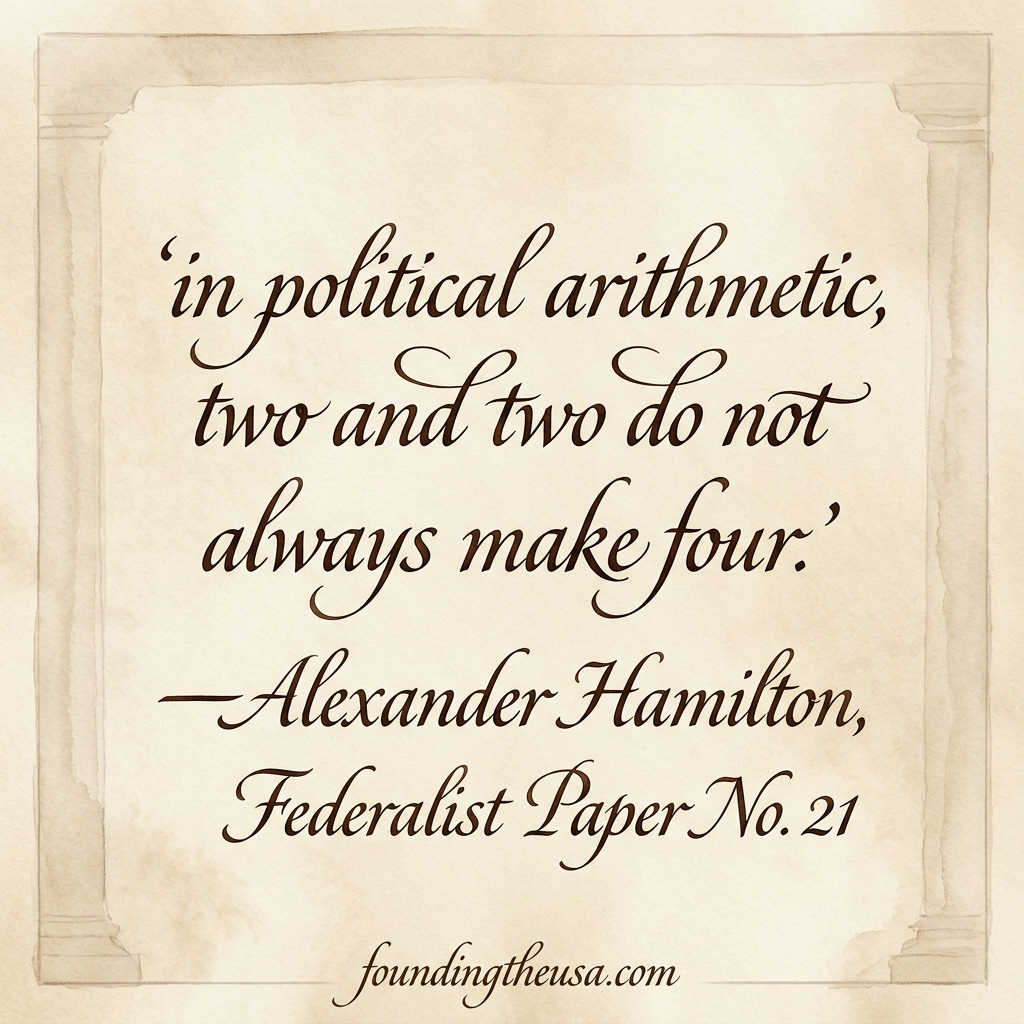
“in political arithmetic, two and two do not always make four.”
Great line. Hamilton is saying public finance does not behave like a schoolroom equation. Push taxes too far and the expected returns can actually shrink.
17. The nature of the tax can itself restrain oppression
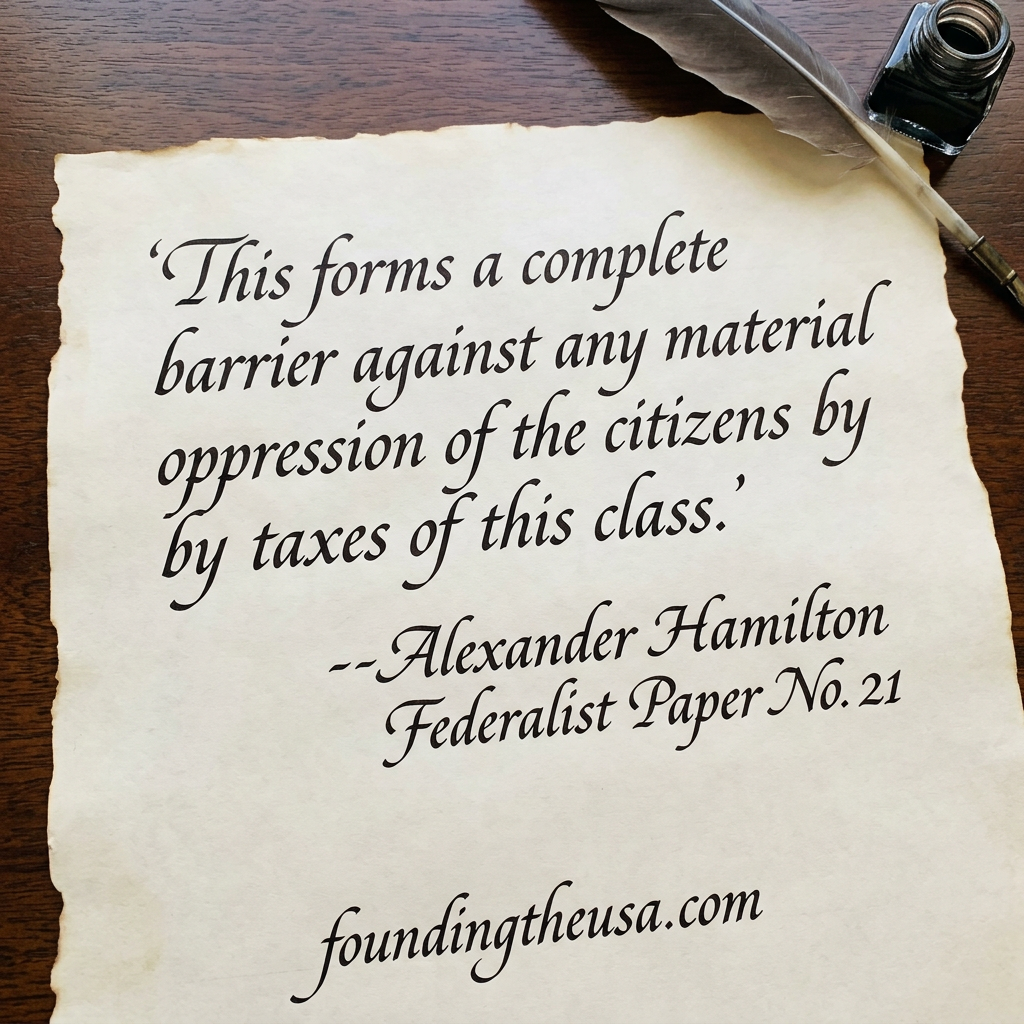
“This forms a complete barrier against any material oppression of the citizens by taxes of this class”
Hamilton is making the case that well-designed indirect taxes are not only productive, but safer than people fear because they self-correct better than blunt direct impositions.
Why Federalist No. 21 Works for Highlights
Federalist No. 21 works very well as a highlights page because it is built around three strong, practical arguments:
- laws without sanctions are weak
- states without guarantees are vulnerable
- quotas without fairness are poison
It is one of the clearest papers for showing Hamilton’s practical mind. He is not dazzled by constitutional poetry alone. He wants a system that can enforce, protect, and fund itself without breaking apart.
Related Links
- Federalist No. 21 Full Text
- Federalist Papers
- Alexander Hamilton
- Federalist No. 20
- Articles of Confederation
- United States Constitution