Federalist No. 15 was written by Alexander Hamilton under the name Publius and published on December 1, 1787. In this essay, Hamilton begins a major attack on the Articles of Confederation, arguing that the existing system was too weak to preserve the Union because it tried to govern states as states rather than citizens as citizens.
This is one of Hamilton’s harder punches. He is not politely saying the Confederation had a few rough edges. He is saying it was built on a bad principle and had pushed the United States toward humiliation, weakness, and near-anarchy.
1. The Confederation needed rescue
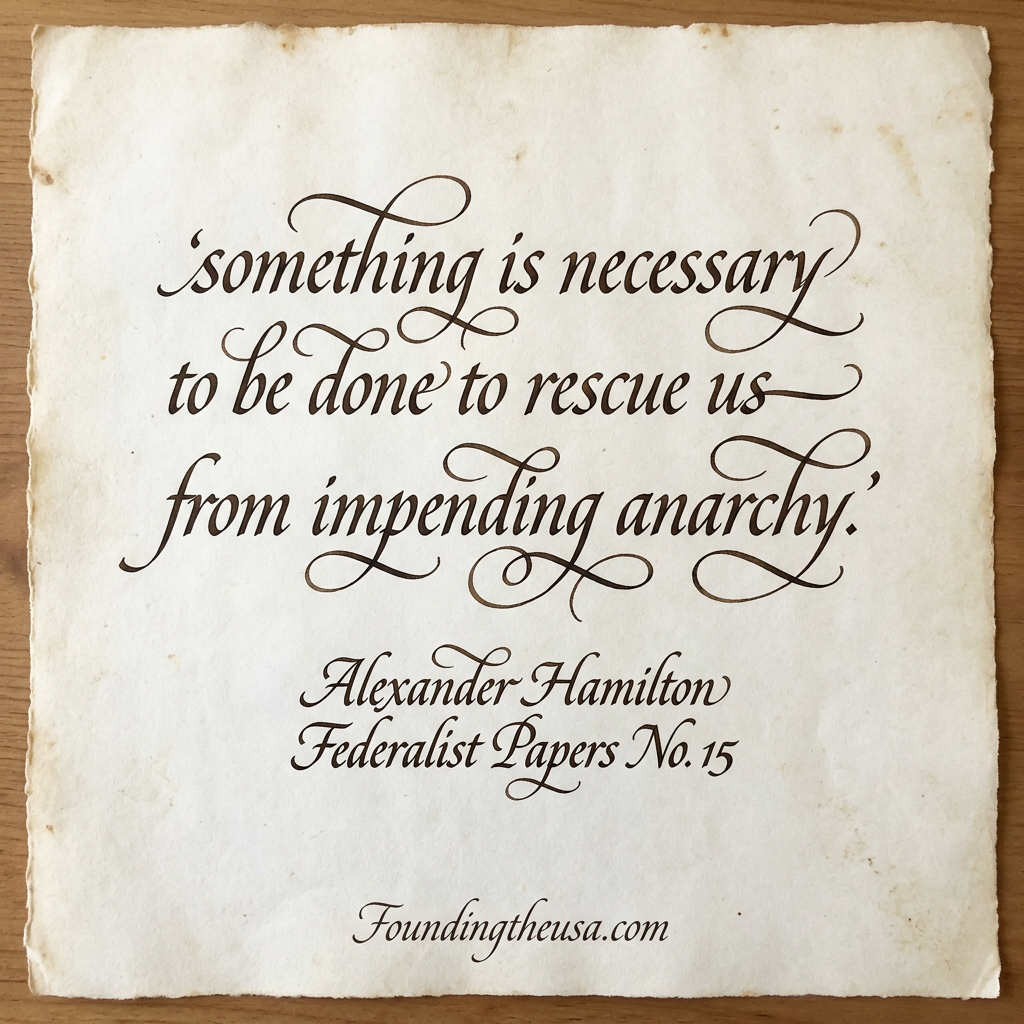
“something is necessary to be done to rescue us from impending anarchy.”
Hamilton says the country’s defects are no longer theoretical. The old system is visibly failing, and the danger is not abstract. That word — anarchy — tells you he thinks the crisis is real and urgent.
2. The last stage of national humiliation
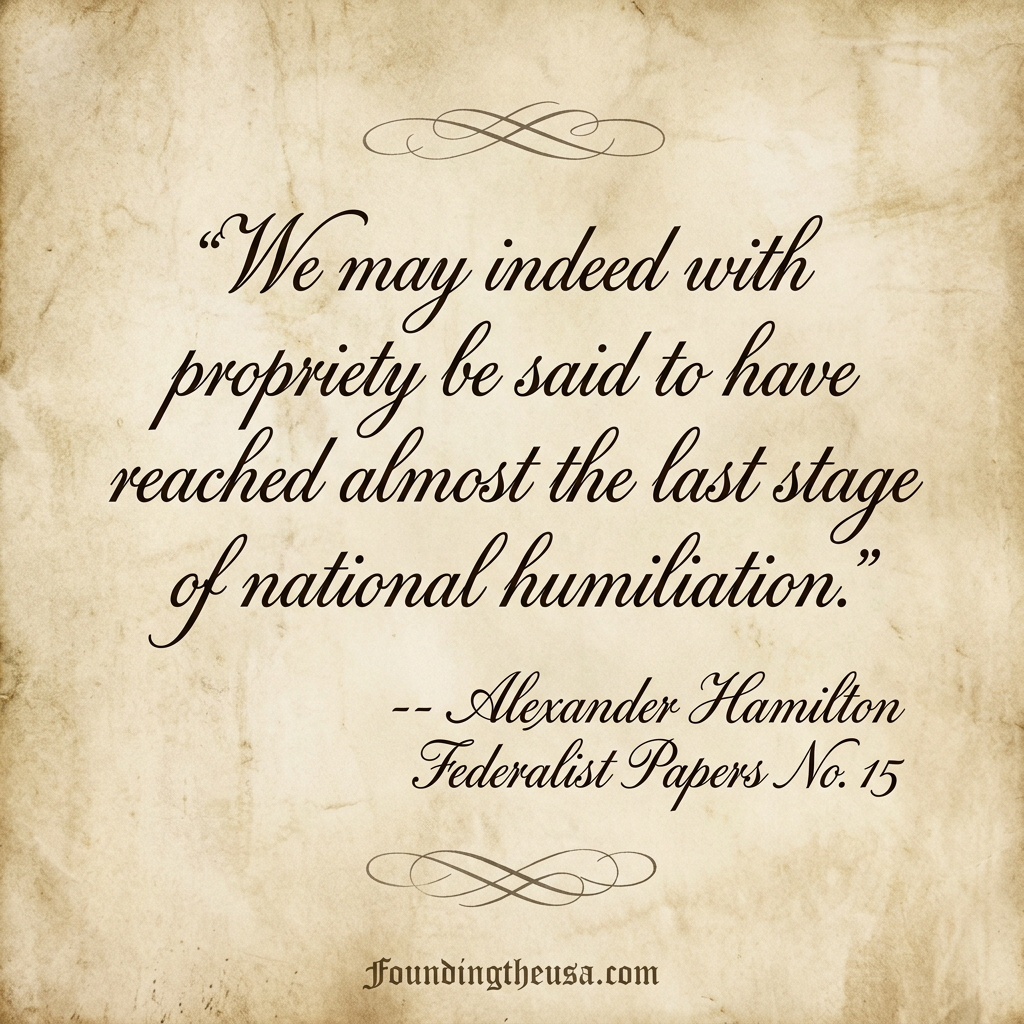
“We may indeed with propriety be said to have reached almost the last stage of national humiliation.”
That is one of the strongest opening blows in the paper. Hamilton is saying the United States is not merely inconvenienced. It is disgraced. This is classic Hamilton: not subtle, but effective.
3. No troops, no treasury, no government
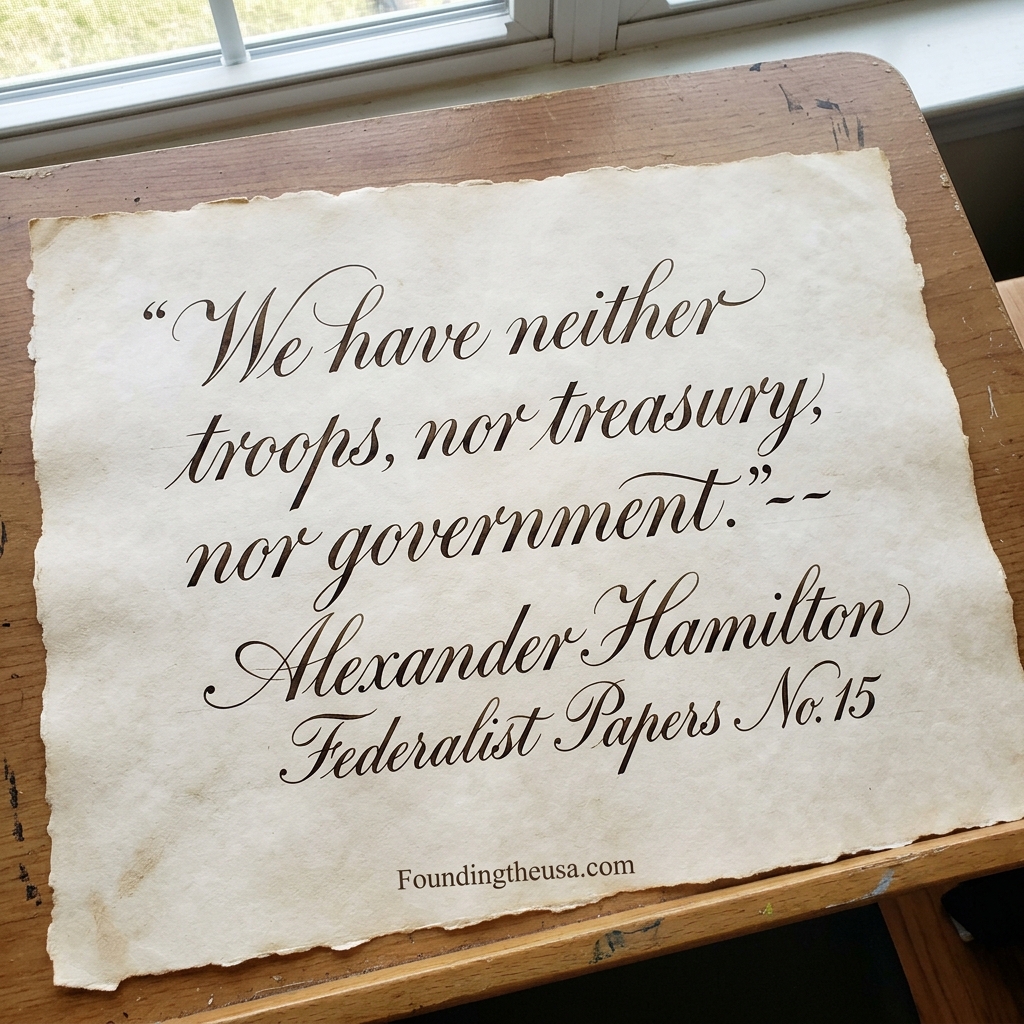
“We have neither troops, nor treasury, nor government.”
This is probably the headline line from Federalist No. 15. Brutal, compact, unforgettable. Hamilton is reducing the Articles-era failure to three missing essentials. That one absolutely deserves quote-image treatment.
4. Mimic sovereignty
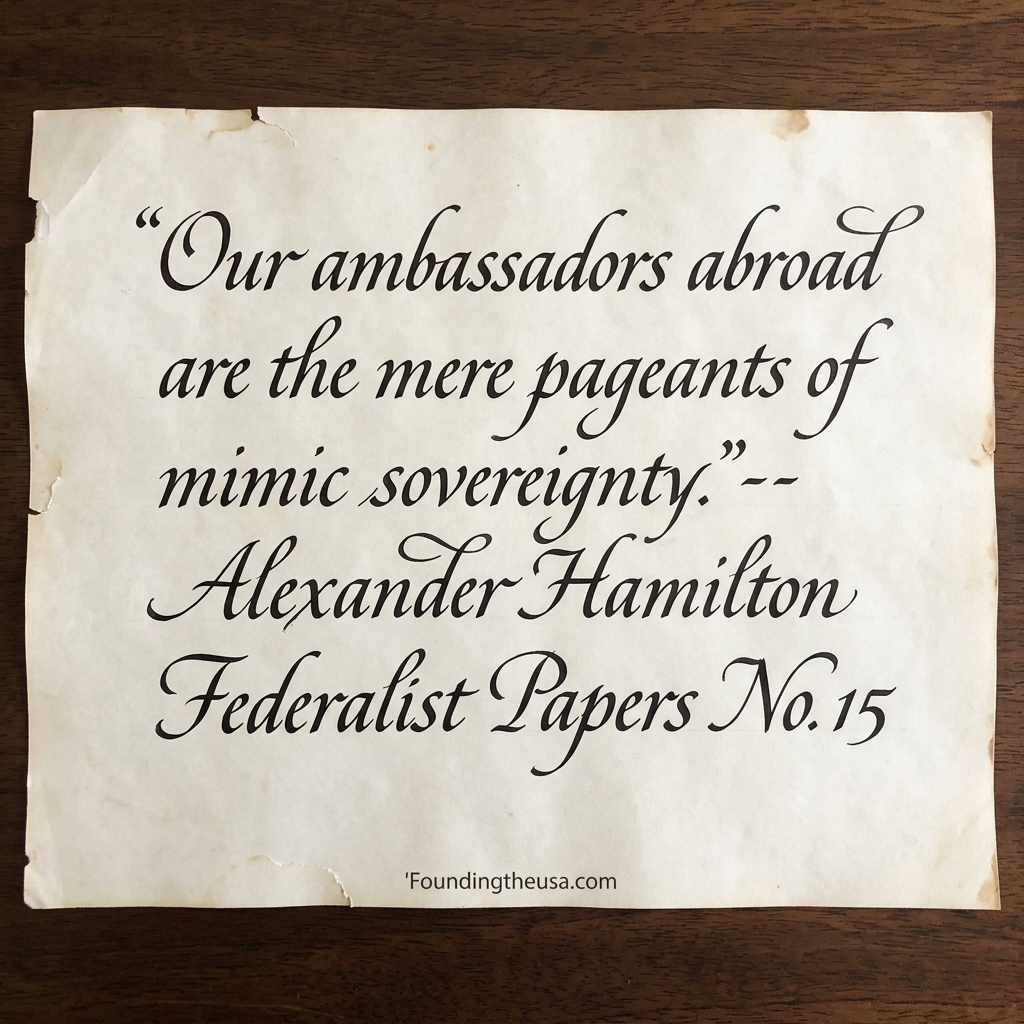
“Our ambassadors abroad are the mere pageants of mimic sovereignty.”
That is a vicious line. Hamilton is saying the United States looks like a nation from far away, but up close it lacks the real force and credibility of one. Great quote. Sharp as a razor.
5. Public credit abandoned
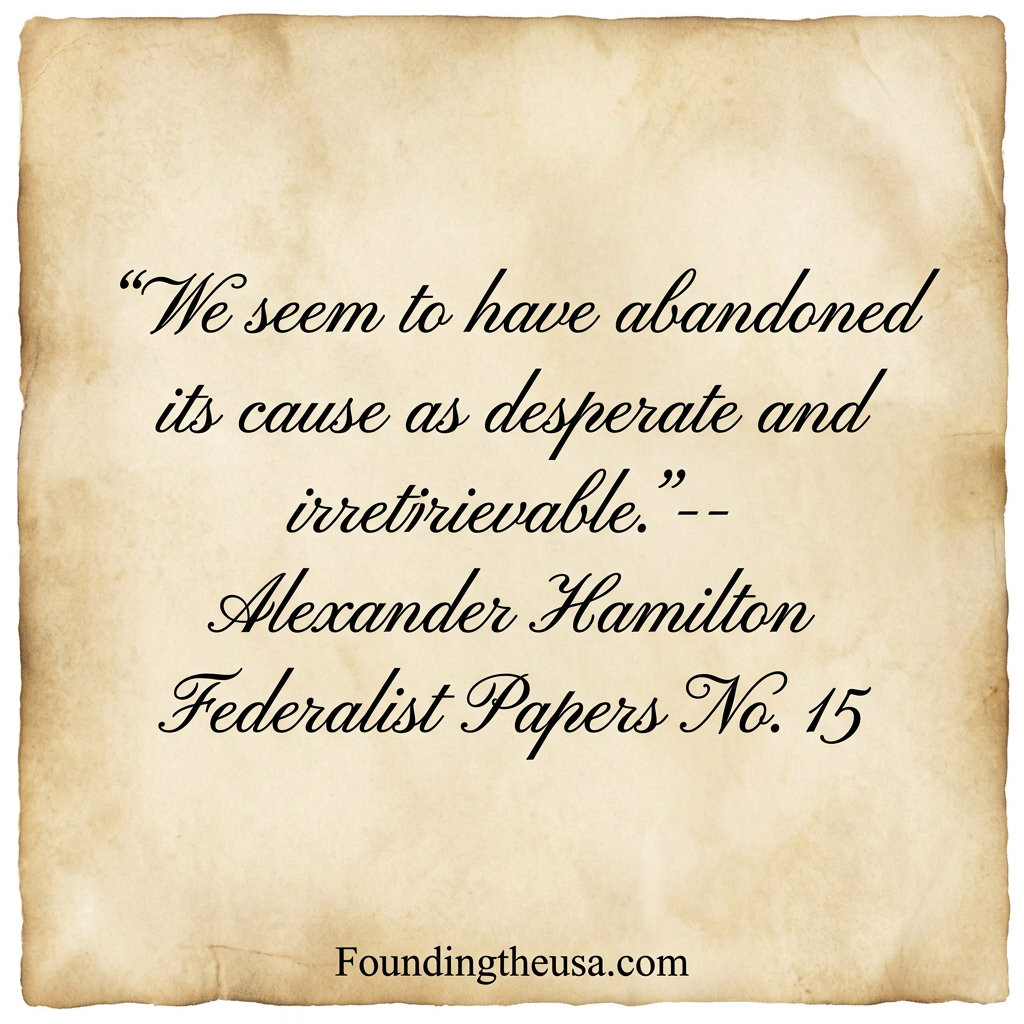
“We seem to have abandoned its cause as desperate and irretrievable.”
He is talking about public credit here, and the point is serious. A government that cannot borrow, cannot pay, and cannot sustain confidence is a government drifting toward impotence. Hamilton, being Hamilton, treats that as intolerable.
6. The brink of a precipice
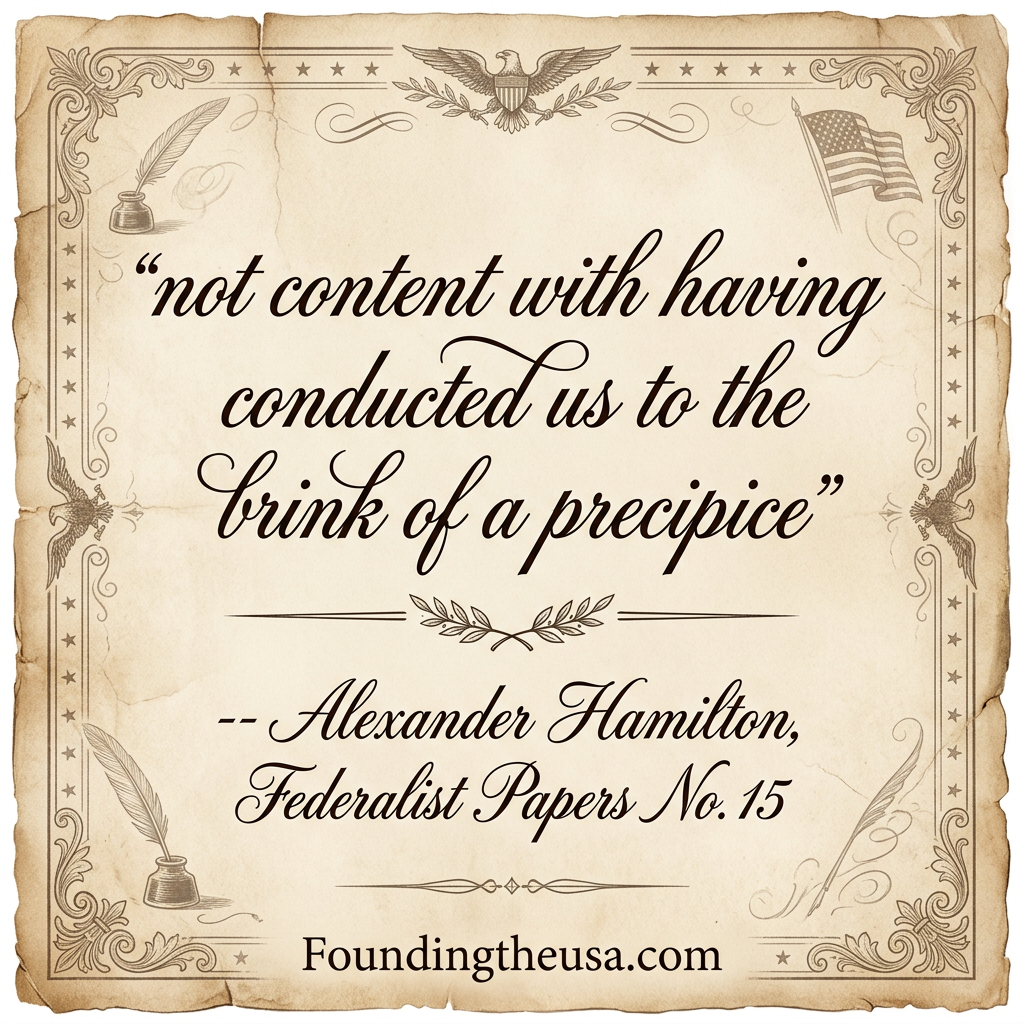
“not content with having conducted us to the brink of a precipice”
Another dramatic Hamilton image. He says the same ideas that got the country into crisis are now being used to block the remedy. In other words: the people who drove the wagon into the ditch are now giving fresh directions.
7. Break the fatal charm
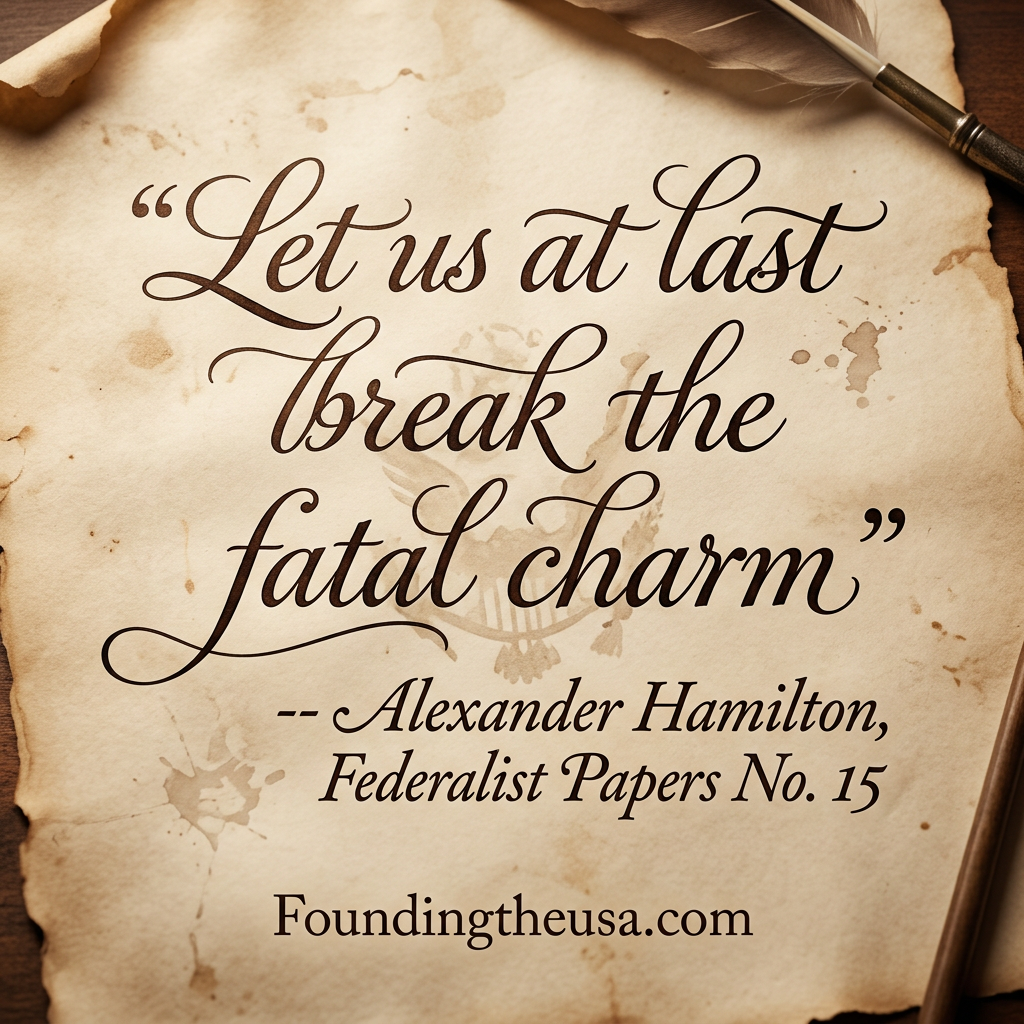
“Let us at last break the fatal charm”
That phrase is great. Hamilton is treating attachment to the old system as a kind of enchantment — irrational, seductive, and destructive. Very memeable. Very Hamilton.
8. An imperium in imperio
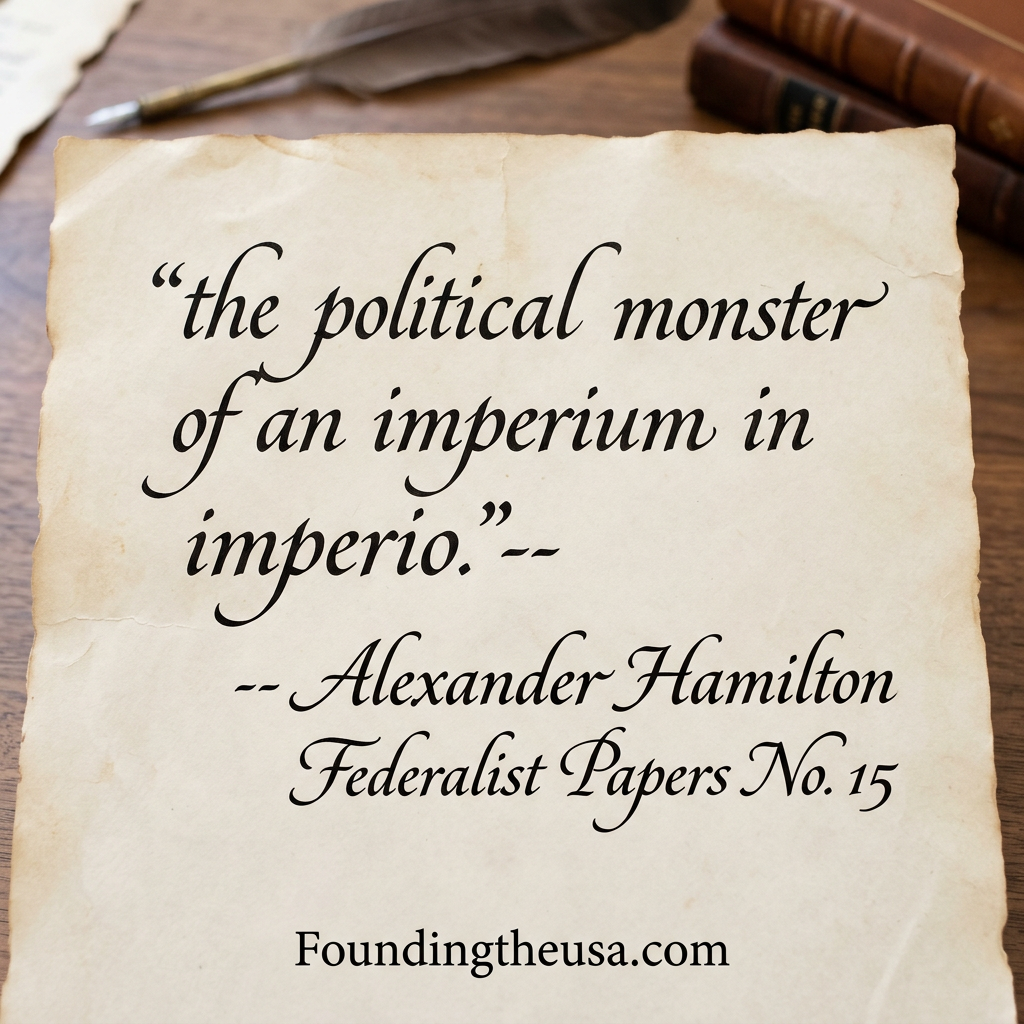
“the political monster of an imperium in imperio.”
This is one of the most memorable lines in the paper. Hamilton is attacking the fantasy of a Union that is somehow sovereign while the states remain fully sovereign too. To him, that is not balance. It is a monster.
9. Fundamental errors, not tiny flaws
“not proceed from minute or partial imperfections, but from fundamental errors in the structure of the building”
That line matters because it shows Hamilton’s larger point. He is not calling for little repairs. He is saying the Confederation is flawed in its first principles. The foundation itself is cracked.
10. The great and radical vice
“The great and radical vice in the construction of the existing Confederation”
This is the turning point of the essay. Hamilton identifies the central structural defect: the Confederation legislates for states in their collective capacities, not for individual people. That is the heart of his case.
11. Mere recommendations
“in practice they are mere recommendations”
Another knockout line. Hamilton says the Confederation’s supposed laws are not really laws at all, because the states may obey or ignore them as they please. That is not government. That is suggestion.
12. The sword instead of the magistrate
“must substitute the violent and sanguinary agency of the sword to the mild influence of the magistracy.”
That is one of the strongest lines in the entire paper. Hamilton is arguing that if a federal system governs states as states, enforcement eventually means war, not law. The choice is civil authority over individuals or military coercion against political bodies.
13. The only proper objects of government
“we must extend the authority of the Union to the persons of the citizens, — the only proper objects of government.”
This is one of the most important lines in Federalist No. 15. It states the Federalist principle directly: real government acts on individuals, not merely on corporate entities. This is a major constitutional idea, not a side note.
14. Law requires sanction
“It is essential to the idea of a law, that it be attended with a sanction”
Hamilton is defining law in the most practical possible way. If there is no penalty for disobedience, then the “law” is just advice dressed up in official clothes. Clear, hard, and important.
15. Advice or recommendation
“amount to nothing more than advice or recommendation.”
That line is another clean dagger. Hamilton keeps pressing the same point from different angles because he wants the reader to feel how absurd the old system really was.
16. Every breach becomes war
“every breach of the laws must involve a state of war”
That is a chilling line. If the Union can only coerce states, and states refuse compliance, the last resort is armed conflict. Hamilton is saying that is not just inefficient — it is insane as a model of government.
17. Not worthy of the name of government
“Such a state of things can certainly not deserve the name of government”
Simple, devastating, and very quotable. Hamilton is saying the Articles system was not even worthy of being called a government in the real sense.
18. Why government exists at all
“Because the passions of men will not conform to the dictates of reason and justice, without constraint.”
This is pure Hamilton realism. Government exists because people do not automatically behave well. That applies to bodies of men too, not just lone individuals. Strong line. Very useful.
19. Bodies of men are not more virtuous
“Has it been found that bodies of men act with more rectitude or greater disinterestedness than individuals?”
Hamilton’s answer is obviously no. He is rejecting the romantic idea that states, assemblies, or political bodies somehow become more moral simply because they are collective.
20. The love of power
“This tendency is not difficult to be accounted for. It has its origin in the love of power.”
Another classic Hamilton move: reduce the political problem to something very human and very old. Why do subordinate sovereignties resist common authority? Because they love power and hate being checked.
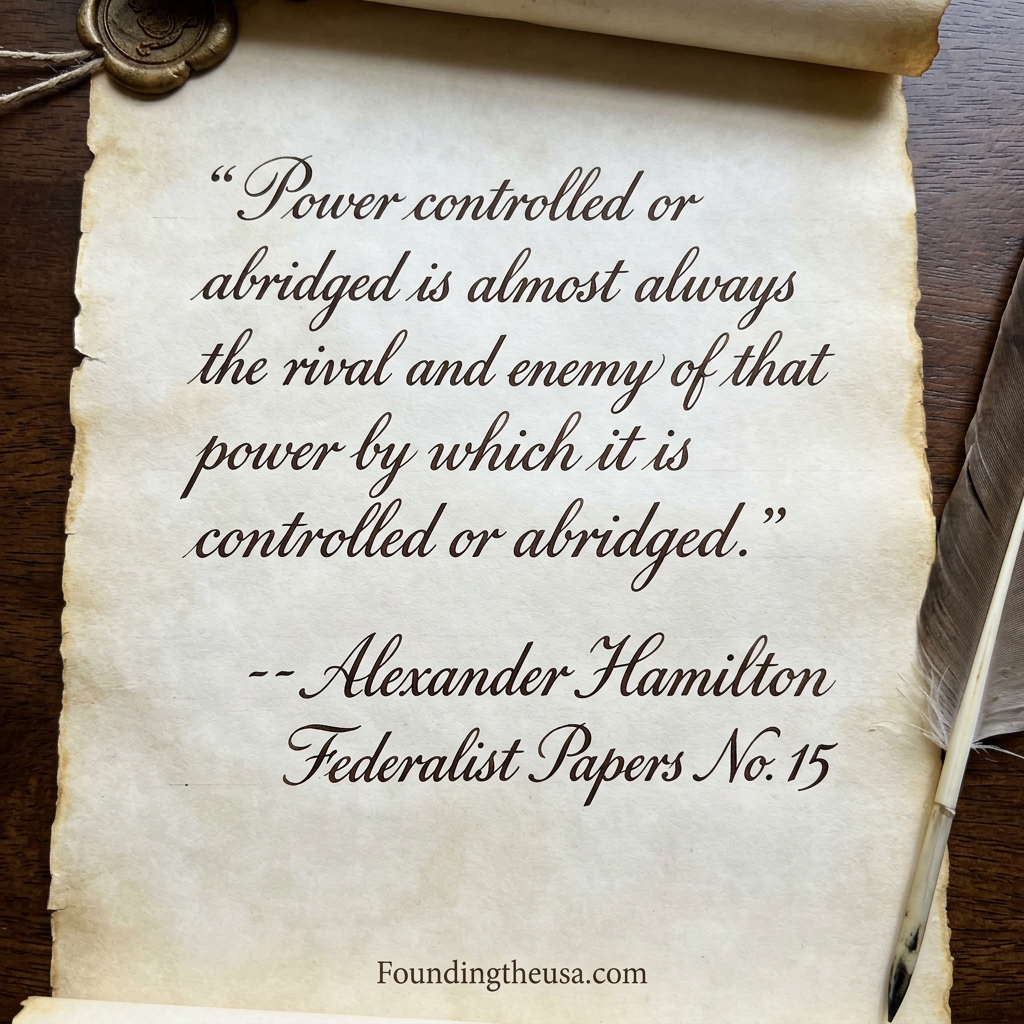
21. Power controlled is power enraged
“Power controlled or abridged is almost always the rival and enemy of that power by which it is controlled or abridged.”
That is one of the best lines in the paper. It is sharp, psychologically accurate, and bigger than the Confederation debate. It applies to political conflict in general.
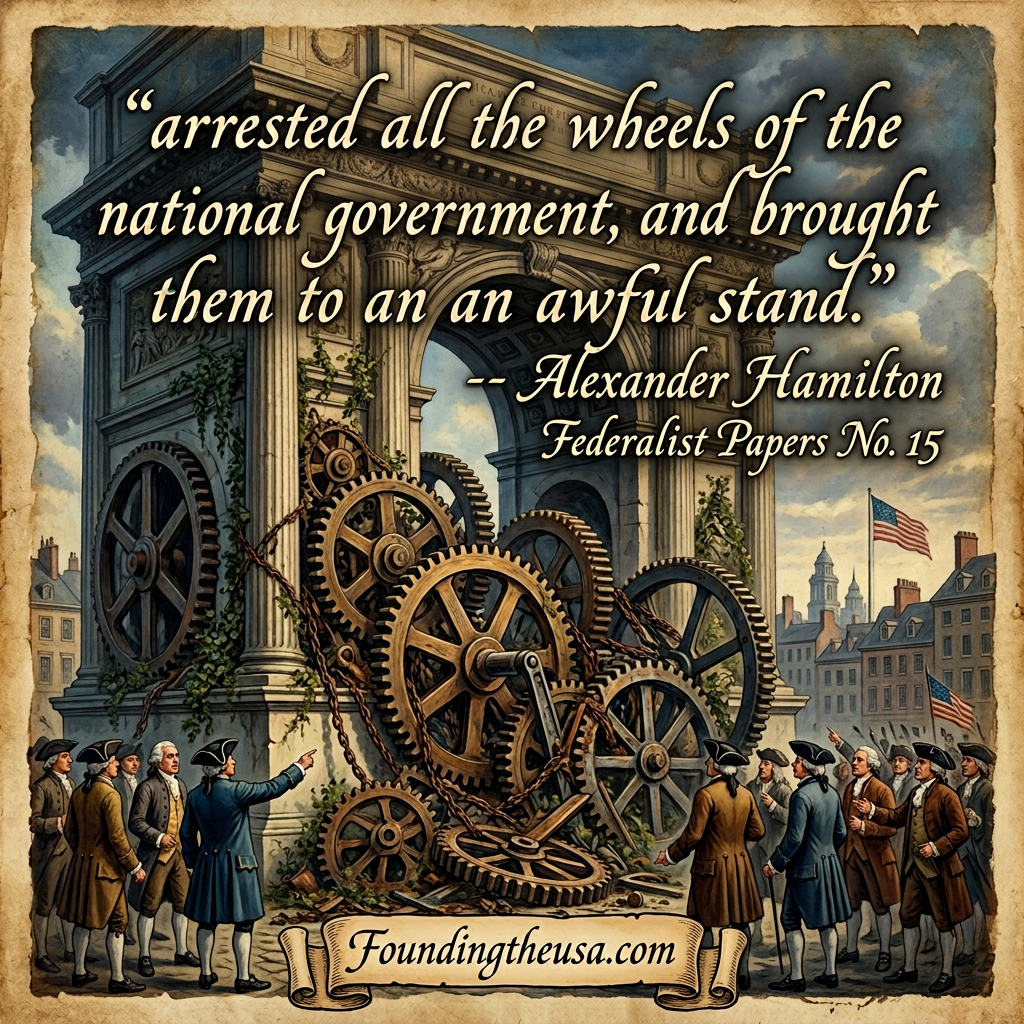
22. The wheels have stopped
“arrested all the wheels of the national government, and brought them to an awful stand.”
That is Hamilton’s closing diagnosis. The Confederation had not merely slowed down. It had seized up. The machine was frozen. Great closing image.
23. A shadow of a federal government
“the present shadow of a federal government.”
Excellent final phrase. Hamilton is saying what remained under the Articles was not substance, only outline — the silhouette of government without the force of it.
Why Federalist No. 15 Works for Highlights
Federalist No. 15 works extremely well as a highlights page because it is packed with quotable lines about national humiliation, weak government, failed enforcement, the difference between law and recommendation, and the fatal structural flaws of the Articles of Confederation.
This is one of the most important early Federalist essays because it moves from praising union in principle to diagnosing why the existing national system had become so useless. It is Hamilton in prosecutorial mode, and he is not gentle.
Related Links
- Federalist No. 15 Full Text
- Federalist Papers
- Alexander Hamilton
- Articles of Confederation
- United States Constitution
- Anti-Federalists