Federalist No. 12 was written by Alexander Hamilton under the name Publius and published on November 27, 1787. In this essay, Hamilton argues that the Union is essential not only for commerce, but for revenue. His point is practical and blunt: a government that cannot raise money cannot remain independent for long.
This paper matters because Hamilton is doing what he often does best — taking a large political principle and dragging it down to the level of nuts, bolts, ports, tariffs, smuggling, and tax collection. He is not asking whether union sounds noble. He is asking whether a nation can actually function, pay its bills, and avoid collapsing under the weight of bad tax structure.
1. Commerce feeds revenue
“Its tendency to promote the interests of revenue will be the subject of our present inquiry.”
Hamilton opens by shifting from commerce in general to revenue in particular. The point is simple: trade does not just make the country busier and richer. It also gives government a more effective and less destructive way to fund itself.
2. Commerce is a productive source of wealth
“the most useful as well as the most productive source of national wealth”
That line captures Hamilton’s whole approach. He sees commerce as one of the most powerful engines of national strength, not as some suspicious side activity to be tolerated reluctantly.
3. Agriculture and commerce are not enemies
“their interests are intimately blended and interwoven.”
This is an important line because Hamilton is rejecting the old rivalry between agriculture and commerce. He argues that trade helps agriculture, increases land values, and creates broader prosperity. In plain English: the farmer and the merchant are not natural enemies.
4. Commerce makes taxes easier to bear
“Commerce, contributing to both these objects, must of necessity render the payment of taxes easier”
Hamilton argues that commerce increases money in circulation and speeds its movement. That matters because a country with more money moving through it can pay taxes more easily than one stuck in stagnation.
5. Direct taxation has been a failure
“it is impracticable to raise any very considerable sums by direct taxation.”
This is one of the central practical claims of the essay. Hamilton says repeated attempts at direct taxation had disappointed expectations and left state treasuries empty. He is not theorizing here. He is pointing to hard experience.
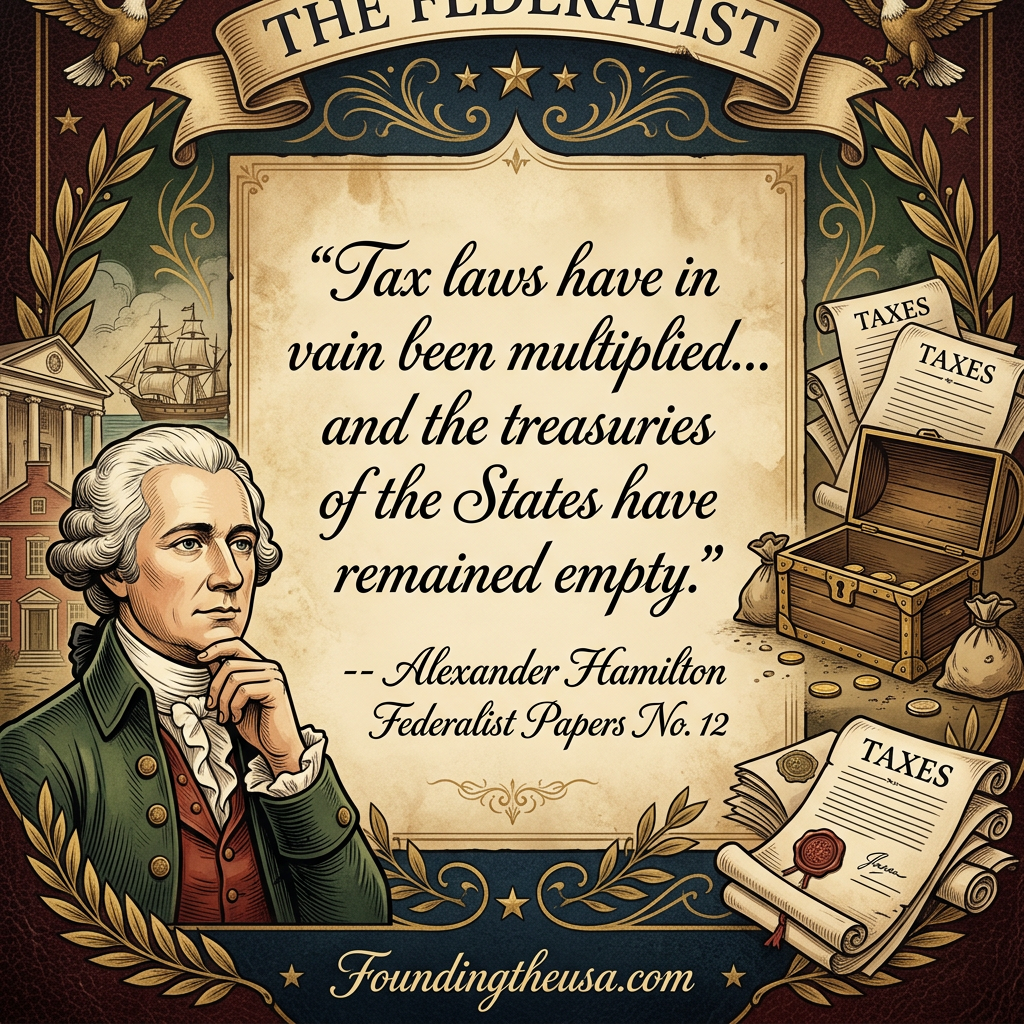
6. Tax laws multiplied, treasuries empty
“Tax laws have in vain been multiplied… and the treasuries of the States have remained empty.”
That line is pure Hamilton frustration. More tax laws did not fix the problem. The system itself was weak and ineffective. Good quote, especially for showing how badly the Articles-era revenue structure was failing.
7. The people will not tolerate excise well
“The genius of the people will ill brook the inquisitive and peremptory spirit of excise laws.”
Hamilton is saying Americans are not likely to tolerate highly intrusive domestic tax enforcement. This matters because it shows why he prefers revenue from imports and consumption over more invasive direct systems.
8. Land would bear the burden
“the pockets of the farmers… will reluctantly yield but scanty supplies”
He is warning that if revenue cannot be drawn effectively from commerce, the burden will fall harder on landowners and farmers. That is one of the paper’s strongest political arguments.
9. Smuggling would thrive under disunion
“an illicit trade between them a matter of little difficulty”
Hamilton argues that if the states are divided, smugglers will have a field day. Rivers, bays, easy communication, and local rivalry would make tax evasion much easier and enforcement much weaker.
10. Europe’s example is ugly
“In France, there is an army of patrols”
This is one of Hamilton’s more vivid practical examples. He points to France using thousands of patrols to fight contraband trade and says, in effect, that this kind of intrusive enforcement would be intolerable in a free country.
11. One side to guard
“there will be, as to the principal part of our commerce, but ONE SIDE to guard—the ATLANTIC COAST.”
That is one of the best lines in the paper. Under one national government, Hamilton says, revenue enforcement becomes much simpler. Instead of policing internal borders and interstate leakage, the government mainly has to guard the coast.
12. A few armed vessels would help
“A few armed vessels, judiciously stationed at the entrances of our ports”
Again, Hamilton gets concrete. He is showing that under union, customs enforcement could be practical, coastal, and manageable instead of sprawling, arbitrary, and impossible.
13. One national government can collect more efficiently
“one national government would be able, at much less expense, to extend the duties on imports”
This is one of the core claims of the essay. A united government can collect customs more effectively and cheaply than separate states or partial confederacies can.
14. Spirits are a gold mine
“There is, perhaps, nothing so much a subject of national extravagance as these spirits.”
Classic Hamilton. He points to imported spirits as a major revenue source and basically says: people are going to spend on this anyway, so government might as well tax it. Not subtle, but very practical.
15. A nation cannot long exist without revenues
“A nation cannot long exist without revenues.”
This is probably the headline line from Federalist No. 12. It is short, brutal, and foundational. No money, no functioning government, no durable independence.
16. Without revenue, independence collapses
“it must resign its independence, and sink into the degraded condition of a province.”
Hamilton pushes the point hard here. Weak revenue is not just an accounting problem. It becomes a sovereignty problem. A government unable to fund itself cannot stay truly independent.
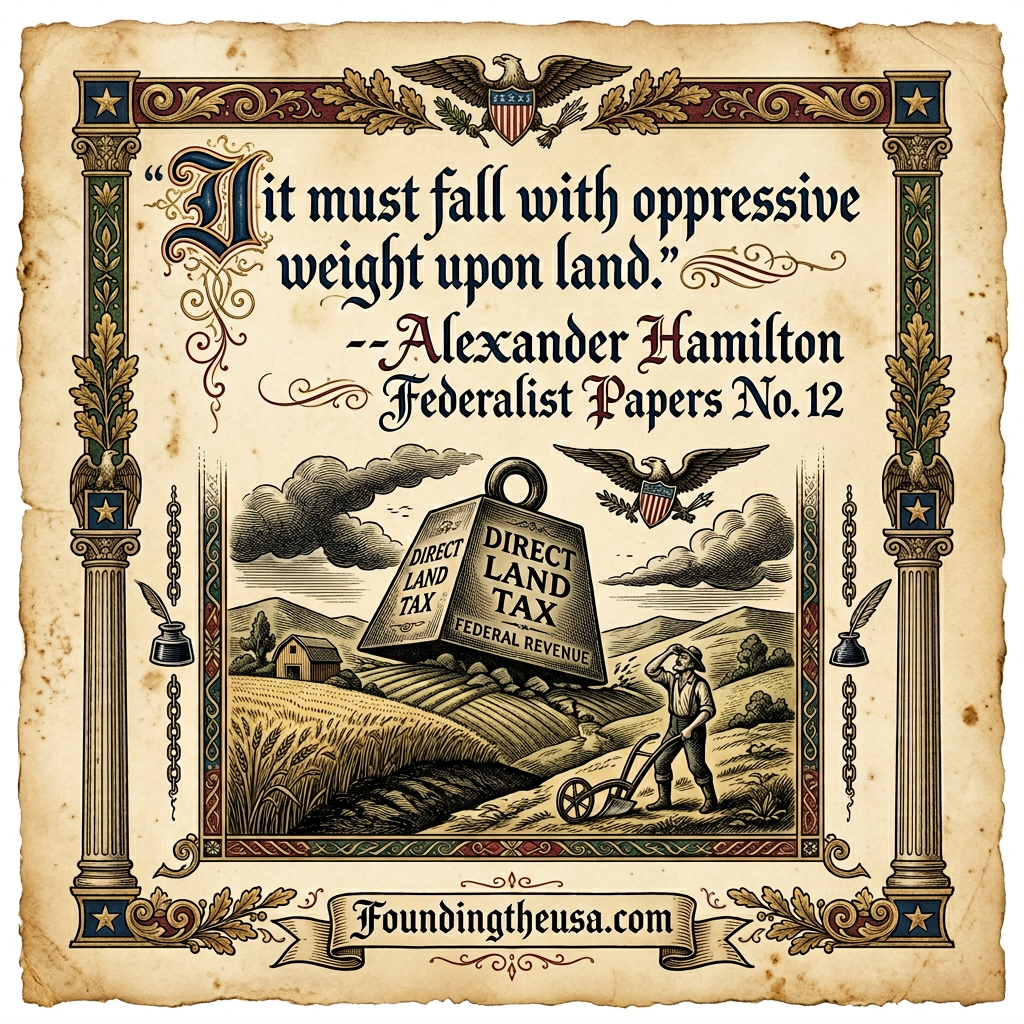
17. If commerce is blocked, land gets crushed
“it must fall with oppressive weight upon land.”
That is one of the strongest and simplest warnings in the essay. If the government cannot raise revenue through commerce, the tax burden shifts onto landowners and agriculture.
18. Public and private distress
“public and private distress will keep pace with each other in gloomy concert”
Excellent Hamilton phrasing. He is saying that under disunion, both the state and ordinary citizens suffer together. The government stays broke, and the people stay burdened. Nobody wins.
Why Federalist No. 12 Works for Highlights
Federalist No. 12 works well as a highlights page because it is full of practical, quotable lines about commerce, taxes, smuggling, land burdens, and national survival. This is Hamilton at his most financial and state-building. He is not selling abstract glory. He is selling solvency.
It is also one of the best papers for showing why Hamilton mattered so much. He keeps asking the uncomfortable question a lot of political dreamers prefer to avoid: how exactly is this government supposed to pay for itself without wrecking the country?
Related Links
- Federalist No. 12 Full Text
- Federalist Papers
- Alexander Hamilton
- Federalist No. 11
- Articles of Confederation
- United States Constitution