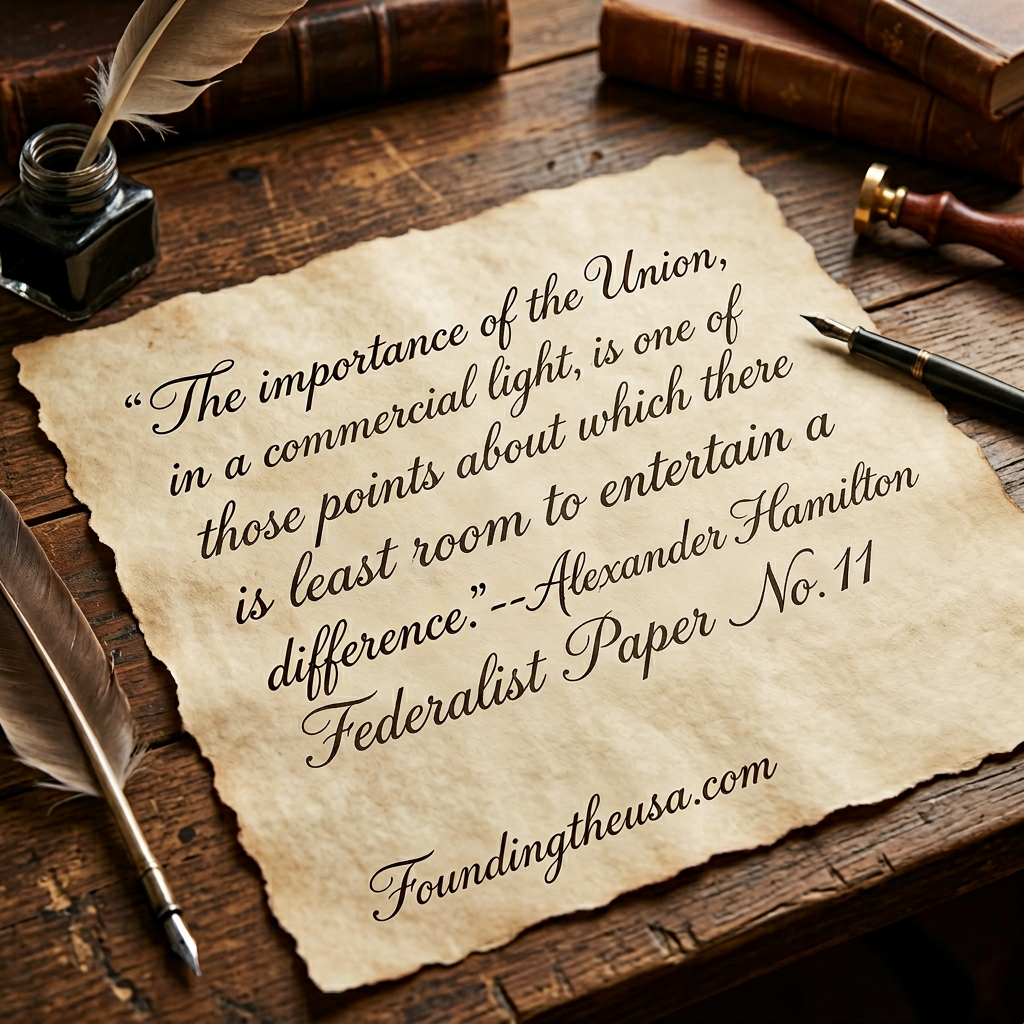
Federalist No. 11 was written by Alexander Hamilton under the name Publius and published on November 24, 1787. In this essay, Hamilton argues that the Union would strengthen American commerce, improve the country’s leverage with foreign powers, and make possible the creation of a navy strong enough to protect American trade and national dignity.
This paper matters because Hamilton ties together commerce, national strength, maritime power, and independence. He does not treat trade as something soft or detached from politics. He sees commerce as tied directly to foreign policy, naval power, and the nation’s future standing in the world.
1. Union and commerce belong together
“The importance of the Union, in a commercial light, is one of those points about which there is least room to entertain a difference of opinion.”
Hamilton opens with confidence here. He treats the commercial value of union as one of the least debatable arguments for the Constitution. This is not some side benefit to him. It is one of the main reasons the Union matters.
2. Europe already sees America as a rising commercial rival
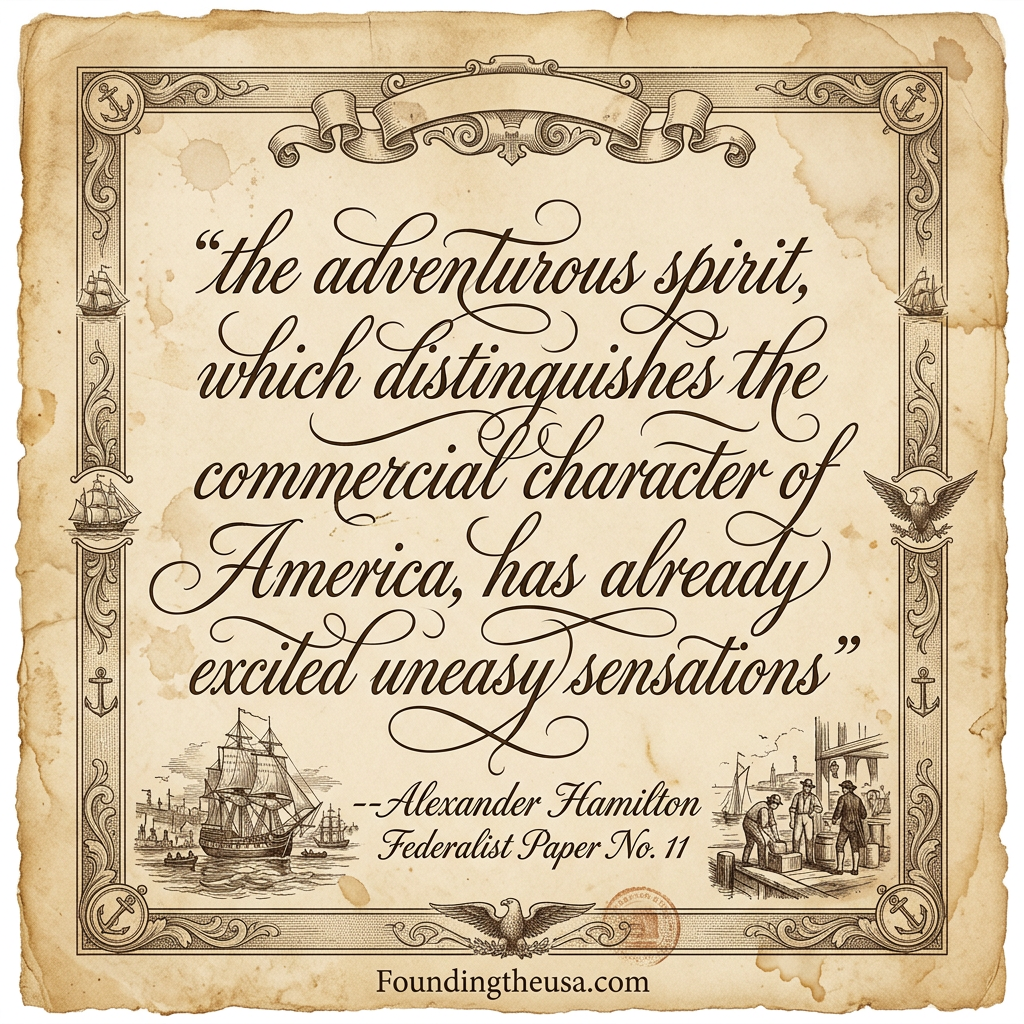
“the adventurous spirit, which distinguishes the commercial character of America, has already excited uneasy sensations”
That is one of the sharper lines in the essay. Hamilton is saying Europe is already nervous about what American trade could become. He is not imagining the young United States as weak forever. He sees real commercial potential and assumes rival powers see it too.
3. Foreign powers would rather keep America divided
“fostering divisions among us”
Short, blunt, and useful. Hamilton argues that maritime powers have every incentive to encourage American division, because division makes the United States easier to control commercially and politically.
4. Active commerce in our own bottoms
“depriving us, as far as possible, of an ACTIVE COMMERCE in our own bottoms.”
That phrase matters. Hamilton is talking about Americans carrying their own trade in American ships rather than letting foreign powers dominate transportation and profit. He wants an America that participates actively, not passively, in world commerce.
5. Foreign powers want to clip America’s wings
“clipping the wings by which we might soar to a dangerous greatness.”
One of the best lines in the essay. Hamilton is saying rival nations would like nothing better than to stunt American growth before it becomes too formidable. That is a very strong meme candidate.
6. Union gives bargaining power
“we may oblige foreign countries to bid against each other, for the privileges of our markets.”
This is a central Hamilton point. A united America could negotiate from strength. Instead of being pushed around by European powers, it could make them compete for access to American markets.
7. The market matters
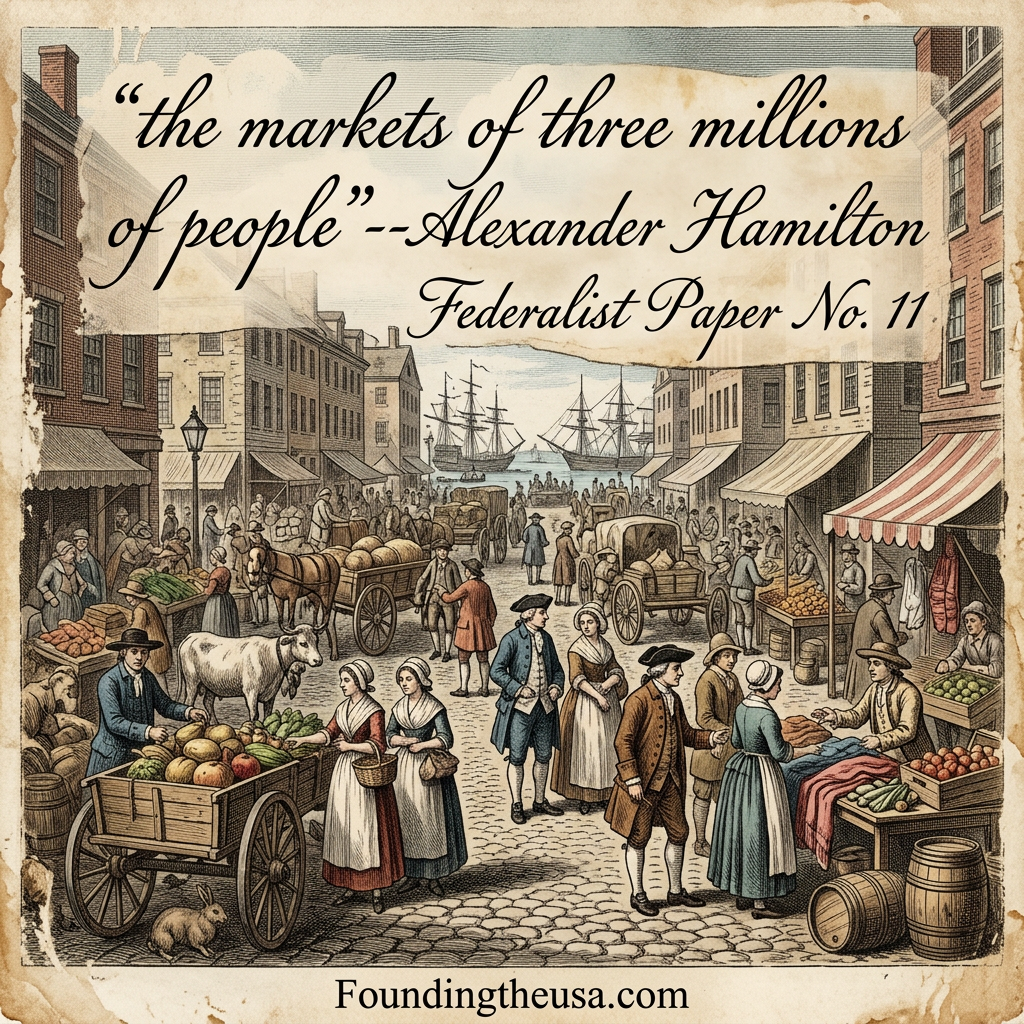
“the markets of three millions of people”
That phrase reminds readers that even in the 1780s Hamilton saw the American market as powerful leverage. He is thinking nationally, not state by state. A large combined market creates bargaining strength that no single state could match.
8. A federal navy changes everything
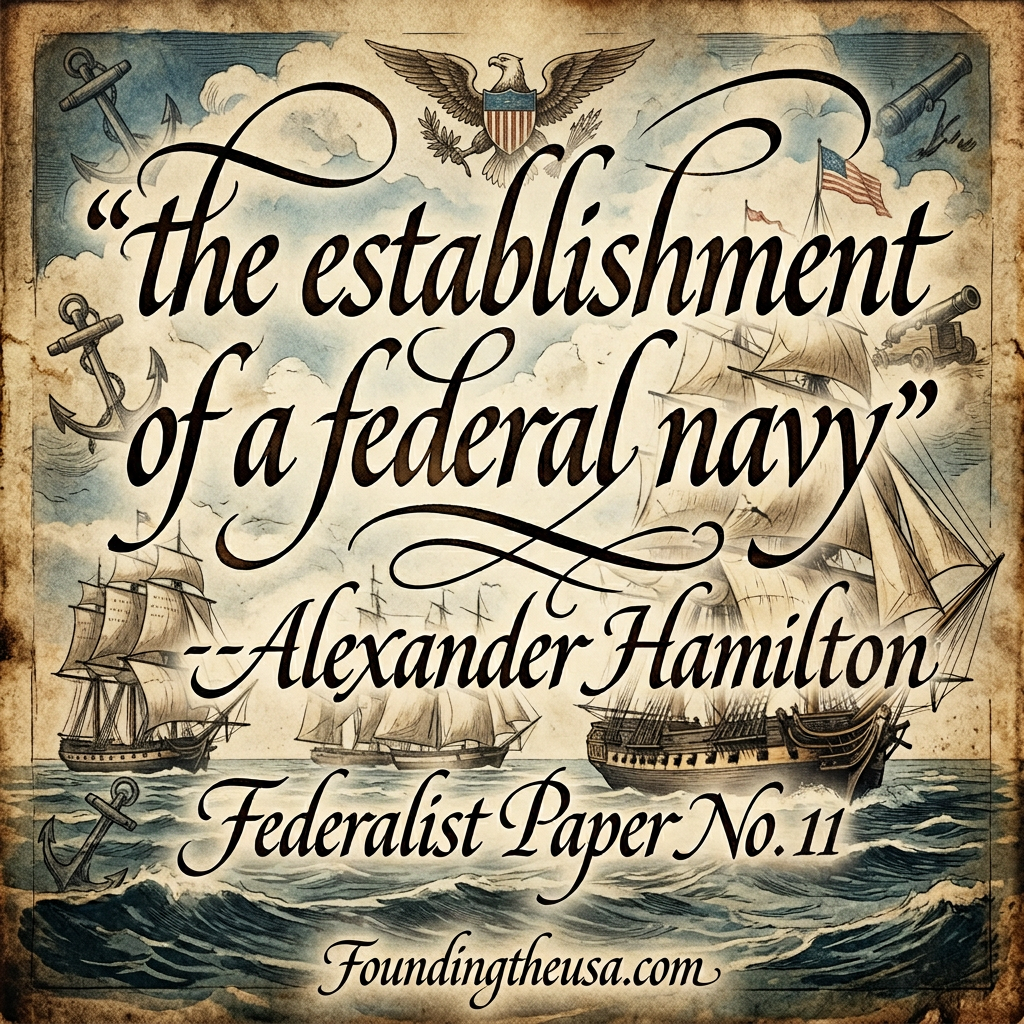
“the establishment of a federal navy”
This is one of the major themes of the paper. Hamilton argues that union makes possible the creation of a navy that can protect trade, influence diplomacy, and give America real weight in the world.
9. Respectable weight
“a navy which… would at least be of respectable weight”
Hamilton is realistic here. He is not claiming the United States will instantly outmatch the great European fleets. But he does argue that a united America can create naval power serious enough to matter.
10. A price on friendship and neutrality
“A price would be set not only upon our friendship, but upon our neutrality.”
That is one of the strongest lines in the essay. Hamilton is arguing that a united and strategically placed America could make even its neutrality valuable. Foreign powers would have to take it seriously, not simply ignore or exploit it.
11. Arbiter of Europe in America
“to become the arbiter of Europe in America”
Bold? Yes. Very Hamilton? Also yes. He is imagining a united America strong enough to influence the balance of European competition in the Western Hemisphere rather than just being jerked around by it.
12. Neutrality means little without power
“The rights of neutrality will only be respected when they are defended by an adequate power.”
Excellent line. Hamilton is saying neutrality is not some magic shield. It only works if backed by enough strength to make others respect it.
13. Weakness forfeits neutrality
“A nation, despicable by its weakness, forfeits even the privilege of being neutral.”
That is one of the best quotes in the paper. Cold, sharp, and timeless. Hamilton’s point is that weakness invites contempt, and contempt erodes rights.
14. Commerce, navigation, and marine grow together
“An active commerce, an extensive navigation, and a flourishing marine would then be the offspring of moral and physical necessity.”
This is Hamilton tying the whole package together. In his mind, commerce, shipping, and naval power are not separate topics. They reinforce each other.
15. Passive commerce is humiliation
“confine us to a PASSIVE COMMERCE.”
That phrase is pure Hamilton contempt. He does not want America reduced to producing goods while letting others carry, protect, and profit from the trade. Passive commerce, in his view, is dependency wearing a business coat.
16. Poverty and disgrace
“poverty and disgrace would overspread a country which, with wisdom, might make herself the admiration and envy of the world.”
Strong line, dramatic and memorable. Hamilton sees a stark choice: union and national power, or weakness and humiliation. He is not subtle about it.
17. Fisheries, lakes, and the Mississippi
“the fisheries, to the navigation of the Western lakes, and to that of the Mississippi”
This is where Hamilton grounds the argument in concrete American interests. He is saying these are not abstract rights. They are real economic and strategic assets that only the Union can defend effectively.
18. A navy is a great national object
“To this great national object, a NAVY, union will contribute in various ways.”
Another key line. Hamilton sees the navy not as a luxury, but as a national necessity tied directly to commerce, security, and national self-respect.
19. Unity of commercial interests requires unity of government
“A unity of commercial, as well as political, interests, can only result from a unity of government.”
This is one of the most important lines in the paper. Hamilton argues that the states cannot expect coherent economic power while remaining politically fragmented. Commercial unity depends on political union.
20. One great American system
“one great American system, superior to the control of all transatlantic force or influence”
Fantastic closing line. Big vision, big ambition, pure Hamilton. He wants Americans to think beyond mere survival and toward a unified national system able to stand on its own against European manipulation.
Why Federalist No. 11 Works for Highlights
Federalist No. 11 works very well as a highlights page because it combines commerce, national strategy, naval strength, and national pride in memorable language. It is one of the clearest places where Hamilton shows that he thinks economics and power go hand in hand.
This paper is also a very strong bridge between constitutional argument and national ambition. Hamilton is not just defending the Union as a defensive necessity. He is defending it as a way for the United States to become stronger, richer, and more respected in the world.
Related Links
- Federalist No. 11 Full Text
- Federalist Papers
- Alexander Hamilton
- Federalist No. 10
- Articles of Confederation
- United States Constitution