

Alexander Hamilton Highlights from Federalist Paper No. 1
Federalist No. 1 was written by Alexander Hamilton under the name Publius and published on October 27, 1787. It serves as the opening essay of the Federalist Papers and introduces the larger argument for ratifying the United States Constitution. In this first paper, Hamilton sets the stakes high. He argues that Americans are facing one of history’s great political tests: whether people can build good government by reason and deliberate choice rather than by chaos, habit, or force.
This is one of the most quotable essays in the entire Federalist series. It has big-picture lines, sharp warnings about faction and demagoguery, and several phrases that still hit hard today. Below are some of the strongest highlights from Federalist No. 1.
1. “Reflection and choice” vs. “accident and force”
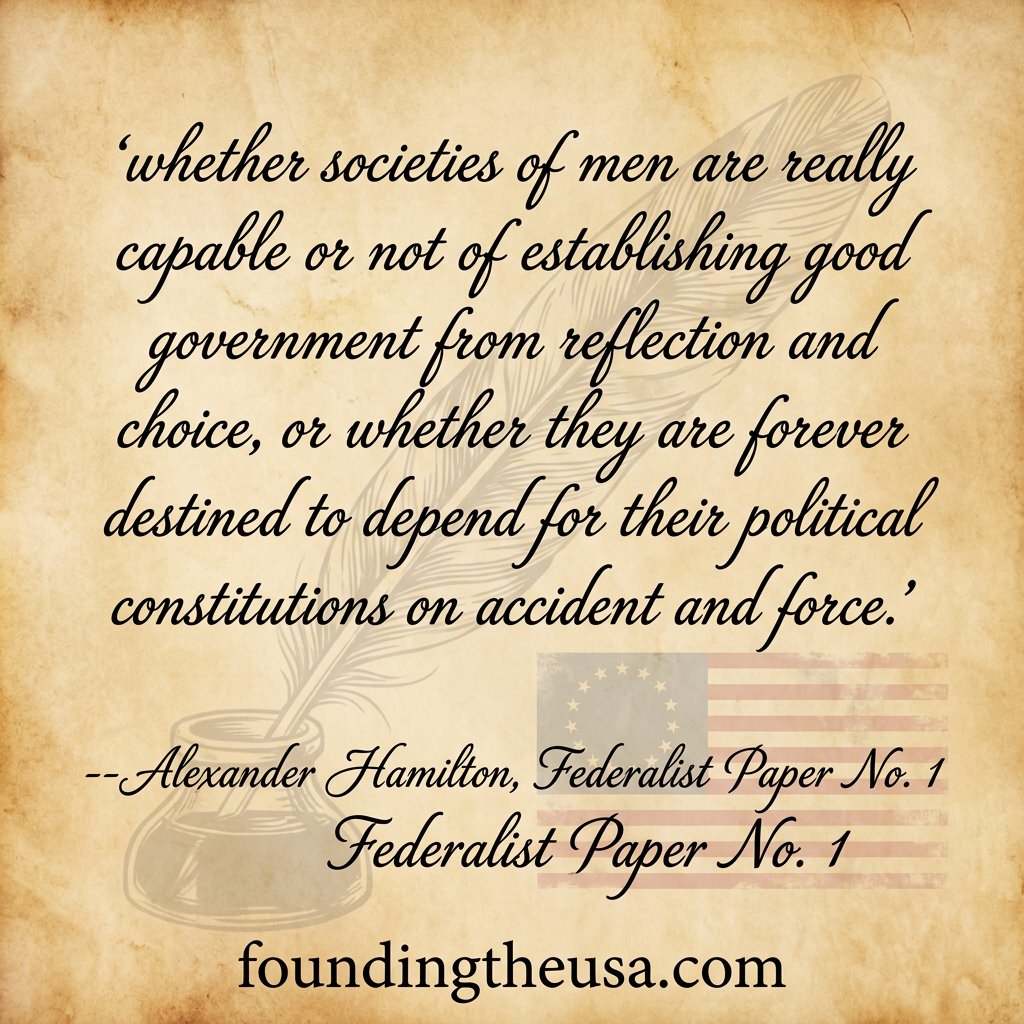
“whether societies of men are really capable or not of establishing good government from reflection and choice, or whether they are forever destined to depend for their political constitutions on accident and force.”
This is the headline quote of Federalist No. 1 and one of the most famous lines in all American political writing. Hamilton is saying the Constitution debate is bigger than one country or one generation. He sees it as a test of whether human beings can govern themselves intelligently and deliberately. That is a monster of a line, and deservedly so.
2. The stakes are larger than America alone
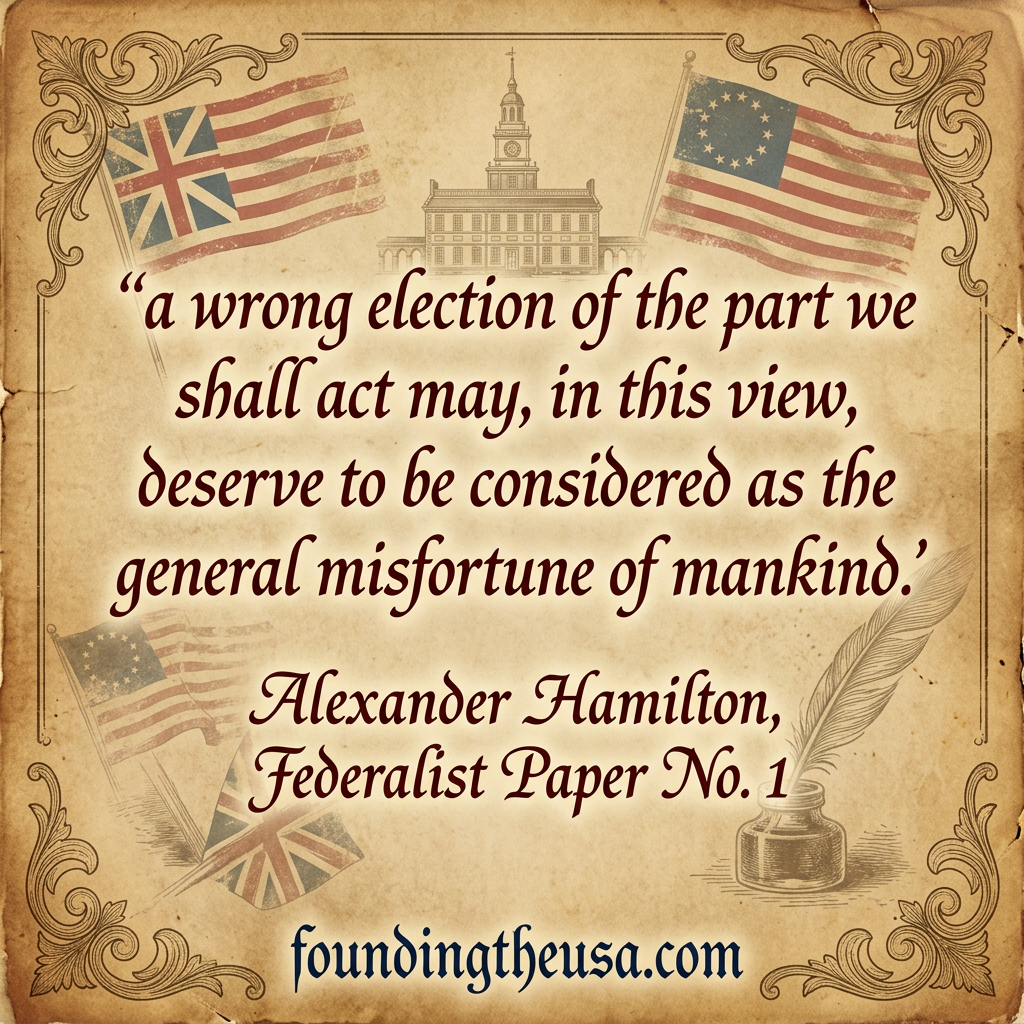
“a wrong election of the part we shall act may, in this view, deserve to be considered as the general misfortune of mankind.”
Hamilton is not exactly known for modesty, and this line proves it. But it also shows how seriously he took the ratification fight. He believed the American experiment mattered not just for the United States, but for the future of self-government more broadly.
3. Political conflict distorts judgment
“The plan offered to our deliberations affects too many particular interests, innovates upon too many local institutions, not to involve in its discussion a variety of objects foreign to its merits, and of views, passions and prejudices little favorable to the discovery of truth.”
That line still feels painfully current. Hamilton is warning that big constitutional debates do not stay clean and abstract for long. Interests, ambitions, local loyalties, fears, and personal grudges all come rushing in. People do not always argue from principle. Sometimes they argue from whatever happens to protect their turf.
4. Some opposition comes from honest fear
“the honest errors of minds led astray by preconceived jealousies and fears.”
This is one of the more balanced lines in the essay. Hamilton clearly supports the Constitution, but he admits that not all opposition is corrupt or malicious. Some people are simply afraid of what they think might happen. That is a useful reminder, especially in a political culture that loves assuming the worst about everybody immediately.
5. A warning about party spirit
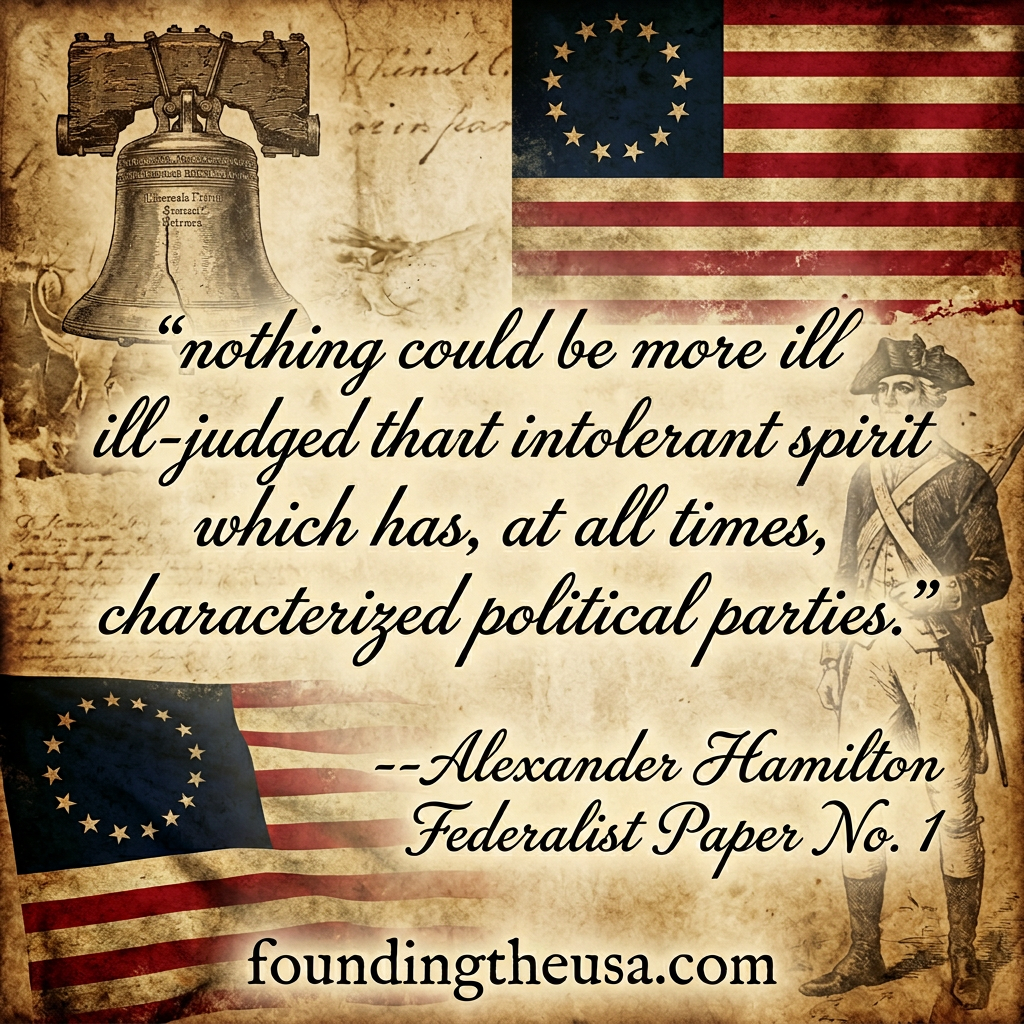
“nothing could be more ill-judged than that intolerant spirit which has, at all times, characterized political parties.”
That one barely needs explanation. Hamilton is warning that party conflict often becomes irrational, intolerant, and self-defeating. The wigs are gone, but the problem is still very much alive and kicking.
6. “Fire and sword”
“in politics, as in religion, it is equally absurd to aim at making proselytes by fire and sword.”
This is one of the sharpest and most meme-ready lines in the paper. Hamilton is arguing that political persuasion cannot be forced through intimidation, rage, or coercion. A strong line, a vivid image, and the sort of quote that survives because it still cuts.
7. Government and liberty are not opposites
“the vigor of government is essential to the security of liberty.”
This is one of the core Federalist ideas in a single sentence. Hamilton argues that weak government is not always the friend of freedom. Sometimes liberty is protected by having a government strong enough to preserve order, enforce law, and hold the union together. This line is central to understanding the Federalist case for the Constitution.
8. The mask of popular zeal
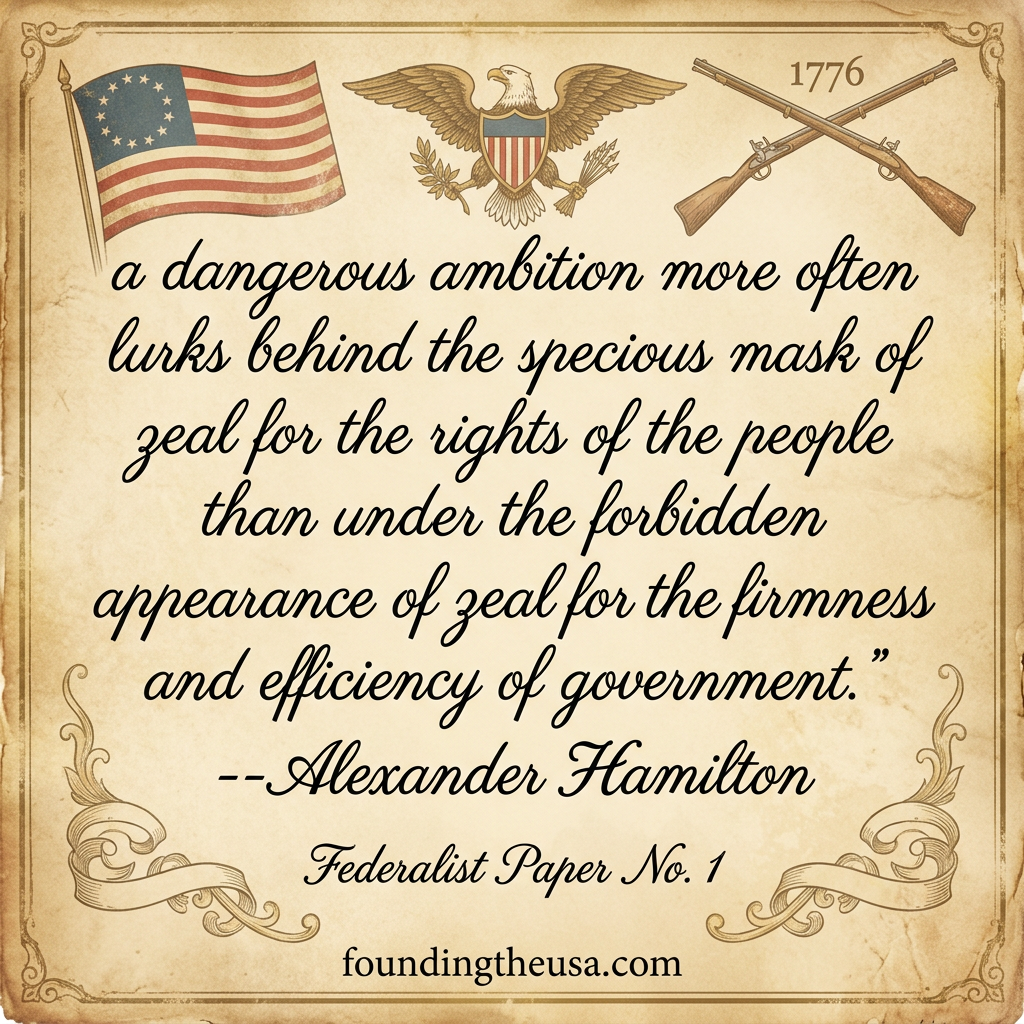
“a dangerous ambition more often lurks behind the specious mask of zeal for the rights of the people than under the forbidden appearance of zeal for the firmness and efficiency of government.”
Classic Hamilton. Suspicious, sharp, and aimed directly at political hypocrisy. He is warning that the loudest defenders of “the people” are not always the safest guardians of liberty. Sometimes demagogues hide behind the language of rights while actually chasing power for themselves.
9. The shortest dagger in the essay
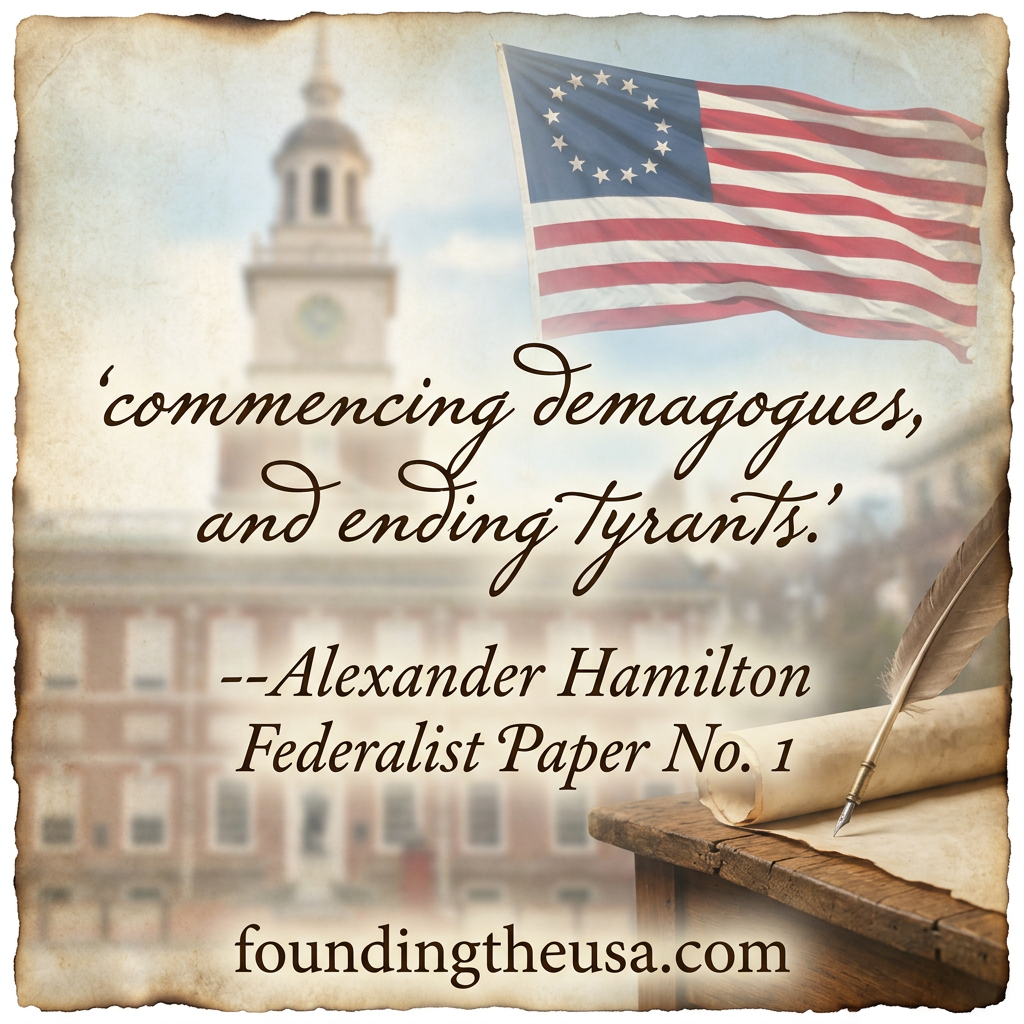
“commencing demagogues, and ending tyrants.”
That is one of the cleanest quotable lines in the whole paper. It is short, memorable, and brutal. Hamilton is talking about the pattern of men who flatter the people at the beginning and destroy liberty in the end. That one deserves its own graphic all by itself.
Related Links
- Federalist No. 1 Full Text
- Federalist Papers
- Alexander Hamilton
- James Madison
- John Jay
- United States Constitution