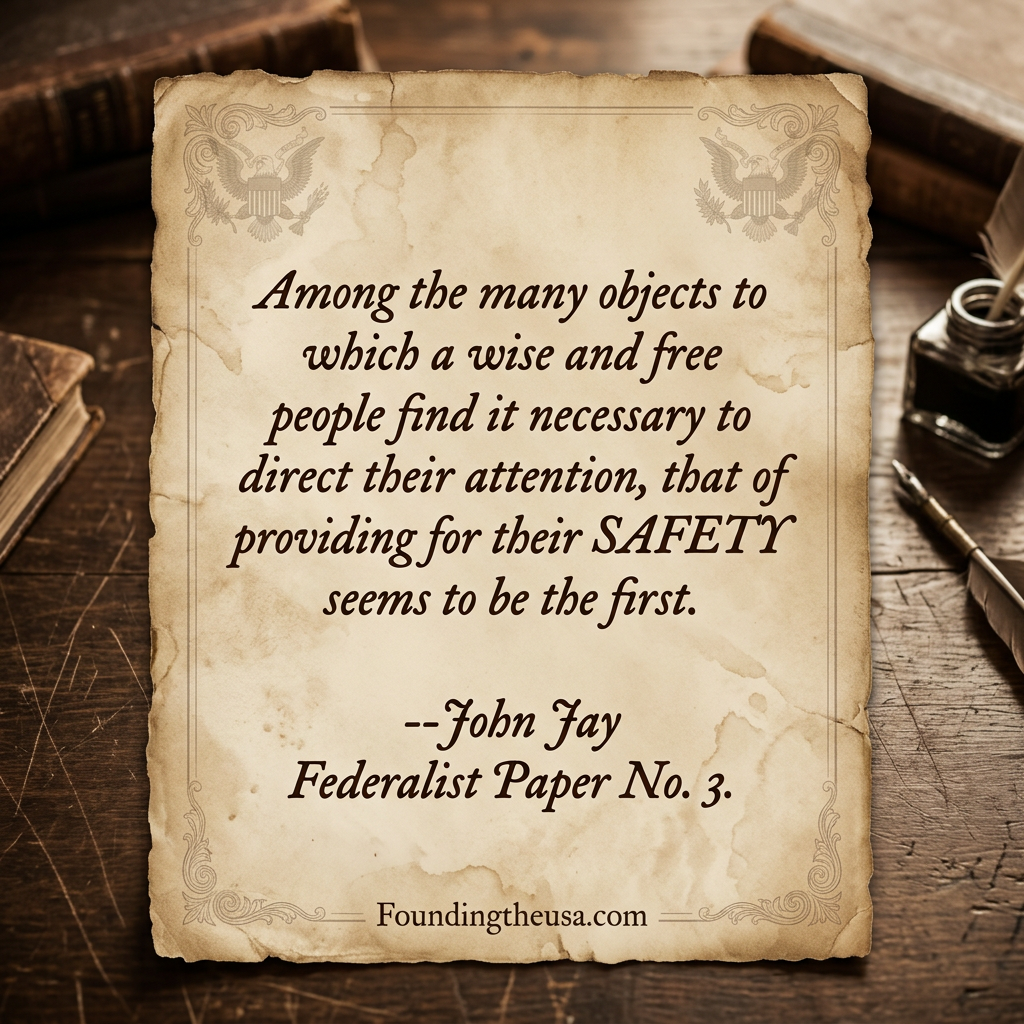
Federalist No. 3 was written by John Jay under the name Publius and published on November 3, 1787. In this essay, Jay argues that a strong union under one national government is the best protection against unnecessary war, foreign hostility, and reckless state-level actions. The basic point is simple: united America is less likely to provoke war than disunited America.
This paper is less flashy than Federalist No. 1, but it is practical and sharp. Jay is basically saying that peace is not preserved just by good intentions. It also depends on having a government steady enough to avoid stupid, impulsive, or locally driven mistakes.
1. Safety comes first
“Among the many objects to which a wise and free people find it necessary to direct their attention, that of providing for their SAFETY seems to be the first.”
That is the opening priority of the paper. Jay is saying that before people can enjoy the benefits of liberty, commerce, and prosperity, they have to secure peace and safety. It is a basic point, but an important one.
2. Union as protection against foreign danger
“a cordial Union, under an efficient national government, affords them the best security that can be devised against HOSTILITIES from abroad.”
This is one of the central lines in Federalist No. 3. Jay is not merely praising union as a sentimental ideal. He is defending it as a practical shield against war and foreign pressure.
3. Fewer causes of war
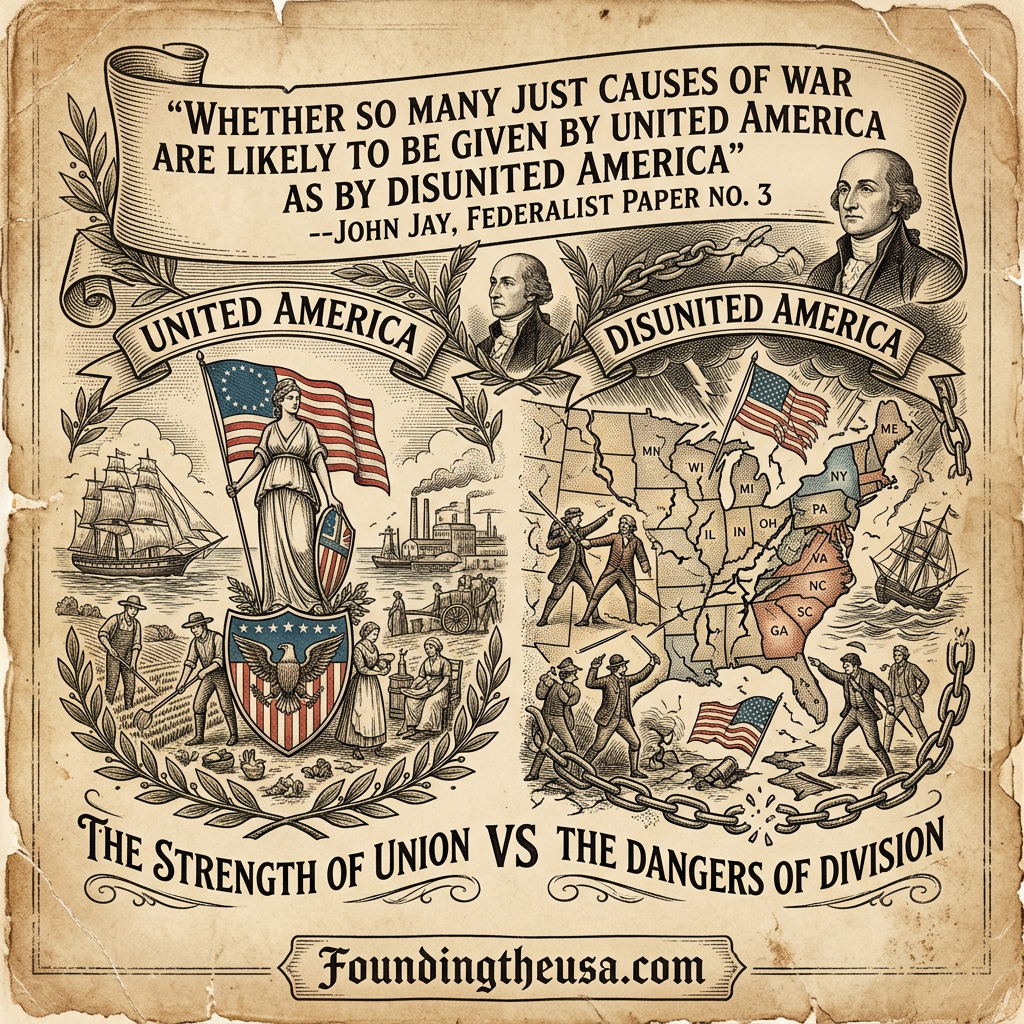
“whether so many JUST causes of war are likely to be given by UNITED AMERICA as by DISUNITED America”
That is the core comparison in the essay. Jay thinks separate states or separate confederacies would create more chances for conflict, more inconsistent policy, and more reckless behavior. United America, in his view, is simply less likely to stumble into war.
4. The best men in the country
“the best men in the country will not only consent to serve, but also will generally be appointed to manage it”
Classic Federalist confidence here. Jay argues that a national government has a wider field of choice and is more likely to attract more capable leadership than smaller state governments captured by narrow local influence. Whether human beings always cooperate with that plan is another matter, but that is definitely his argument.
5. One sense, one execution
“treaties and articles of treaties, as well as the laws of nations, will always be expounded in one sense and executed in the same manner”
This is one of the most important practical lines in the paper. Jay is making the case that foreign policy cannot be safely handled by a patchwork of conflicting state interpretations. Consistency matters, especially when dealing with other nations.
6. Local temptations vs. national steadiness
“the prospect of present loss or advantage may often tempt the governing party in one or two States to swerve from good faith and justice”
Jay is warning that local governments can be driven by short-term pressure, economic interest, or regional emotion. A national government, in theory, is less likely to be warped by local temptation.
7. The passions of a part, not the whole
“such violences are more frequently caused by the passions and interests of a part than of the whole”
That is one of the strongest lines in the essay. Jay is arguing that wars often begin because a region, faction, or border interest gets hot-headed, not because the whole country calmly decides war is wise. A national government can check that impulse better than smaller governments can.
8. Border states are dangerous flashpoints
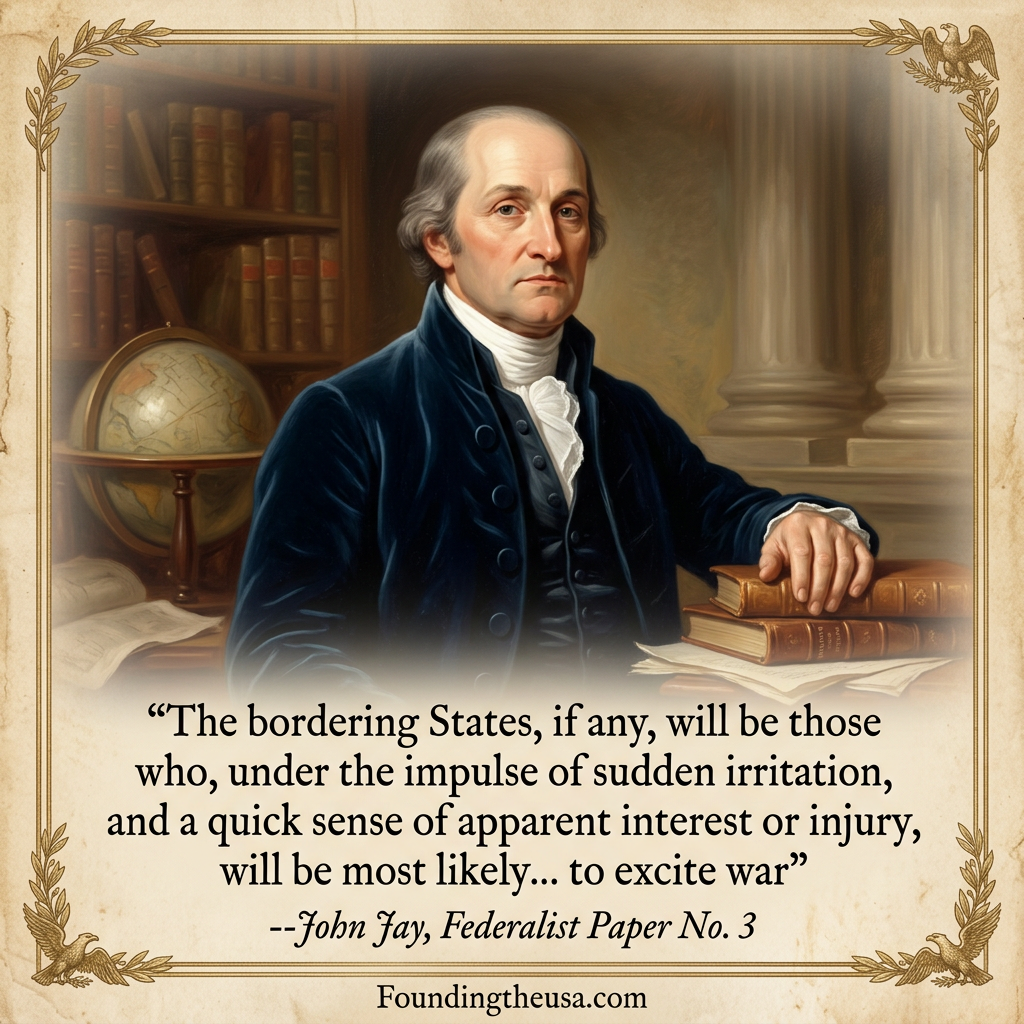
“The bordering States, if any, will be those who, under the impulse of sudden irritation, and a quick sense of apparent interest or injury, will be most likely… to excite war”
This is a very practical warning. Jay knows that border regions often feel danger and insult first, and that makes them more likely to react rashly. His answer is not to ignore those regions, but to prevent them from dragging the whole country into war without national judgment.
9. A united nation can settle disputes better
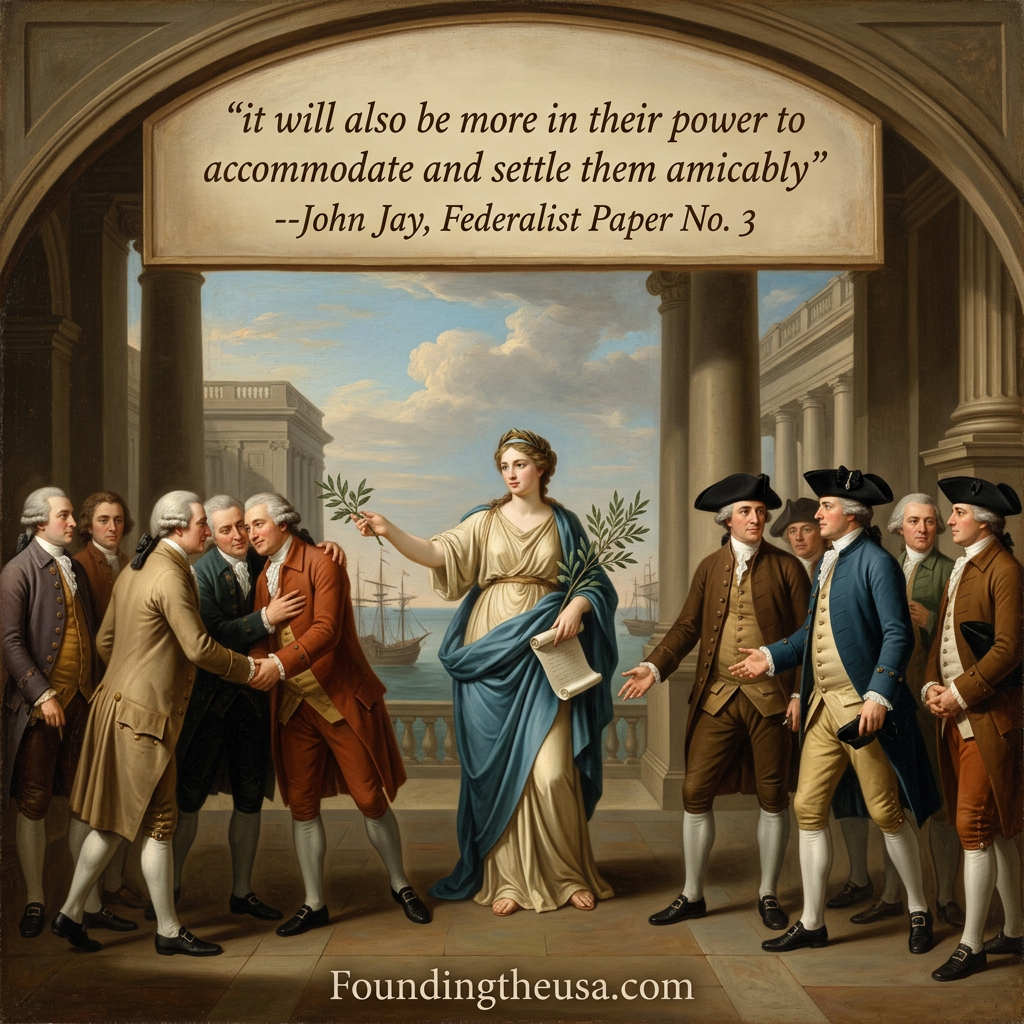
“it will also be more in their power to accommodate and settle them amicably”
Jay is not just saying union avoids war by being stronger. He is also saying union is better at peace. A national government, being more temperate and less caught up in local pride, is more capable of settling conflicts before they explode.
10. The pride of states
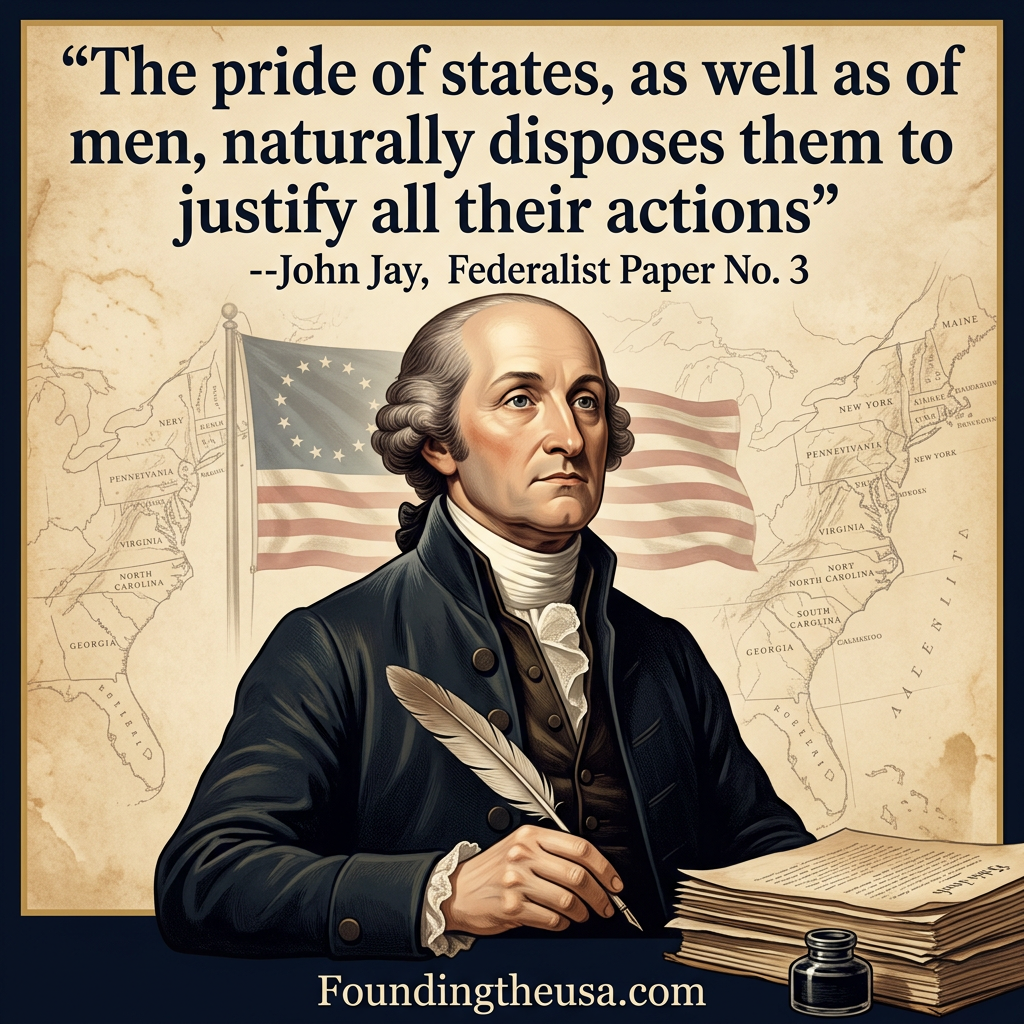
“The pride of states, as well as of men, naturally disposes them to justify all their actions”
That one still lands. Jay is saying governments behave a lot like individuals: they hate admitting mistakes. Small state governments, in his view, are especially prone to defensive pride and stubborn escalation.
11. Strength changes how foreign powers respond
“acknowledgments, explanations, and compensations are often accepted as satisfactory from a strong united nation, which would be rejected as unsatisfactory if offered by a State or confederacy of little consideration or power.”
This is one of the strongest practical arguments in the paper. Jay is reminding readers that foreign nations do not treat weak, divided powers the same way they treat strong ones. Union does not just change America internally. It changes how the rest of the world deals with America.
12. The humiliation of weakness
“Would he on any occasion either have demanded or have received the like humiliation from Spain, or Britain, or any other POWERFUL nation?”
Jay ends with a historical example involving Genoa and Louis XIV to make the point that weak states get humiliated in ways strong nations do not. It is a dramatic ending, and the message is clear: division invites disrespect.
Related Links
- Federalist No. 3 Full Text
- Federalist Papers
- John Jay
- Federalist No. 2
- United States Constitution
- Articles of Confederation